
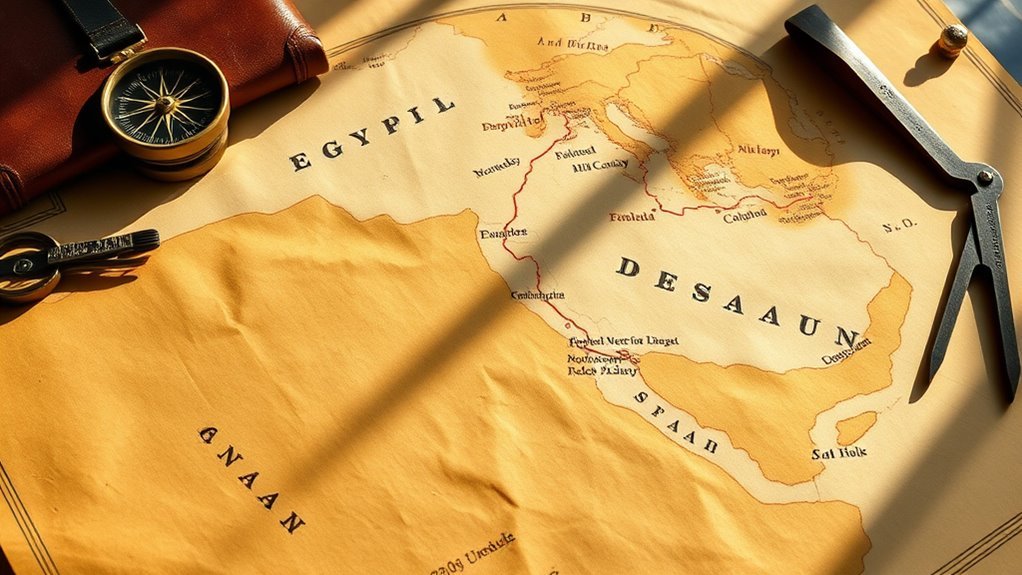
You can trace the Egypt to Canaan journey as a staged route of about 700 km, beginning in Goshen on Nisan 15, 1446 BC. You move through Succoth, cross the Red Sea around Day 25, and reach the Wilderness of Sin by Day 31, where manna begins. At Sinai, Israel camps for months as Moses receives the law. Later, you follow the long pause at Kadesh Barnea before entering Canaan at the Jordan, with more details just ahead.
Egypt to Canaan Map Overview

The journey from Egypt to Canaan began in Goshen and covered roughly 700 km over 47 days, from Nisan 15 to Sivan 1, with the main route moving through Succoth, the Straits of Tiran, and the Red Sea crossing before reaching Mt. Sinai.
You can trace this path through Egyptian geography and compare it with Canaanite culture to see why the route mattered. Archaeological evidence and historical context suggest a real migration pattern, not just a symbol.
After the sea crossing, you’d note stops at the Wilderness of Sin, where manna sustained you, and Dophkah, where water failed.
At Kadesh Barnea, you’d face a long pause shaped by rebellion and Aaron’s death.
Finally, in 1406 BC, you’d cross the Jordan on dry ground into Canaan, a moment of liberation with biblical significance for every people seeking freedom.
How Long Was the Exodus Route?
Measuring the Exodus route means tracing both distance and time, because the path from Goshen to Mt. Sinai wasn’t just a map line—it was a lived exodus duration shaped by journey challenges. You can estimate about 700 km over 47 days, which shows steady movement toward freedom rather than a quick escape.
- Day 9: you reach Succoth, the first clear milestone.
- Day 25: you cross the Red Sea, where danger gives way to deliverance.
- At the Wilderness of Sin: you camp for 8 days, learning endurance in the open land.
After Mt. Sinai, you keep moving for about 11 months to Kadesh Barnea, making 20 stops. That later stretch reveals a larger pattern: liberation often comes through long, measured progress.
When you study the full route—from the Sinai Peninsula to the regions near the Jordan River—you see a journey that trained a people to survive, trust, and claim freedom.
Key Stops on the Exodus Route
As you trace the Exodus route step by step, the key stops reveal how the journey unfolded in measured stages rather than one rapid flight. You can read the route as a liberation record: Day 9 brought Succoth, where the camp paused with the workers, showing Succoth significance as a gathering point before movement resumed.
| Stop | Day | Meaning |
|---|---|---|
| Succoth | 9 | Regrouping and organizing |
| Red Sea | 25 | Deliverance under pressure |
| Wilderness of Sin | 31 | Manna provision begins |
At the Red Sea, you see Pharaoh’s pursuit close in during an eight-day camp, yet the people kept moving forward. By Day 31, the Wilderness lessons shifted to dependence, because manna provision taught daily trust. Farther on, Kadesh Barnea stretched the test for 38 years, and Mt. Sinai marked the Sinai experience, where covenant formed hope into law.
Red Sea Crossing and Sinai Route
After leaving Goshen, you can trace the route as a 700 km progression toward Mt. Sinai, and the timeline shows a disciplined Wilderness Journey.
You move from Succoth to Pi-hahiroth, then reach the Red Sea on Day 25. There, you see Pharaoh’s army closing in, yet the crossing opens a path to freedom.
The Israelites camp eight days after that escape, then enter the Wilderness of Sin on Day 31, where the record shows Manna Provision for the next eight days.
Throughout, Divine Guidance stays constant through the pillar of cloud by day and fire by night, keeping you on the right path.
- A sea divided, with dry ground underfoot.
- A marching camp under a night sky of fire.
- A barren wilderness sustained by daily bread.
Evidence from the route suggests movement wasn’t random; it was purposeful liberation, measured in days, stops, and survival.
Mount Sinai and the Law
From the wilderness route, the journey now narrows to Mt. Sinai, where your evidence trail turns legal and covenantal.
On Day 48 of the Exodus, Moses’ ascent brought him up the mountain, and God recited the Ten Commandments. Two days later, Israelite preparation intensified as Exodus 19:10-11 records the people readying for God’s descent.
Over the next 40 days, God gave Moses the Sinai laws, forming the basis of Israelite society and public justice. This wasn’t mere ritual; it carried Covenant significance, binding a freed people to shared obligations, moral limits, and divine promise.
After the law was given, Israel camped at Sinai for 343 days, long enough for these commands to shape identity before movement resumed toward Canaan.
If you want liberation, read Sinai as formation: freedom needed structure, and the map proves it.
Kadesh Barnea and the Wilderness Years
Kadesh Barnea became the Israelites’ central base during the 38 years of wilderness wandering, and it’s where their failure to trust God reshaped the rest of the journey. From Mt. Sinai, you can trace about 11 months and 20 stops to reach this desert hub. Its Kadesh significance shows up in repeated Wilderness challenges: scarce water, strained provision, and restless Community dynamics.
- Picture spy reports carried back across campfires after Promised Land scouting.
- Picture dust rising as Israelite rebellions spread fear instead of freedom.
- Picture Aaron’s death in the 40th year, signaling Leadership changes.
Chronologically, the record shows you how resistance to trust delayed entry into Canaan. In the Eastern Wilderness, you also see Edom conflicts and Moab encounters, yet the people avoided direct war while moving on.
Kadesh teaches that liberation needs obedient movement, not fear-driven delay.
Alternative Exodus Route Theories
You can first compare the coastal route theory, which follows the Mediterranean edge toward Canaan but would’ve passed heavily defended Egyptian garrisons.
Then you can weigh the Sinai Peninsula route, which traces a southern path to Jabal Musa and fits the traditional setting for the giving of the Law.
As you assess both options chronologically, you’ll see that the evidence points to a complex escape history rather than a single, simple march.
Coastal Route Theory
The Coastal Route Theory proposes that the Hebrews traveled north along the Mediterranean coast, taking a more direct route to Canaan than the traditional path through the Sinai Peninsula. You’d move from Rameses past guarded shorelines, where Egyptian garrisons tried to control movement, yet freedom still called.
Archaeological evidence suggests coastal settlements could’ve offered food, water, and shelter, easing logistical challenges that usually slow a fleeing people.
- Picture reed-lined marshes breaking into open sea air.
- Picture watchtowers, road markers, and crowded market stops.
- Picture Jericho waiting beyond the final rise, near the Promised Land.
If Pharaoh hadn’t pursued, this route might’ve delivered you faster to liberation.
Still, the theory remains debated because the coast’s military oversight and route constraints shape the historical question.
Sinai Peninsula Route
From the coastal theory, the map shifts inland to the Sinai Peninsula route, which some scholars place along the eastern coast and southward toward sites like Jabal Musa, long associated with the giving of the Law to Moses.
You follow a path that bends away from Egyptian strongpoints and into harsher terrain, where geography itself becomes part of the story.
The route’s Sinai significance lies in its link to revelation, not just travel. As you trace it chronologically, you see Exodus challenges: water scarcity, rugged passes, and the need for the pillar of cloud and fire to guide movement.
This route also fits a liberation memory shaped by smaller escapes of Levantine slaves, not only a single mass flight.
You can weigh the evidence without surrendering the hope of deliverance.
Jordan River Crossing and Jericho
After crossing the Jordan River on dry ground on the 10th day of the 1st month in 1406 BC, Israel marked the shift into Canaan with a memorial of stones set up at Gilgal.
You can read this Jordan Crossing as a public sign: freedom had become land, and the Monument Significance pointed to deliverance. The stones at Gilgal let you remember that liberation wasn’t abstract; it had a place, a date, and witnesses.
Then you face Jericho, the first fortified barrier in the Israelite Conquest. The Jericho Strategy wasn’t military brilliance by human standards; it was obedience. For seven days, you’d watch them circle the city, hear the trumpet blasts, and see the walls fall.
- A river made passable, with no mud underfoot.
- A ring of silent marchers around towering walls.
- A collapsed city opening the road ahead.
This sequence shows you that conquest followed faith, and freedom advanced step by step.
Exodus Timeline
Moving out of Goshen, you can trace the Exodus timeline with unusual precision: the journey to Mount Sinai lasted 47 days and covered about 700 km, beginning on Nisan 15 in 1446 BC and ending on Sivan 1.
You see the movement unfold in clear stages: Succoth on Day 9, the Red Sea crossing on Day 25, and Sinai on Day 47. Each marker shows Moses’ leadership directing a people toward freedom, while Israel’s faithfulness sustained the march through uncertainty.
On Day 48, Moses climbed the mountain to receive the Ten Commandments, and by Day 50, his descent was already in view.
Then you remain at Sinai for 343 days, long enough for law, order, and covenant to shape a liberated nation.
From there, the next 11 months to Kadesh Barnea include 20 stops, Aaron’s death, and the healing pole, proving that the route’s timeline carries both struggle and hope.
What the Map Reveals About the Exodus
What the map reveals is a route that’s both measured and meaningful: the Exodus stretched about 700 km over 47 days, beginning on Nisan 15 in 1446 BC and ending on Sivan 1.
You can trace liberation step by step, from Goshen to Succoth on Day 9, then to the Red Sea on Day 25, where Pharaoh’s pressure couldn’t stop your path.
The map shows how divine guidance met geographical challenges with a cloud by day and fire by night, leading you through the Wilderness of Sin, where manna sustained you, and Rephidim, where you faced the Amalekites.
Cloud by day, fire by night, the path through wilderness was guided, sustained, and tested.
- A night sky split by fire above marching families.
- Waves parting beside fleeing feet and broken chains.
- A desert trail marked by camps, dust, and promise.
This route carries historical significance because it doesn’t just record movement; it records survival.
From Mt. Sinai to Kadesh Barnea, 20 stops in 11 months, then 38 years at Kadesh, reveal a people being formed for freedom.
Frequently Asked Questions
What Route Did the Israelites Take From Egypt to Canaan?
You’d trace the Exodus journey from Goshen through Succoth, the Wilderness of Sin, and the Red Sea to Mt. Sinai, then north to Kadesh Barnea and across the Jordan, following Biblical geography toward Canaan.
Conclusion
So, as you trace the Egypt to Canaan map, you see the Exodus not as a blur, but as a sequence of events shaped by distance, terrain, and timing. First came departure, then wilderness, then Sinai, then the push toward the Jordan. Each stop leaves a clue; each clue narrows the route. If the map is the question, the journey is the answer. And if you follow the evidence, the path begins to make sense.