
Last Updated on August 29, 2026 by Logan Reeves
Disclosure: As an Amazon Associate, we earn from qualifying purchases. If you click a link on this page and make a purchase, we may receive a small commission at no extra cost to you.
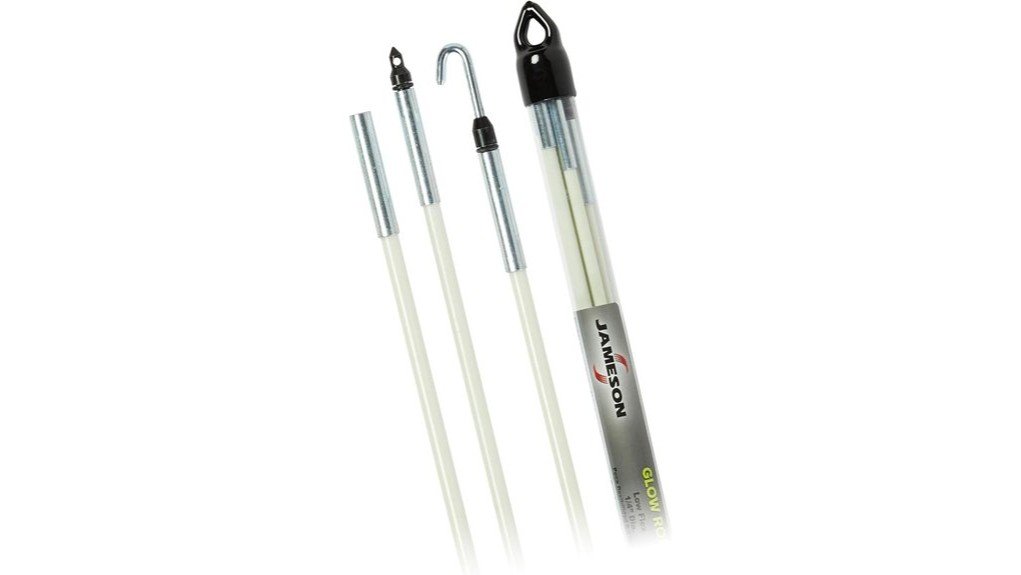
Running cable through a dark attic, drop ceiling, wall, or crawl space gets frustrating when your fish rod is too flexible to hold a line or too stiff to make a turn. The Jameson Glow Fish Rod Kit 7-34T gives you three rigid 4-foot fiberglass sections that connect for up to 12 feet of reach. Its glow material, threaded steel ferrules, 750-lb rated pull/tensile strength, and included tips make it especially useful for telecom, datacom, and electrical installation work. The main tradeoff is its rigidity: the 1/4-inch rods suit longer spans well, but they are not Jameson’s most flexible option for very tight routing.
Quick Verdict
Rating: Recommended with caveats
Best For: Electricians, telecom installers, datacom technicians, and DIYers who need a rigid glow rod for longer wire runs.
Bottom Line: The Jameson 7-34T combines useful low-light visibility, strong threaded connections, and adjustable working length in a simple three-section kit. Its 1/4-inch rods are designed for rigidity, so buyers who regularly navigate very tight turns may prefer a thinner or more flexible fish rod.
Jameson Glow Fish Rod Kit Specifications
| Specification | Detail |
|---|---|
| Brand | Jameson |
| Model / Part Number | 7-34T |
| Product Type | Glow fish rod kit for routing wire and cable |
| Total Reach | 12 ft when all three sections are connected |
| Rod Sections | Three 4 ft rods |
| Rod Diameter | 1/4 in |
| Material | Luminescent non-conductive fiberglass |
| Minimum Bend Radius | 6 in |
| Pull / Tensile Strength | 750 lb |
| Connections | Durable steel threaded ferrules |
| Included Accessories | Bullet nose with eyelet, hook, and plastic storage tube with cap |
| Accessory Retention | Accessories use O-rings for secure attachment |
| Best Uses | Drop ceilings, attics, floors, walls, crawl spaces, telecom, datacom, and electrical installations |
What Is the Jameson Glow Fish Rod Kit?
The Jameson 7-34T is a sectional fiberglass tool for pushing, guiding, and retrieving wire or cable through spaces that are difficult to reach by hand. Despite the word “fish” in the name, it is not fishing equipment. It is an installation tool commonly used when routing electrical, telecom, and data cable.
You receive three 4-foot sections. Each section has threaded ferrules, so you can connect only the length needed for the job or assemble all three for a 12-foot run. Jameson describes the 1/4-inch rod as its most rigid rod size for long spans, which helps when you need to push across a ceiling or other open area without excessive droop.
The fiberglass also has a luminescent glow that improves visibility in dim spaces. That can make it easier to locate the end of the rod above ceilings or inside dark access areas.
Before You Buy: The advertised 12-foot length is the total length of three connected 4-foot sections. The 1/4-inch rods are intentionally rigid and have a 6-inch minimum bend radius, so this kit is better suited to longer runs than extremely tight bends.
Who Should Buy It?
Best For
- Telecom and datacom installers working above ceilings or inside walls.
- Electrical work where a rigid sectional rod makes longer cable runs easier to control.
- Buyers who want a glow rod with interchangeable working lengths and basic pulling accessories included.
Skip If
- Your normal cable routes involve extremely tight turns that call for a thinner, more flexible rod.
- You need more than 12 feet of reach without adding compatible sections or changing kits.
- You need specialized tips beyond the included hook and bullet nose with eyelet.
Build Quality and Rigidity
The three rods use 1/4-inch fiberglass, and Jameson positions this diameter as the most rigid rod in its glow-rod range for long spans. That stiffness is useful when you are pushing a rod across a drop ceiling, through an open wall cavity, or toward an access point where a softer rod might sag.
Rigidity does create a tradeoff. The specified 6-inch minimum bend radius tells you that the rod can handle turns, but it should not be forced around bends tighter than its design allows. For routing that repeatedly snakes around close obstacles, an extra-flex alternative can make more sense.
Glow Visibility in Dark Work Areas
The fiberglass is luminescent, giving you a visible glow in low-light work spaces. That is especially useful in attics, above suspended ceilings, crawl spaces, and other areas where the far end of a conventional rod can be difficult to locate.
The glow feature does not replace proper job-site lighting. Its advantage is visibility of the rod itself, helping you identify where it has traveled when access and sight lines are limited.
Threaded Ferrules and Adjustable Length
Each section uses steel threaded ferrules. You can work with a single 4-foot rod for a short route, join two sections for 8 feet, or connect all three for the full 12-foot reach.
This sectional design is one of the kit’s most practical features because extra length can make a rod harder to position in a small room. Starting short and adding a section only when needed gives you better control.
Pro Tip: Start with the shortest rod length that reaches your target. Add sections as the run gets longer, and make sure each threaded ferrule is fully seated before pushing or pulling cable.
Included Accessories and Storage
The kit includes a bullet nose with eyelet and a hook. The bullet nose gives the leading end a smoother profile and provides an eyelet for attaching a line when appropriate. The hook gives you another option for retrieving or manipulating a cable or pull line.
Jameson also supplies a plastic storage tube with a cap. That matters more than it might appear because sectional rods and small threaded tips are easier to damage or misplace when they are loose in a vehicle or tool bag. The accessories also use O-rings to help keep them secured when attached.
How It Performs in Real Use
Across Drop Ceilings
The rigid 1/4-inch sections make the 7-34T well suited to pushing across longer spans above suspended ceilings. You can add sections as the rod advances instead of trying to manage the full 12-foot assembly from the start.
Inside Attics and Crawl Spaces
These areas often combine poor lighting with limited access. The glow material makes the rod easier to spot, while the selectable 4-, 8-, or 12-foot working length lets you match the setup to the available room.
Through Walls and Floors
The bullet nose can help present a smoother leading end as you guide the rod through an available pathway. The 6-inch minimum bend radius still matters, so the rod should not be forced around a turn that is too sharp for its relatively rigid construction.
Telecom and Datacom Installations
Jameson specifically lists telecom and datacom work among the intended applications. For installers routing communication cable through ceilings and wall cavities, the combination of glow visibility and long-span rigidity is the main reason to consider this model.
Setup Tips Before You Start
Inspect the fiberglass rods, threaded ferrules, and chosen accessory before each job. Join the sections firmly by the ferrules rather than trying to bend or twist the fiberglass itself.
Use only the number of sections you need. A shorter assembly is usually easier to control in a confined area. When the run requires more reach, attach another section and continue working gradually.
Plan the route before pushing the rod. Avoid forcing it when you meet solid resistance, since resistance may mean you have encountered framing, insulation, another obstruction, or a turn tighter than the rod can comfortably follow.
Compatibility and Safety
Jameson identifies the glow rods as non-conductive fiberglass. That material choice is useful for an electrical installation tool, but you should not treat the rod as permission to work on energized circuits. Follow applicable electrical safety practices, de-energize circuits when required, and follow workplace procedures and local electrical rules.
Fiberglass tools should also be inspected for cracks, splintering, damaged ferrules, or other visible wear. Stop using a section if its condition could affect safe handling or connection strength.
Pros and Cons
Pros
- Three 4-foot sections give you adjustable 4-, 8-, or 12-foot working lengths.
- 1/4-inch fiberglass provides useful rigidity for longer spans.
- Luminescent material improves rod visibility in dark work areas.
- 750-lb rated pull/tensile strength provides a substantial published strength specification.
- Bullet nose, hook, threaded ferrules, and storage tube are included.
Cons
- The rigid 1/4-inch design is not the best choice for extremely tight or highly curved routes.
- The included kit provides a maximum assembled reach of 12 feet.
- Only a bullet nose with eyelet and hook are included, so specialized jobs may call for additional compatible accessories.
Is It Worth the Price?
The Jameson 7-34T makes the most sense when you value professional-style construction, strong published pull strength, rigid long-span performance, glow visibility, and a sectional design in one compact kit. You also get the essential hook and bullet nose rather than having to purchase basic tips separately.
Its value is less compelling if your work mainly involves close, complicated turns. In that situation, flexibility may matter more than the 1/4-inch rod’s stiffness. Your best choice depends on the routes you handle most often, not simply the highest tensile-strength number.
How It Compares to Alternatives
The IDEAL Tuff-Rod Extra Flex Glow 31-631 is another 12-foot sectional glow kit, but its 3/16-inch extra-flex design is aimed more toward routes where flexibility is a priority. The Jameson 7-34T instead uses a stiffer 1/4-inch rod and emphasizes long-span control.
The Milwaukee 48-22-4152 Mid Flex Fish Stick Kit provides 15 feet of reach through three 5-foot sections and adds features such as an anti-splinter coating and knurled grips. The Jameson remains a sensible choice when 12 feet is enough and you specifically want its rigid 1/4-inch construction, 750-lb published pull/tensile rating, and Jameson accessory system.
Frequently Asked Questions
Is the Jameson Glow Fish Rod Kit a fishing rod?
No. “Fish rod” refers to a tool used to fish or route wire and cable through walls, ceilings, floors, attics, and similar spaces. It is not designed for catching fish.
Is each rod 12 feet long?
No. The kit contains three 4-foot rods. Connecting all three gives you a total assembled reach of 12 feet.
Can you use fewer than three sections?
Yes. The threaded ferrules allow you to connect sections as needed. You can use one section for 4 feet, two for 8 feet, or all three for 12 feet.
Does the rod really glow in dark areas?
The rods use luminescent fiberglass designed to improve visibility in low-light work areas. The feature is particularly useful above ceilings, in attics, and in other spaces where seeing the far end of a normal rod can be difficult.
Is the 7-34T good for tight bends?
It can handle turns within its design limits, and Jameson specifies a 6-inch minimum bend radius. However, its 1/4-inch rod is the most rigid size in the series, so an extra-flex rod can be a better choice for very tight or complex routes.
Is the fiberglass non-conductive?
Jameson describes the rods as non-conductive fiberglass. You should still follow electrical safety procedures and should not assume that a non-conductive fish rod makes energized electrical work safe.
What accessories come with the kit?
The 7-34T includes one bullet nose with eyelet, one hook, three 4-foot rods, and a plastic storage tube with a cap. Jameson also notes that its attachments use O-rings to help keep them secure.
How should you store the rods after use?
Remove dirt and debris, inspect the rods and ferrules for damage, and keep the sections together in the supplied storage tube. Storing the tips with the kit also reduces the chance of losing small threaded accessories between jobs.
The Bottom Line
The Jameson Glow Fish Rod Kit 7-34T is a strong fit when you need a rigid, visible, sectional rod for telecom, datacom, or electrical cable routing across longer spans. Its main limitation is the same feature that gives it good pushing control: the 1/4-inch rods are relatively stiff, so buyers facing frequent tight turns should compare a more flexible rod before choosing.

