
Last Updated on September 10, 2026 by Daniel Globe
Disclosure: As an Amazon Associate, we earn from qualifying purchases. If you click a link on this page and make a purchase, we may receive a small commission at no extra cost to you.
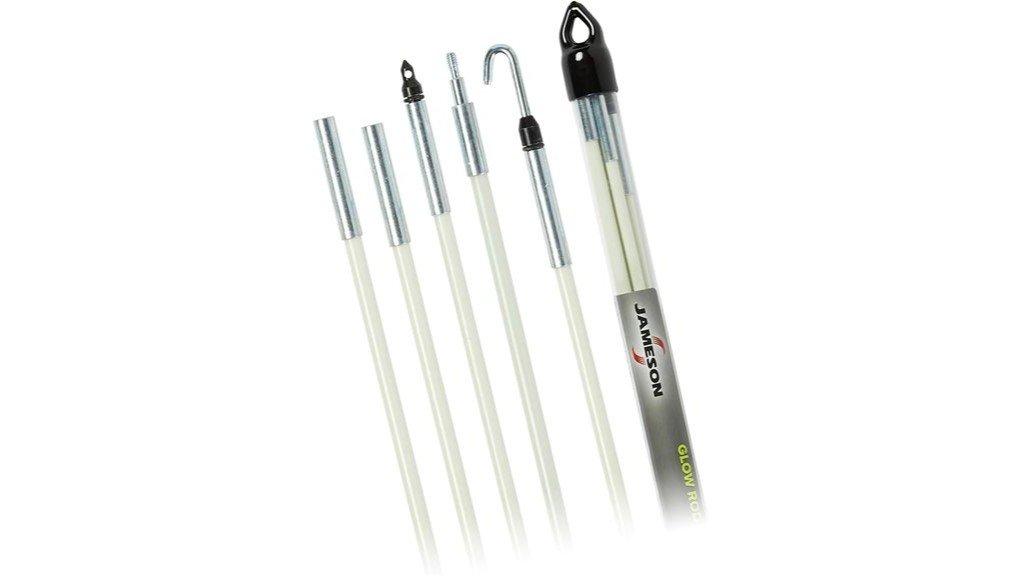
Running cable through a wall, attic, drop ceiling, or crawl space can turn into a slow job when your fish rod is too short, too flexible, or hard to see. The Jameson 7-36-23T Fiberglass Glow Rod Kit gives you up to 24 feet of rigid, connectable rod for longer wire-fishing runs. Its 1/4-inch fiberglass sections, threaded steel ferrules, glow material, and two included tips make it a practical choice for electrical, telecom, and datacom work. The tradeoff is that its long-span rigidity is less useful when you need very tight turns or a compact kit for confined spaces.
Quick Verdict
Rating: 8/10, recommended with caveats
Best For: Installers who need a rigid, configurable glow rod for long wire runs through walls, ceilings, attics, floors, and crawl spaces.
Bottom Line: The 24-foot reach, 1/4-inch rigidity, and interchangeable threaded sections make this kit useful for straight or gently turning cable routes. Choose a thinner rod system if your work involves repeated tight bends or very limited access.
| Specification | Detail |
|---|---|
| Brand | Jameson |
| Model | 7-36-23T |
| Product type | Fiberglass glow fish rod kit for wire installation |
| Total rod length | 24 feet when all five sections are connected |
| Rod sections | Three 6-foot rods and two 3-foot rods |
| Rod diameter | 1/4 inch |
| Material | Luminescent, non-conductive fiberglass rods with steel threaded ferrules |
| Minimum bend radius | 6 inches |
| Rated pull strength | 750 pounds, according to Jameson |
| Included tips | One bullet nose with eyelet and one hook |
| Attachment retention | Accessories use O-rings for a more secure connection |
| Storage | Plastic tube with cap, approximately 6 feet long |
| Best use | Long wire runs in drop ceilings, attics, floors, walls, and crawl spaces |
| Manufacturer notice | The official product page carries a California Proposition 65 warning |
What Is the Jameson 7-36-23T?
The Jameson 7-36-23T is a modular glow fish rod kit made for routing wire through concealed building spaces. You connect the three 6-foot sections and two 3-foot sections in different combinations, so you can use only the length required for a job or assemble the full 24 feet for a longer span.
The 1/4-inch rods are the most rigid size in Jameson’s glow-rod range. That rigidity helps you push across open ceiling spaces and other longer routes without the rod sagging as much as a thinner model. The included bullet nose with eyelet supports pull-line attachment, while the hook helps you catch or retrieve a wire in an accessible cavity.
Who Should Buy It?
Best For
- Electricians and low-voltage installers running cable across long, mostly open spans
- Telecom and datacom work in drop ceilings, attics, walls, floors, or crawl spaces
- Buyers who want configurable 3-foot and 6-foot sections instead of one fixed-length rod
Skip If
- Your route includes repeated tight bends that call for a thinner, more flexible rod
- You need a compact kit shorter than the 6-foot storage tube
- You need a tool rated and certified for live-line electrical work
Before You Buy: The term “non-conductive” does not make this kit a live-line hot stick. De-energize and verify the circuit before routing wire, follow applicable electrical-safety procedures, and do not use a damaged fiberglass section.
Feature-by-Feature Review
Build Quality and Long-Span Rigidity
Each rod is 1/4 inch in diameter, which Jameson positions as its most rigid glow-rod size for long spans. That makes the 7-36-23T better suited to crossing an open ceiling bay or pushing through a relatively straight wall cavity than a thinner rod that bends more under its own weight.
The fiberglass still allows controlled bending, and the listed minimum bend radius is 6 inches. You should not force a sharper turn, kink a section, or use the rod as a pry bar. Excessive side loading can damage fiberglass or stress the ferrules even when the rod has a high published pull rating.
Configurable Length and Threaded Ferrules
The mix of three 6-foot rods and two 3-foot rods gives you more setup choices than a kit made only from equal-length sections. You can start with a short assembly near the access point, add sections as the route grows, and reach the full 24 feet only when necessary.
Jameson uses the same threaded ferrule size across its glow-rod range, which improves accessory and rod compatibility within the system. The steel threaded ferrules should be started straight and tightened firmly by hand. Cross-threading or leaving a joint loose can create a snag point and may make the assembly separate inside a wall or ceiling.
Glow Visibility in Dark Work Areas
The rods use luminescent fiberglass to improve visibility in low-light areas. This can help you track the rod above a drop ceiling or inside an attic, especially after the material has been exposed to a bright light. The glow feature does not replace a work light, but it gives you a clearer visual reference than a standard dark rod.
Because the glow is built into the rod material, there are no batteries or electronic light modules to maintain. Visibility will still depend on how well the rod has been charged by ambient or artificial light and how dark the work area is.
Included Bullet Nose, Eyelet, and Hook
The bullet nose provides a rounded leading end that is less likely to catch on minor obstructions than an exposed threaded ferrule. Its eyelet gives you a point for attaching a pull line or appropriately sized cable setup. The hook is useful when you need to catch a wire or retrieve a line from a nearby opening.
Both accessories use O-rings to help keep them secure. Check that the O-ring is present, the tip is fully seated, and the connection is tight before you send the rod into a concealed space.
How It Performs in Real Use
Across Drop Ceilings
The 1/4-inch diameter is a strong match for long, open ceiling spans because the rod stays relatively straight as you push it. The luminescent material also makes it easier to locate the rod above ceiling tiles. You still need to watch for hangers, sharp metal edges, sprinkler components, and other services that can snag the tip.
Inside Walls and Floors
The two 3-foot sections give you useful control when the access opening is small or when you cannot begin with a full 6-foot rod. For mostly straight cavities, you can add sections in stages. The 6-inch minimum bend radius limits how tightly you can steer, so a thinner rod may work better around multiple corners.
In Attics and Crawl Spaces
The full 24-foot reach can reduce how often you need to reposition yourself in an attic or crawl space. The rigid rod helps bridge open areas, while the storage tube keeps the long sections together between jobs. In dirty or damp spaces, inspect and dry each section before returning it to the tube.
For Telecom and Datacom Installation
The kit is well suited to low-voltage cable routes where you need reach and a visible rod rather than extreme bend capability. The bullet eyelet and hook cover common pulling and retrieval tasks. For narrow pathways, short-radius turns, or crowded conduit, compare a 3/16-inch or 5/32-inch Jameson rod before buying.
Setup Tips and Common Mistakes to Avoid
- Plan the route first. Identify access points, likely obstructions, bend locations, and nearby electrical or mechanical systems before inserting the rod.
- Use the shortest workable assembly. Extra length adds leverage and makes the rod harder to control. Add one section at a time as the route requires.
- Align every ferrule carefully. Start the threads straight, tighten the joint, and check it again before the joint disappears into a concealed space.
- Respect the bend radius. Do not force the 1/4-inch rods around a corner tighter than the design allows. Switch to a more flexible rod when the path demands it.
- Use a pull line for demanding pulls. The rod is a positioning tool. For cable weight or friction that is hard to judge, use the eyelet to place a suitable pull line and follow accepted installation practices.
- Inspect after each job. Look for cracks, exposed fibers, damaged threads, missing O-rings, or loose ferrules before storage and before the next use.
Pro Tip: Charge the luminescent rods under a bright work light before entering an attic or ceiling space, then assemble only the length you need. This improves visibility and gives you better control at the access point.
Safety, Care, and Storage
Jameson describes the rods as non-conductive fiberglass, but the product page does not identify the 7-36-23T as a rated live-line tool. Treat every circuit as energized until it has been properly de-energized and verified under the procedures that apply to your work. Wear suitable personal protective equipment and follow the product instructions, workplace rules, and local electrical codes.
Fiberglass can become uncomfortable or unsafe to handle when a rod is cracked, abraded, or shedding fibers. Stop using any damaged section. Wipe dirt and moisture from the rods, allow them to dry, keep the threads clean, and store the rods and tips in the capped plastic tube. The manufacturer’s product page also carries a California Proposition 65 warning, so review that notice if it applies to your purchase or work location.
Pros and Cons
Pros
- Full 24-foot reach for long wall, ceiling, attic, floor, and crawl-space runs
- Three 6-foot and two 3-foot sections let you build several working lengths
- Rigid 1/4-inch fiberglass helps bridge longer open spans
- Luminescent material improves visibility in dark work areas without batteries
- Bullet nose with eyelet, hook, O-rings, and storage tube are included
Cons
- The 1/4-inch rods are less suitable for repeated tight turns than thinner alternatives
- The 6-foot package length may be awkward in small vehicles or compact storage areas
- Threaded joints and fiberglass surfaces require inspection and careful handling
Is It Worth the Price?
The Jameson 7-36-23T offers strong value when you regularly need a professional wire-fishing tool with long reach, modular sections, and better visibility in dark spaces. You get five fiberglass rods, two useful tips, secure O-ring accessory connections, and a storage tube in one kit, so you can begin common pulling and retrieval tasks without building a system one part at a time.
It is less compelling for occasional home use when a shorter, lower-cost rod would cover every planned job. It is also not the best fit when your routes have tight bends, because the same 1/4-inch rigidity that helps on long spans reduces maneuverability in cramped paths.
How It Compares to Alternatives
The Jameson 7-63T uses the same 1/4-inch rod diameter but provides 18 feet through six 3-foot sections. That model is easier to store and gives you finer length adjustments, while the 7-36-23T provides six more feet of total reach and fewer joints at full length.
For tighter routes, the Jameson 7S-45T offers 20 feet of 3/16-inch rod and a smaller 4-inch minimum bend radius. It is more flexible but has a lower published pull rating than the 1/4-inch system. The 7-36-23T makes the most sense when long-span rigidity and maximum reach matter more than compact storage or sharp-turn handling.
Frequently Asked Questions
How long is the Jameson 7-36-23T when fully assembled?
All five sections connect to provide 24 feet of total rod length. The kit includes three 6-foot rods and two 3-foot rods, so you can also build shorter combinations for better control.
What jobs is this glow rod kit designed for?
Jameson lists drop ceilings, attics, floors, walls, and crawl spaces as the main use areas. The 1/4-inch rods are aimed at electrical, telecom, and datacom wire-fishing tasks, especially longer spans that benefit from extra rigidity.
Does the kit actually glow in the dark?
The fiberglass uses luminescent material that improves visibility in a dark work area after exposure to light. It does not use batteries, and the glow level depends on how much light the rod receives before use.
Can you use the rods on energized electrical circuits?
You should not treat this glow rod kit as a live-line hot stick. Although Jameson describes the fiberglass as non-conductive, the product listing does not state that the kit is rated for energized work. De-energize and verify the circuit before use.
Can the 1/4-inch rods handle tight turns?
They can bend around gradual turns, and Jameson lists a 6-inch minimum bend radius. For repeated sharp bends or very restricted spaces, a 3/16-inch or 5/32-inch glow rod is likely to be easier to steer.
What accessories come with the kit?
The kit includes one bullet nose with an eyelet, one hook, and a capped plastic storage tube. The accessories use O-rings to help secure the connection to the threaded ferrules.
Are replacement rods available?
Jameson lists model 7-6 as a 6-foot, 1/4-inch replacement rod with male and female ferrules. Confirm current availability and thread compatibility with the seller before ordering replacement parts.
How should you store and maintain the rods?
Inspect the fiberglass, threads, ferrules, and O-rings after use. Remove dirt and moisture, allow the parts to dry, and keep the rods and tips in the capped storage tube. Replace any section that is cracked, badly abraded, or shedding fibers.
The Bottom Line
The Jameson 7-36-23T is a strong choice when you need up to 24 feet of rigid, visible, modular rod for long wire-fishing routes. Buy it for drop ceilings, walls, attics, floors, crawl spaces, and low-voltage installations where reach matters most. Skip it for repeated tight bends, very compact storage needs, or any task that requires a certified live-line tool.
