

Last Updated on August 26, 2026 by Ethan Caldwell
You can reach Normandy by train, car, coach, ferry, or plane, but the best route depends on where you start and what you want to see. From Paris, direct trains are usually the easiest choice for Rouen, Caen, Bayeux, Le Havre, and Cherbourg. A car becomes more useful for rural areas, the D-Day beaches, and multi-stop coastal trips.
Quick Answer
From Paris, the simplest way to get to Normandy is usually a direct train from Gare Saint-Lazare. Rouen can be reached in roughly 1.25–1.75 hours and Caen in about 2 hours. Drive if you want maximum flexibility, or use ferries from England and Ireland if you are bringing a car or bicycle.
Key Takeaways
- Train: usually the easiest option from Paris for Rouen, Caen, Bayeux, Le Havre, Cherbourg, and several other Normandy destinations.
- Car: best for the D-Day beaches, countryside, small villages, and trips with several stops.
- Ferry: convenient from England and Ireland, especially if you want to bring a vehicle or bicycle.
- Coach: often cheaper than rail, with FlixBus, BlaBlaCar Bus, and NOMAD regional services covering useful routes.
- Plane: Caen has useful regional flights, while Paris Charles de Gaulle and Orly remain the main air gateways for most international travelers.
Disclosure: As an Amazon Associate I earn from qualifying purchases. Some links on this page are affiliate links, at no extra cost to you.
Best Ways to Reach Normandy
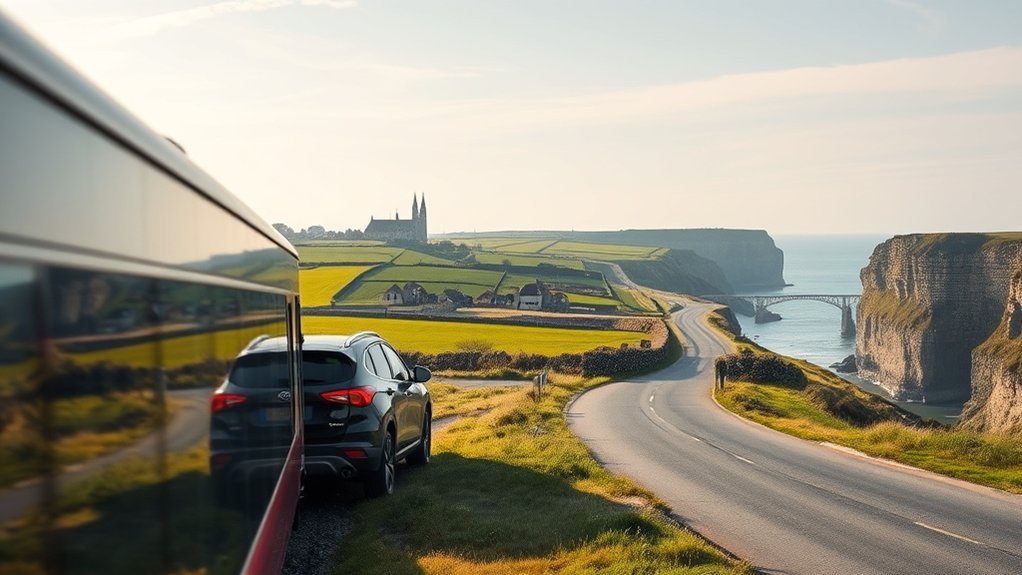
Normandy is well connected to Paris and the rest of France by rail and road. According to Normandy Tourism, the region has 101 railway stations, regional NOMAD Train and NOMAD Car services, cross-Channel ferries, long-distance coaches, cycling routes, and several regional airports.
If you are coming from Paris, train travel is usually the most convenient starting point. Current SNCF schedules for Paris to Caen include direct journeys of about two hours, while Paris to Rouen can be considerably quicker.
Driving is better when your itinerary includes several rural or coastal locations. Ferries make sense for travelers arriving from Britain or Ireland with a car or bicycle, while coaches can reduce costs if travel time is less important.
Normandy Tourism currently lists 101 railway stations across the region, making many major towns practical to visit without a car.
How to Get to Normandy by Car
Driving gives you the most flexibility once you leave Normandy’s main rail corridors. From Paris, the A13 is the principal motorway toward Rouen and Caen. Normal travel times vary with Paris traffic, roadworks, stops, and your exact starting point, so check live conditions before leaving.
Caen is a useful road base for western Normandy. Bayeux is only about 30 km away and normally takes roughly half an hour by car rather than two hours. Mont-Saint-Michel is farther southwest and is generally reached from Caen using the A84 before connecting to local roads.
Warning: The A13/A14 Paris-Normandy motorway corridor uses free-flow tolling. There may be no traditional toll barrier, but payment is still required. Sanef states that drivers generally have up to 72 hours to pay after using the tolled sections.
Before driving through Rouen, also check the city’s low-emission-zone rules. The Métropole Rouen Normandie ZFE-m restricts Crit’Air 4, Crit’Air 5, and unclassified vehicles unless an exemption applies. Foreign-registered vehicles may also need the appropriate French Crit’Air certificate when entering regulated areas.
Fuel stations are common on major routes, but they become less frequent on rural roads. If you are renting a car, confirm fuel type, toll-payment arrangements, parking rules, and whether the rental vehicle already carries a Crit’Air sticker.
Best Train Routes to Normandy
Train travel is the easiest option for many visitors arriving from Paris. Most services to northern and central Normandy leave Paris Saint-Lazare, although western routes toward places such as Granville can use Paris Montparnasse.
For major attractions, the station you choose matters. Rouen and Caen are excellent transport hubs. Bayeux has a railway station and receives some direct Paris services, while Cherbourg and Le Havre also have direct or through options depending on the timetable.
Pro Tip: Search your exact travel date on SNCF Connect rather than relying on a fixed journey time. Normandy schedules vary by weekday, season, engineering work, and whether the service is direct.
Direct Trains From Paris
Direct trains from Paris Saint-Lazare make Rouen and Caen especially easy to reach. Current SNCF timetables show Paris–Caen direct trips at around two hours, with some journeys under that mark. Paris–Rouen services commonly take about 1.25 to 1.75 hours.
Bayeux can also be reached directly on selected services. Current SNCF schedules show direct Paris–Bayeux trips of a little over two hours on some departures. Cherbourg is farther west and generally takes more than three hours from Paris.
Le Havre is another straightforward rail destination. Journey times are usually around two hours or slightly longer. If your destination is Deauville-Trouville, Vernon-Giverny, Dieppe, or another regional stop, check whether your chosen departure is direct or requires a connection.
Key Norman Station Hubs
Choosing the right station can save significant onward travel time.
- Rouen Rive Droite: best for Rouen’s historic center and useful for eastern Normandy.
- Caen: strong base for Bayeux, the D-Day area, Ouistreham, and western Normandy.
- Le Havre: useful for Le Havre and onward connections toward the Seine estuary.
- Bayeux: one of the most practical rail bases for organized D-Day tours.
- Cherbourg: useful for the Cotentin Peninsula and ferry connections.
- Vernon-Giverny: the rail gateway normally used for Giverny; Giverny itself does not have a conventional mainline station.
Normandy Tourism also lists rail access from other French cities. Some long-distance journeys can be direct, while others require a change, often in Paris. Current SNCF schedules should always be checked for your specific date.
Taking a Ferry to Normandy
A ferry is one of the most practical ways to reach Normandy from England or Ireland if you are traveling with a car, motorcycle, caravan, or bicycle. It also avoids having to collect a rental vehicle after arrival.
Current Normandy Tourism information lists the following principal England–Normandy routes:
| Route | Operator | Useful For |
|---|---|---|
| Portsmouth–Caen/Ouistreham | Brittany Ferries | Caen and D-Day area |
| Portsmouth–Le Havre | Brittany Ferries | Le Havre and eastern Normandy |
| Portsmouth–Cherbourg | Brittany Ferries | Cotentin Peninsula |
| Poole–Cherbourg | Brittany Ferries | Western Normandy |
| Newhaven–Dieppe | DFDS | Dieppe and eastern Normandy |
From Ireland, Normandy Tourism currently lists Dublin–Cherbourg with Irish Ferries, Rosslare–Cherbourg with Stena Line, and Rosslare–Le Havre with Brittany Ferries. Availability can be seasonal, so check the operator’s timetable before building your itinerary around a particular crossing.
Ferry baggage, vehicle, bicycle, pet, and check-in rules vary by operator. Reserve early for summer, school holidays, and weekends if you need a vehicle space or cabin.
Coach Travel to Normandy on a Budget
Coach travel can cost less than rail, especially when booked in advance. Normandy Tourism lists FlixBus, BlaBlaCar Bus, and the regional NOMAD Car network among useful options.
- Compare coach and train fares before booking because the cheapest mode varies by date.
- Use FlixBus or BlaBlaCar Bus for selected intercity services.
- Use NOMAD Car for many regional links within Normandy.
- Allow more travel time than you would for a direct train.
- Check the exact departure stop because coach terminals are not always beside railway stations.
BlaBlaCar also operates a separate ridesharing marketplace, so make sure you know whether you are booking a scheduled bus or a seat in a private driver’s car.
Flying to Normandy From Regional Airports
Normandy has several airports, but flying is not the default option for most travelers coming from Paris. For international visitors, Paris Charles de Gaulle and Paris Orly are usually the main gateways, followed by train, coach, rental car, or a private transfer to Normandy.
Caen-Carpiquet Airport (CFR) is the most useful regional airport for many conventional scheduled journeys. Current 2026 airport information lists direct destinations including Lyon, Marseille, Montpellier, Nice, Toulouse, and several Corsican airports, with schedules that vary by season.
Deauville-Normandie Airport (DOL) serves scheduled, seasonal, charter, and holiday flights, with a strong emphasis on European and Mediterranean leisure destinations. It is particularly convenient for Deauville, Trouville, Honfleur, and the Côte Fleurie when the available route matches your trip.
Note: Regional-airport schedules change frequently and many routes are seasonal. Check the airport’s current destination list before booking a connecting itinerary.
Regional Airport Options
Normandy Tourism identifies several airports in the region, including Caen-Carpiquet, Deauville-Normandie, Cherbourg-Maupertus, Le Havre-Octeville, and Rouen-Vallée de Seine. Their roles differ significantly, and not every airport has scheduled passenger flights suitable for a normal holiday itinerary.
- Caen-Carpiquet: best regional choice when a suitable scheduled route is operating.
- Deauville-Normandie: useful for seasonal and leisure flights serving the Côte Fleurie.
- Paris CDG/Orly: usually better for long-haul and international arrivals.
- Rental car: useful when landing regionally and continuing to rural Normandy.
- Public transport: Caen-Carpiquet is connected with Caen by Twisto bus service.
Flight Durations
There is no single reliable flight-duration table for Normandy because the available city pairs change seasonally. Instead of planning around older routes from cities such as Nantes or Bordeaux, check the current Caen and Deauville timetables first.
As a general rule, domestic French flights into Caen are short, but total journey time also includes airport check-in, security, ground transfers, and possible connections. From Paris, the train is usually more practical than flying to Normandy.
Airport To City Travel
Caen-Carpiquet is approximately 7 km from central Caen. The official Normandy Airports site lists Twisto Line 3 as a public-transport connection to the city. Taxis and rental cars are also available.
- Use a rental car if your first destination is rural or spread across several sites.
- Use local public transport if you are staying in central Caen.
- Check airport bus operating hours against your flight arrival time.
- For Deauville Airport, verify taxi, bus, or pre-booked transfer arrangements before arrival.
- For international arrivals at CDG or Orly, compare through-coach options with a transfer into Paris for onward rail travel.
Getting to Normandy From Paris Airports
If you land at Charles de Gaulle Airport or Orly Airport, do not assume you need another flight. Normandy Tourism describes the Paris airports as the principal gateways for many international travelers.
For destinations served from Paris Saint-Lazare, such as Rouen, Caen, Bayeux, Le Havre, and Cherbourg, one common approach is to travel from the airport into Paris and continue by NOMAD/SNCF train. Some coach services also connect Charles de Gaulle with Normandy cities, so compare the full door-to-door journey rather than only the train time.
If you have several large bags, young children, limited mobility, or a group splitting the fare, a pre-booked private transfer or rental car can be more convenient despite the higher cost.
Private Transfers From Paris and Nearby Cities
Private transfers are the most expensive option, but they can be useful for groups, families with significant luggage, travelers arriving late, or visitors going directly to rural accommodation that is awkward by public transport.
| Route | What to Expect | Best For |
|---|---|---|
| Paris to Caen | Several hours depending on traffic | Door-to-door groups |
| Rennes to western Normandy | Road time varies by destination | Mont-Saint-Michel area |
| Amiens to Rouen | Regional road transfer | Eastern Normandy |
| Airport to rural hotel | Direct pre-booked journey | Heavy luggage or late arrival |
| Custom sightseeing transfer | Price varies by stops and distance | Small private groups |
Ask whether the quoted price includes tolls, airport waiting time, luggage, child seats, and extra sightseeing stops before confirming the booking.
Best Routes for the D-Day Beaches and Mont-Saint-Michel
Getting to the D-Day Beaches
Bayeux and Caen are the two most useful rail bases for the D-Day area. Bayeux is particularly convenient for organized battlefield tours, while Caen has broader regional transport and car-rental options.
The beaches, cemeteries, bunkers, and memorials are spread across a long section of coast, so a rental car or organized tour is much easier than trying to visit several major sites using only local public transport.
During summer, NOMAD also operates seasonal coastal services on selected routes. Check current regional timetables before assuming the same bus will operate year-round.
Getting to Mont-Saint-Michel
Mont-Saint-Michel sits on Normandy’s southwestern edge and requires more planning than Rouen or Caen. Travelers coming from Paris can compare rail and coach combinations via western Normandy or Brittany, while drivers can approach using the A84 and local access roads.
If Mont-Saint-Michel is the main purpose of your visit, staying in western Normandy can save travel time. If it is only one stop on a broader D-Day and Normandy itinerary, Caen can still work as a transport base, particularly with a rental car.
Which Normandy Arrival Point Works Best?
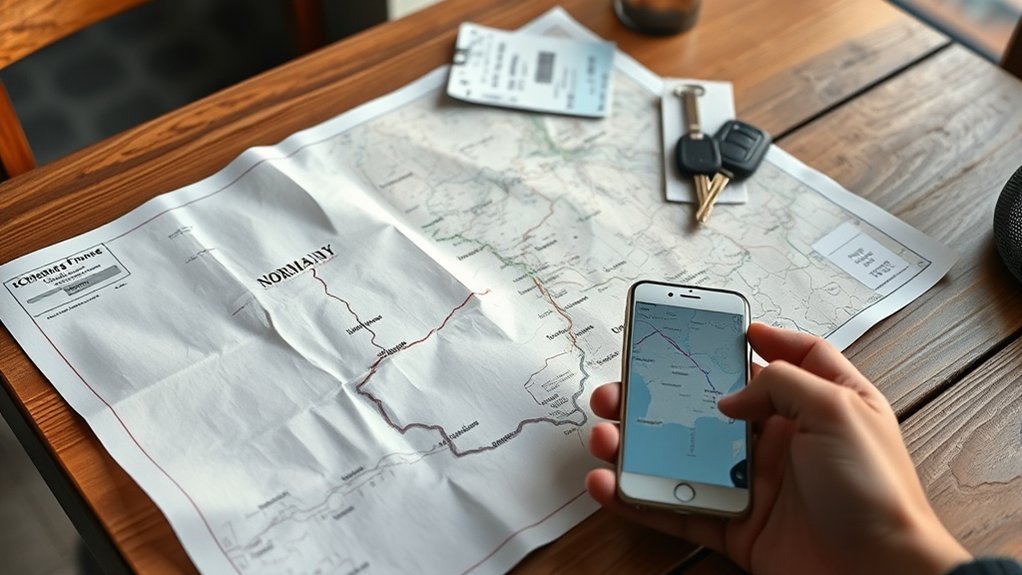
Your best arrival point depends more on your itinerary than on which Norman city is largest. Caen is excellent for western Normandy, Rouen for the east, Bayeux for D-Day tours, Le Havre for the Seine estuary and coast, and Cherbourg for the Cotentin Peninsula.
Best Arrival Cities
- Caen: best all-round transport base for western Normandy, Bayeux, Ouistreham, and D-Day excursions.
- Rouen: best for medieval architecture, museums, and eastern Normandy.
- Le Havre: useful for Le Havre, the coast, ferries, and onward travel toward Honfleur.
- Bayeux: ideal for the Bayeux Tapestry and organized D-Day tours.
- Cherbourg: useful for ferry passengers and Cotentin Peninsula trips.
- Vernon-Giverny: the practical rail stop for visiting Giverny and Monet’s garden.
Giverny itself should not be treated as a major transport hub. Rail travelers normally use Vernon-Giverny station and continue locally.
Choosing Your Base
Caen works well if you want a mixture of museums, city services, car rental, rail links, and access to the D-Day area. Rouen is better for eastern Normandy and a city-focused stay. Bayeux is smaller and more atmospheric, with easy access to D-Day tours.
Honfleur is an attractive coastal base but does not have the same direct mainline rail access as Caen or Rouen. Le Havre is better connected by train, while Honfleur is reached by road or bus from surrounding transport hubs.
| Base | Best For | Car Needed? |
|---|---|---|
| Caen | Transport and D-Day access | Helpful for coast |
| Rouen | Culture and eastern Normandy | Not for city stay |
| Bayeux | D-Day tours and heritage | Helpful unless touring |
| Le Havre | Rail and coastal access | Optional |
| Honfleur | Harbor and Côte Fleurie | Useful |
Eco-Friendly Ways to Travel in Normandy
You can explore a substantial part of Normandy without driving. The regional rail network covers many major towns, NOMAD buses extend into areas without railway stations, and the region promotes six major long-distance cycling routes.
Normandy’s Low Carbon Rate gives qualifying visitors at least a 10% discount at participating attractions when they arrive by train, coach/bus, or bicycle and present the required proof. Conditions and participating sites can change, so check the current scheme before your visit.
- Use NOMAD trains between major cities.
- Use regional buses for destinations beyond the rail network.
- Cycle designated long-distance routes where appropriate.
- Use the Atoumod regional journey planner for public transport.
- Check the Normandy Low Carbon Rate before buying attraction tickets.
If you travel with a bicycle on the train, check the rules for your specific service. Space and reservation requirements can vary by train and travel period.
Getting Around Normandy by Train, Car, and Bus
There is no single best way to get around all of Normandy. Rail works well between major cities, while buses fill many regional gaps. A car is most useful when your itinerary includes rural villages, several D-Day sites, remote stretches of coast, or accommodation outside town centers.
For a city-based trip to Rouen, Caen, Bayeux, or Le Havre, you may not need a car every day. Instead, travel by train between bases and rent a car only for the portion of the itinerary that requires it.
Places such as Honfleur, Étretat, and individual D-Day sites need more careful public-transport planning because they are not all served by direct mainline rail. Check the Atoumod/NOMAD journey planner for the exact day you intend to travel.
Frequently Asked Questions
What’s the easiest way to get to Normandy from Paris?
For most visitors, the easiest option is a direct train from Paris Saint-Lazare. Rouen commonly takes around 1.25–1.75 hours, while Caen is about two hours. Choose your station according to the part of Normandy you want to visit.
What is the best way to tour Normandy, France?
A car is best for a multi-stop itinerary covering D-Day beaches, countryside, villages, and coastal sites. If you are mainly visiting Rouen, Caen, Bayeux, and Le Havre, train travel combined with occasional tours or buses can work well.
What are the 3 C’s of Normandy?
“Culture, cuisine, and coastline” is a useful informal way to describe Normandy’s appeal, but it is not an official transport or tourism classification. The region is known for historic cities and D-Day heritage, foods such as Camembert and cider, and a long Channel coastline.
What is the best airport to fly into to see Normandy?
For most international travelers, Paris Charles de Gaulle or Orly offers the widest choice of flights, followed by ground transport to Normandy. Caen-Carpiquet is convenient when a suitable regional direct flight is available, while Deauville is useful for selected seasonal and leisure routes.
Can you visit Normandy without a car?
Yes. Rouen, Caen, Bayeux, Le Havre, Cherbourg, and several other towns are practical by train. A car becomes more useful for rural areas, several D-Day sites in one day, and destinations with limited rail access such as Honfleur.
Which Normandy station is best for the D-Day beaches?
Bayeux is one of the most convenient stations for organized D-Day tours. Caen is another strong choice because it has excellent rail connections, car rentals, regional buses, and easy road access toward the coast.
Conclusion
Normandy is easy to reach once you match your transport to your itinerary. From Paris, direct trains are usually the best choice for Rouen, Caen, Bayeux, Le Havre, and Cherbourg. Ferries are excellent for travelers bringing a vehicle from Britain or Ireland, while coaches can reduce costs.
If your plans include several D-Day beaches, rural villages, or remote coastal stops, renting a car for at least part of the trip will make the itinerary much easier. Before driving, remember to check A13/A14 free-flow toll requirements and Rouen’s current Crit’Air rules.
Sources
- Normandy Tourism — Getting to and around Normandy — rail network, ferry routes, coach travel, airports, cycling, Atoumod, and regional transport.
- SNCF Connect — Paris to Caen timetable — current rail journey times and direct-service examples.
- SNCF Connect — Paris to Rouen timetable — current rail journey times and direct-service examples.
- Normandy Airports — Caen-Carpiquet Airport — 2026 destinations, airlines, airport distance, and public transport.
- Sanef — A13/A14 free-flow tolls — toll operation and payment requirements on the Paris-Normandy motorway.
- Métropole Rouen Normandie — Low Emission Zone — current Rouen ZFE-m and Crit’Air vehicle restrictions.

