
Last Updated on September 11, 2026 by Daniel Globe
Starting your Swisspa correctly is not a matter of pouring in every chemical from the startup kit. You first need to confirm the spa’s water capacity, approved sanitizer system, fill level, and source-water readings. The sequence below fits a SpaBoss-style startup kit, but your Swisspa owner’s manual and the directions on each chemical container always take priority.
Quick Answer
Fill your Swisspa to its marked level, start circulation, and test the water before dosing. Add a stain-and-scale product only when needed, then correct calcium hardness, total alkalinity, and pH. Add the approved sanitizer last. Do not soak until the water is clear and every tested reading is within its safe range.
Key Takeaways
- Confirm the spa’s gallon capacity and sanitizer system before measuring any chemical.
- Test first. You may not need Cal-Rise, Alka-Rise, or pH adjuster if the water is already in range.
- Add only one chemical at a time and allow it to circulate before retesting.
- Use product-label doses rather than a universal number of ounces or spoonfuls.
- Add sanitizer last and enter only after pH, sanitizer, temperature, clarity, and circulation are safe.
At a Glance
| Time Required | About 1-3 hours for filling, testing, and initial balancing, plus additional heating time |
| Difficulty | Easy to moderate |
| Tools Needed | Owner’s manual, current test strips or drop kit, clean measuring tool, gloves, eye protection, and an accurate thermometer |
| Cost | Varies by spa volume, source-water quality, and which adjustments the test results require |
Disclosure: As an Amazon Associate I earn from qualifying purchases. Some links on this page are affiliate links, at no extra cost to you.
Swisspa Startup Chemicals: What to Add First
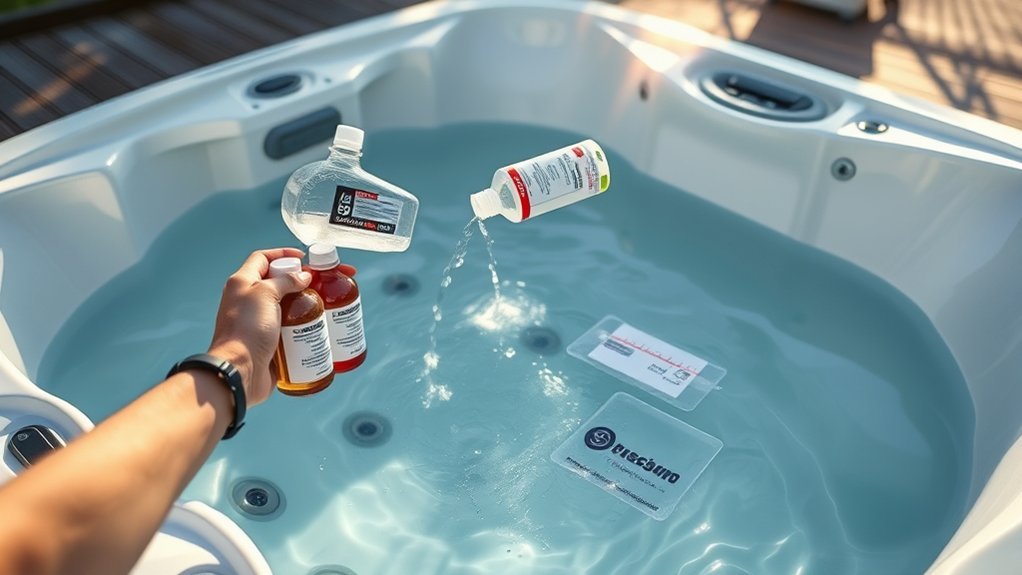
The first product you add depends on your water source and the chemical program supplied with the spa. A typical SpaBoss-style kit may include a stain-and-scale controller, Cal-Rise, Alka-Rise, pH Plus, pH Minus, and Chlor-Aid. You should not automatically use all of them.
Before opening a container, find the spa’s fill volume in the owner’s manual. A dose for a 250-gallon spa can be very different from a dose for a large swim spa. Never estimate the volume from the spa’s outside dimensions.
- Fill and circulate the water. Fill to the marked level in the owner’s manual. Start the circulation system and confirm that water is moving normally.
- Test the untreated water. Check calcium hardness, total alkalinity, pH, and any metals your kit can measure.
- Add a stain-and-scale controller if needed. This is most useful with well water or water that contains iron, copper, manganese, or a high mineral load.
- Correct calcium hardness. Add Cal-Rise only if the reading is below the range specified for your spa.
- Correct total alkalinity. Use Alka-Rise when alkalinity is low. Follow the label if a reducer is needed.
- Adjust pH. Use pH Plus or pH Minus in small label-directed doses.
- Add the approved sanitizer last. Use Chlor-Aid only if stabilized chlorine is approved for your specific Swisspa and water-care system.
Note: Some SpaBoss startup instructions say to add the sequestering agent during the initial fill and let the water circulate until it reaches about 80°F before adding the remaining chemicals. That temperature is part of a particular startup program, not a universal rule for every spa chemical.
Confirm the Volume and Sanitizer System
Two checks prevent many startup mistakes: knowing the true water capacity and identifying the sanitizer system.
Find the Correct Water Capacity
Look for the capacity in the Swisspa owner’s manual, specification label, or dealer documentation. Use the actual filled-water capacity rather than the shell’s maximum theoretical volume. If the manual gives capacity in liters, convert it before following a label that doses by gallons.
Identify the Approved Sanitizer
Check whether your spa uses chlorine, bromine, a salt system, biguanide, or another manufacturer-approved program. Do not add Chlor-Aid to a bromine, salt, or specialty system unless the manual confirms that it is compatible.
SpaBoss Chlor-Aid is a stabilized sodium-dichlor product. Its current listed directions specify adjusting pH to 7.2-7.6, adding 1/2 teaspoon per 100 gallons with the pump running, and retesting at 15- to 20-minute intervals until a 3-5 ppm available-chlorine residual is established. Always use the directions printed on your own container because labels and formulations can change.
Note: CDC home-hot-tub guidance advises against cyanuric acid and stabilized chlorine products such as dichlor in hot tubs, while some spa manufacturers still specify dichlor products. Follow the Swisspa manual, the registered product label, and applicable local public-health guidance. Ask the dealer or a qualified water-care professional when those instructions conflict.
Chemical Safety Before You Start
Warning: Never mix spa chemicals with each other. Never combine chlorine with acid, pH reducer, household cleaners, or another chlorine product. Dangerous heat, fire, or toxic gas can result. Keep everyone out of the spa while chemicals are being added.
Follow these precautions every time you handle spa chemicals:
- Read the entire product label before measuring a dose.
- Wear the gloves, eye protection, or other equipment required by the label.
- Work outdoors or in a well-ventilated area.
- Open only one chemical container at a time.
- Use a clean, dry measuring tool dedicated to that product.
- Add one product, close its container, and store it before opening another.
- Never use the same scoop for chlorine and pH products.
- Predissolve a product only when its label specifically tells you to do so.
- When predissolving is required, add the chemical to water. Never pour water into a container of chemical.
- Store every product in its original labeled container, away from moisture, heat, children, and pets.
These precautions follow the CDC’s current pool and spa chemical-safety guidance.
How to Add Chemicals to Your Swisspa
1. Fill to the Marked Level
Turn off power during filling if your manual requires it. Install clean filters and fill the spa to the manufacturer’s marked line. Do not rely on a general rule such as “just above the skimmer,” because suction and filter layouts differ between models.
Once the spa is full, restore power according to the manual. Confirm that the circulation pump primes correctly and that water moves through the jets or return fittings. Stop and correct the problem if the pump is noisy, repeatedly loses prime, or produces little flow.
2. Inspect for Leaks and Flow Problems
Check unions, pump connections, drain fittings, and visible plumbing for drips. Look for error messages on the control panel. Do not continue heating or dosing if the spa has an active leak, an air lock, a low-flow warning, or a dry-heater warning.
3. Test the Source Water
Use fresh test strips or a drop-based kit. Test the water before adding chemicals so you know which products are actually needed. At minimum, measure:
- Calcium hardness
- Total alkalinity
- pH
- Free chlorine or bromine after sanitizer is added
If you use well water or have previously seen brown, orange, green, or blue staining, ask a dealer or water-testing service to check for iron, copper, or manganese.
4. Add Stain-and-Scale Control if Needed
A sequestering product helps keep dissolved metals and minerals suspended so they are less likely to discolor the shell or form deposits. It does not remove hardness or metals from the water, and it does not replace proper filtration.
Use only the dose shown on the exact stain-and-scale product you own. Do not assume that 8 ounces is correct. The concentration, spa volume, and source-water condition all affect the amount.
Pro Tip: If a sequestering treatment captures a noticeable mineral load, inspect and rinse the filter as directed by the spa and filter manufacturer. The product can keep minerals suspended, but the filter still has to collect and remove debris.
5. Adjust Calcium Hardness
For the SpaBoss-style startup program described by Master Spa Parts, calcium hardness is commonly maintained around 150-250 ppm. Your Swisspa manual may specify a different target.
Add Cal-Rise only when the reading is low. High calcium cannot be corrected by adding another balancing product. It may require partial replacement with lower-hardness water or professional treatment.
6. Adjust Total Alkalinity
Total alkalinity helps resist sudden pH changes. The SpaBoss-style startup guide uses a range of about 80-150 ppm. Other manufacturers may use a narrower target.
If alkalinity is low, add Alka-Rise in small label-directed doses. Let the water circulate for the specified period, then retest. If alkalinity is high, follow the product and spa instructions for lowering it. Do not repeatedly add large amounts of pH Minus without checking both pH and alkalinity.
7. Adjust pH
After alkalinity is stable, test pH again. Common spa targets fall within 7.2-7.8, but the Chlor-Aid directions specify 7.2-7.6. Use the narrower range required by your active sanitizer and spa manual.
Add pH Plus when the reading is low or pH Minus when it is high. Use small amounts and retest between additions. Large corrective doses can push the water past the target and create a cycle of adding one product after another.
8. Add Sanitizer Last
After alkalinity and pH are stable, add the sanitizer approved for your Swisspa. Keep the pumps running and apply the product exactly where its label directs. Do not pour a chemical through the skimmer or filter compartment unless the label or manual specifically tells you to do that.
If Chlor-Aid is the approved product, use the current label on your container to calculate the initial dose. Test the water after the stated circulation interval and add more only when the reading remains below the required residual.
9. Circulate and Retest
Leave the cover fully open while adding chemicals and for the ventilation period specified by the chemical or cover manufacturer. Retest after each product’s required waiting period.
There is no universal need to wait 24-48 hours before checking the water. Many startup products require testing after 15-60 minutes. The correct interval is the one printed on the product label.
What Each Startup Chemical Does
| Product Type | What It Does | When to Use It |
|---|---|---|
| Stain-and-scale controller | Sequesters dissolved metals and minerals to reduce staining and scale risk | When the source water contains metals, high minerals, or the startup program calls for it |
| Cal-Rise | Raises calcium hardness | Only when a test shows that calcium hardness is below the model’s target |
| Alka-Rise | Raises total alkalinity and helps stabilize pH | When total alkalinity is low |
| pH Plus | Raises pH | When pH remains below the required range after alkalinity is corrected |
| pH Minus | Lowers pH and may also lower total alkalinity | When pH is high, using small doses and repeated testing |
| Chlor-Aid | Provides stabilized chlorine for disinfection | Only when sodium dichlor is approved for the spa’s sanitizer program |
Water Level and Temperature Basics
Keep the water at the fill mark specified by the manufacturer. A level that is too low can allow the pump to draw air, reduce circulation, interrupt heating, or trigger a low-flow error. A level that is too high can cause excessive overflow when people enter.
Check the level after the first heating cycle because trapped air may leave the plumbing and evaporation may lower the water slightly. Top up only after the system has circulated and the pumps are off, unless the manual directs otherwise.
For soaking, the water must never exceed 104°F. The U.S. Consumer Product Safety Commission identifies about 100°F as a reasonable temperature for a healthy adult, but many people prefer a lower setting.
Warning: Do not use alcohol before or during a soak. Pregnant people and anyone with heart disease, circulation problems, diabetes, blood-pressure concerns, or medications that cause drowsiness should seek medical advice before using a hot tub. Follow current age restrictions and supervise children continuously.
Balance pH, Alkalinity, Calcium, and Sanitizer
The correct target is the one specified by your Swisspa manual and sanitizer label. The figures below are common reference points for the SpaBoss-style products discussed in this guide, not guaranteed specifications for every model.
| Reading | Common Reference Range | Important Detail |
|---|---|---|
| pH | Commonly 7.2-7.8 | The Chlor-Aid directions specify 7.2-7.6 |
| Total alkalinity | About 80-150 ppm in the cited SpaBoss program | Correct alkalinity before making repeated pH adjustments |
| Calcium hardness | About 150-250 ppm in the cited SpaBoss program | Do not add Cal-Rise when the reading is already adequate or high |
| Available chlorine with Chlor-Aid | 3-5 ppm under the current listed directions | Do not enter above the product or manufacturer’s allowed level |
The CDC recommends keeping hot-tub pH within 7.0-7.8 and maintaining at least 3 ppm chlorine when chlorine is the approved sanitizer. Your product label or manufacturer may require a narrower operating range.
A waiting period cannot replace a water test. Your Swisspa is ready only when the measured chemistry, water clarity, circulation, and temperature are all safe.
What to Check Before Your First Soak
Complete this check after the final chemical has circulated for the label-directed period. Do not rely on smell or water appearance alone.
| Check | What to Look For | Why It Matters |
|---|---|---|
| Water level | At the marked fill line | Supports proper pump and heater operation |
| Plumbing and fittings | Dry connections with no active leak | Prevents water loss and equipment damage |
| Circulation | Normal flow with no air-lock or low-flow warning | Ensures even heating, filtration, and chemical distribution |
| pH and alkalinity | Within the manual and sanitizer-label ranges | Improves sanitizer performance and protects equipment |
| Sanitizer | A verified residual within the approved operating range | Reduces the risk of exposure to poorly disinfected or overtreated water |
| Temperature | Comfortable and no higher than 104°F | Reduces overheating and burn risk |
| Water condition | Clear water with no floating residue or unusually strong chemical odor | Cloudiness or strong odor may signal a chemistry or filtration problem |
Common Swisspa Startup Problems
The Water Is Cloudy After Filling
Check the filter installation, circulation, pH, alkalinity, calcium hardness, and sanitizer. New water can become cloudy when minerals precipitate, the filter is dirty, or several chemicals are added too quickly. Do not add a clarifier until the basic chemistry and circulation have been checked.
The Sanitizer Reading Drops to Zero
Fresh water, dirty plumbing, body oils, or organic contamination can consume sanitizer quickly. Confirm that the test kit is current, then add the approved sanitizer according to its label. Keep the spa closed until a stable residual is maintained.
The pH Keeps Changing
Unstable pH often points to total alkalinity outside the recommended range. Correct alkalinity first, allow circulation, and then retest pH. Strong aeration can also make pH rise over time.
The Water Turns Brown, Green, or Blue
Colored water shortly after filling may indicate iron, copper, manganese, or another dissolved metal. Stop adding unneeded chemicals, keep the water circulating, and have the source water tested. Use a compatible sequestering treatment according to its label.
The Water Foams
Foam can come from soap residue, detergent in swimsuits, body products, low calcium hardness, or old water. Check calcium and sanitizer, clean or rinse the filter as directed, and ask users to shower before entering. Persistent foam may require partial or complete water replacement.
The Chlorine Reading Is Too High
Do not enter. Leave the cover open, keep the circulation system running, and allow the level to fall naturally while preventing access. Retest before use. Do not add a neutralizer unless the product label or a qualified professional recommends it for your system.
Ongoing Swisspa Water Care
Startup balancing is only the first step. Test the water before use and often enough to catch changes caused by heat, jets, bathers, rain, source-water top-ups, and sanitizer demand.
- Test pH and sanitizer before soaking.
- Check total alkalinity and calcium hardness on the schedule in the owner’s manual.
- Rinse or clean filters only with methods approved for the filter type.
- Keep the cover clean and allow chemical vapors to escape after dosing.
- Top up with the same source water when possible, then retest.
- Drain and refill on the schedule recommended for the spa’s size, bather load, and water-care system.
- Stop using the spa when the water is cloudy, sanitizer cannot be maintained, or an equipment warning appears.
Frequently Asked Questions
Do I have to wait until the Swisspa reaches 80°F before adding chemicals?
Not for every product. Some SpaBoss startup instructions say to add the sequestering agent during filling and wait until the water reaches about 80°F before adding the remaining balancing chemicals. Follow the directions for your exact startup kit and Swisspa model.
Should I add 8 ounces of Stain n Scale?
Do not use 8 ounces as a universal dose. Confirm the exact product, the spa’s filled-water capacity, and the dose printed on the current container. Different stain-and-scale products can have very different concentrations.
Do I balance alkalinity or pH first?
A SpaBoss-style startup normally corrects total alkalinity before the final pH adjustment because alkalinity helps stabilize pH. Some manufacturers use a different sequence, so follow your owner’s manual when it conflicts with general guidance.
How long after adding chemicals can I use the Swisspa?
There is no safe universal waiting time. Let each product circulate for its label-directed period, then test again. Enter only when pH, sanitizer, water clarity, circulation, and temperature are all within the approved ranges.
Can I use Chlor-Aid in every Swisspa?
No. Chlor-Aid is a stabilized sodium-dichlor sanitizer. Use it only when the Swisspa manual approves that sanitizer. Do not add it to a bromine, salt, biguanide, or other specialty system unless compatibility is confirmed.
Can I mix chemical brands in my startup kit?
Products from different brands may be compatible, but you should never physically mix them or assume they use the same dose. Use one product at a time, follow each label, and confirm that every product fits the same sanitizer program.
Sources
- Master Spas: Chemicals for Hot Tub Start-Up — startup testing order, circulation, and sanitizer retesting guidance
- Master Spa Parts: Six Steps to Starting Up a Master Spa — SpaBoss-style chemical sequence and common balancing targets
- Master Spa Parts: SpaBoss Chlor-Aid Directions — active ingredient, volume-based dose, pH range, and sanitizer target
- CDC: Home Pool and Hot Tub Water Treatment and Testing — current residential pH, sanitizer, and stabilized-chlorine guidance
- CDC: Pool Chemical Safety — chemical handling, storage, PPE, and mixing precautions
- U.S. Consumer Product Safety Commission: Hot Tub Temperature Warning — 104°F maximum and safe-use precautions
Conclusion
To start your Swisspa safely, fill it to the correct level, confirm its water capacity and sanitizer system, and test the untreated water. Add only the chemicals the test results call for. Correct calcium hardness, alkalinity, and pH before adding the approved sanitizer, and use label-based doses rather than a fixed number of ounces.
Keep the cover open while dosing, never mix chemicals, and retest after each required circulation period. Your first soak should begin only when the water is clear, the equipment is operating normally, the temperature is no higher than 104°F, and every chemistry reading is within the range required by the Swisspa manual and sanitizer label.
