
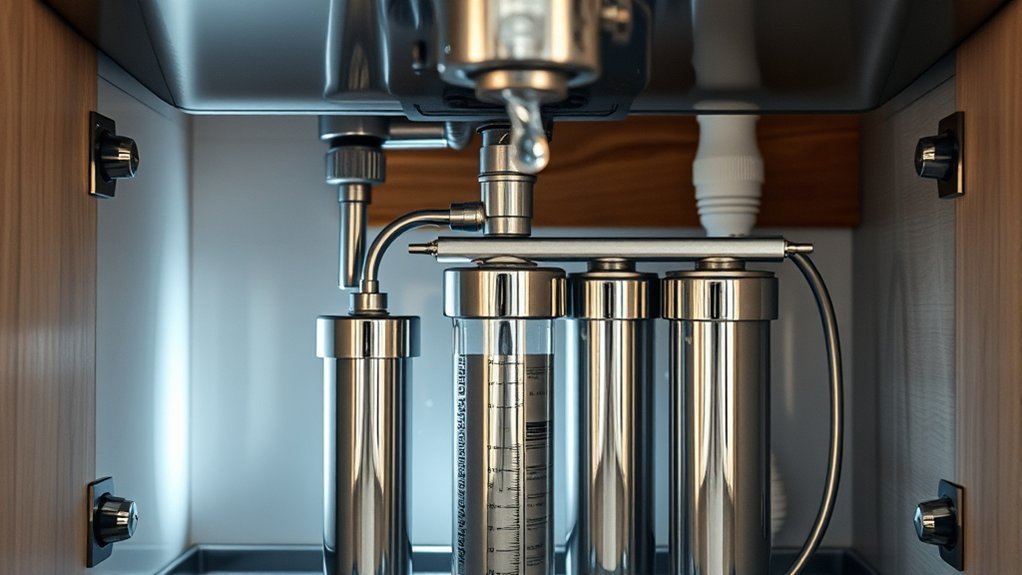
Last Updated on September 27, 2026 by Logan Reeves
Choosing an under sink water filter for well water starts with knowing what is in your water. Sediment, iron, bacteria, nitrates, arsenic, and dissolved minerals require different treatment methods. A filter that improves taste may not make contaminated well water safe to drink.
For broader drinking-water treatment, consider the iSpring RCC7AK-BN. Its reverse osmosis membrane reduces many dissolved contaminants. The 3M Aqua-Pure 3MFF100 is another option for households that need full-flow filtration without a separate drinking-water faucet.
These systems serve different needs. Always match the manufacturer’s approved feed-water requirements and certified contaminant-reduction claims to your well-water test results.
Key Takeaways
- Test your well water before buying a filtration system. Include bacteria, nitrates, total dissolved solids, and pH in routine testing.
- Choose reverse osmosis when your test results show dissolved contaminants that the selected system is certified to reduce.
- Use sediment pretreatment when your well contains sand, rust, or other particles that could clog an under-sink filter.
- Do not assume that a 0.01-micron membrane removes dissolved chemicals, nitrates, or every disease-causing microorganism.
- Check the exact model’s certification and performance data sheet rather than relying on a general NSF claim.
- Replace cartridges according to the manufacturer’s schedule and your actual water conditions.
Under Sink Water Filters for Well Water Compared
| Product | Best for | Filtration | Well-water requirements |
|---|---|---|---|
| PUREPLUS Under Sink Water Filter System
|
Pretreated-water alternative | Composite filtration | Whole-house pretreatment required. |
| 3M Aqua-Pure 3MFF100
|
Full-flow filtration | Triple-stage filtration | Designed for chlorinated and non-chlorinated supplies. |
| Waterdrop 10UB
|
Municipal-water alternative | Multistage carbon | Requires suitable pretreatment for well water. |
| iSpring US31
|
Sediment and taste | Three-stage filtration | Use only with appropriately tested and treated water. |
| CuZn UC-200
|
Long service life | Sediment, KDF and carbon | Not a standalone microbial treatment system. |
| Waterdrop WD-TSA-UF
|
Pretreated-water alternative | Nine-stage ultrafiltration | Requires prefiltration. |
| Waterdrop T3-M
|
Tankless reverse osmosis | Nine-stage RO | Confirm feed-water limits and pretreatment. |
| iSpring RCC7AK-BN
|
Broad dissolved-contaminant reduction | Six-stage RO | Confirm sediment, iron and microbial pretreatment needs. |
| Waterdrop TSB-UF
|
Dedicated-faucet alternative | Nine-stage ultrafiltration | Requires pretreated feed water. |
| Waterdrop TSA
|
Direct-connect alternative | Eight-layer filtration | Municipal water or appropriately pretreated supply. |
| Waterdrop TST-UF
|
Municipal-water alternative | Six-layer ultrafiltration | Not recommended for well water. |
| Waterdrop 10UA-UF
|
Compact ultrafiltration alternative | 0.01-micron membrane | Check pretreatment and approved feed water. |
| Waterdrop TSB
|
Municipal-water alternative | Eight-stage filtration | Not for untreated well water. |
| Waterdrop 10UA
|
Municipal-water alternative | Multistage filtration | Not recommended for well water. |
| iSpring CU-A4
|
Four-stage ultrafiltration | Sediment, UF, KDF and carbon | Confirm microbial safety and feed-water conditions. |
Under Sink Water Filters for Well Water: Our Top Picks
Six-stage reverse osmosis with remineralization for tested water.
Filters through your existing faucet without a separate drinking tap.
Tankless reverse osmosis with a remineralization stage.
Combines sediment filtration, ultrafiltration, KDF and carbon.
More Details on Our Top Picks
1. PUREPLUS Under Sink Water Filter System
Bottom line: This is not a standalone solution for untreated well water. PUREPLUS recommends using a whole-house filter before this under-sink unit when the source is a private well.
The composite filter is designed to reduce chlorine, sediment and selected contaminants while retaining dissolved minerals. Its direct-connect layout uses your existing faucet.
- Filtration: Composite filter.
- Rated capacity: Up to 22,000 gallons under specified conditions.
- Rated lifespan: Up to five years.
- Flow: Up to 2.5 GPM.
- TDS: Not designed to reduce dissolved solids.
- Long rated service life.
- Direct connection to existing faucet.
- Good flow for routine sink use.
- Requires pretreatment for well water.
- Does not reduce TDS.
- Not a standalone microbial treatment system.
Best for: Homes with an existing whole-house treatment system. Skip it if: Your well water is untreated. Check first: Feed-water quality and available cabinet space.
2. 3M Aqua-Pure 3MFF100
Bottom line: The 3M Aqua-Pure 3MFF100 is designed for both chlorinated municipal water and non-chlorinated well water. It suits households that want filtered water through their existing faucet.
Its triple-stage filtration reduces sediment, chlorine taste and odor, lead, certain VOCs and parasitic protozoan cysts within its certified performance claims. It does not replace treatment for every possible well-water contaminant.
- Filtration: Triple-stage system.
- Capacity: Up to 6,000 gallons.
- Flow: Up to 2.5 GPM.
- Installation: Existing faucet.
- Certification: Check the model’s NSF performance data sheet.
- Designed for non-chlorinated water.
- Full-flow faucet connection.
- Reduces several specifically identified contaminants.
- Does not address every dissolved contaminant.
- Replacement cartridges are required.
- Additional treatment may be needed for bacteria or nitrates.
Best for: Tested well water needing the system’s documented contaminant reductions. Skip it if: Your results require reverse osmosis or dedicated disinfection. Check first: Your laboratory results against its certified reduction claims.
3. Waterdrop 10UB
Bottom line: The Waterdrop 10UB is primarily a municipal-water filter. Its manual requires suitable prefiltration when using well water, and the manufacturer does not recommend it for untreated well supplies.
It includes a dedicated faucet and uses a multistage cartridge to improve taste and reduce selected contaminants.
- Filtration: Multistage carbon.
- Flow: Approximately 0.75 GPM.
- Filter life: Up to 12 months under rated conditions.
- Faucet: Dedicated stainless-steel faucet.
- Dedicated drinking-water faucet.
- Compact cartridge design.
- Simple replacement mechanism.
- Not suitable for untreated well water.
- Requires a separate faucet installation.
- Does not significantly reduce TDS.
Best for: Municipal water or approved pretreated supplies. Skip it if: You need direct treatment of untreated well water. Check first: Feed-water requirements.
4. iSpring US31
Bottom line: The iSpring US31 combines sediment and carbon filtration for households that need to improve water clarity, taste and odor.
Its first stage captures particles such as sand and rust. The following carbon stages address additional impurities. The system does not lower TDS, so it is not a substitute for reverse osmosis when dissolved contaminants are the main concern.
- Filtration: Three stages.
- Flow: Up to 1 GPM.
- Filter interval: Approximately 6–12 months.
- Design: Tankless, with dedicated faucet.
- Separate sediment and carbon stages.
- Visible first-stage housing.
- Retains dissolved minerals.
- Does not reduce TDS.
- Multiple cartridges require maintenance.
- Does not replace required disinfection.
Best for: Tested, appropriately treated water with sediment and taste concerns. Skip it if: You need significant dissolved-solids reduction. Check first: Available water pressure and installation clearance.
5. CuZn UC-200
Bottom line: The CuZn UC-200 suits households seeking long-lasting point-of-use filtration for water that is already microbiologically safe.
Its sediment, KDF-55 and coconut-shell carbon media help address selected contaminants and improve taste. The filter retains dissolved minerals rather than functioning as a reverse osmosis system.
- Filtration: Three stages.
- Rated life: Up to five years.
- Installation: Existing faucet connection.
- Media: Sediment, KDF and carbon.
- Long rated lifespan.
- No separate faucet required.
- Preserves naturally occurring minerals.
- Not a reverse osmosis system.
- Does not provide complete microbial treatment.
- Filter life depends on incoming water quality.
Best for: Tested water with suitable pretreatment. Skip it if: Your well has unresolved bacterial or nitrate contamination. Check first: The contaminant-specific performance data.
6. Waterdrop WD-TSA-UF
Bottom line: The Waterdrop WD-TSA-UF is designed around municipal cold water. Waterdrop advises using prefiltration before feeding it well water.
Its nine-stage design includes a 0.01-micron ultrafiltration membrane. The system retains dissolved minerals and does not function as reverse osmosis.
- Filtration: Nine-stage system.
- Membrane: 0.01 micron.
- Flow: Up to 1.59 GPM.
- Installation: Direct connection.
- Ultrafiltration membrane.
- Direct-connect installation.
- Retains dissolved minerals.
- Requires pretreatment for well water.
- Does not significantly lower TDS.
- Three cartridges require maintenance.
Best for: Municipal water or pretreated supplies. Skip it if: Your well water is untreated. Check first: Compatible tubing and replacement cartridges.
7. Waterdrop T3-M
Bottom line: The Waterdrop T3-M is a tankless reverse osmosis system for households seeking dissolved-contaminant reduction with a remineralization stage.
Its rated production capacity is 450 gallons per day. That figure describes daily membrane production under specified conditions, not the instantaneous flow from the drinking-water faucet.
- Filtration: Nine-stage reverse osmosis.
- Capacity: 450 GPD.
- Design: Tankless.
- Water efficiency: Advertised 2:1 pure-to-drain ratio.
- Reverse osmosis membrane.
- Tankless construction.
- Remineralization stage.
- Produces wastewater.
- Requires drain and power connections.
- Well-water pretreatment requirements must be checked.
Best for: Households seeking tankless RO treatment. Skip it if: You cannot provide the required drain, electrical connection or feed-water conditions. Check first: Water pressure and contaminant-reduction certifications.
8. iSpring RCC7AK-BN
Bottom line: The iSpring RCC7AK-BN combines six-stage reverse osmosis with alkaline remineralization. It is suited to tested water that needs broader dissolved-contaminant reduction.
The RO membrane reduces contaminants such as lead, arsenic and fluoride within the system’s certified performance claims. The final alkaline stage adds minerals back for taste.
Because this is not the UV-equipped version, do not rely on it alone to resolve known microbial contamination. Check whether your well needs sediment, iron or disinfection treatment upstream.
- Filtration: Six-stage reverse osmosis.
- Capacity: 75 GPD.
- Certification: NSF/ANSI 58.
- Design: Storage tank and dedicated faucet.
- Final stage: Alkaline remineralization.
- Certified RO system.
- Reduces multiple dissolved contaminants.
- Remineralization improves taste.
- Transparent first-stage housing.
- Requires storage-tank space.
- Produces wastewater.
- No dedicated UV stage.
Best for: Tested well water requiring the contaminants covered by its certified RO performance. Skip it if: You need a tankless system. Check first: Feed pressure, pretreatment needs and the BN faucet variant.
9. Waterdrop TSB-UF
Bottom line: The Waterdrop TSB-UF targets municipal water and requires pretreatment before use with well water.
Its nine-stage filtration includes ultrafiltration and a separate drinking-water faucet. It is useful for improving taste and reducing selected impurities, but it does not perform the same job as reverse osmosis.
- Filtration: Nine-stage ultrafiltration.
- Membrane: 0.01 micron.
- Faucet: Dedicated drinking-water faucet.
- TDS: Not designed for significant reduction.
- Dedicated faucet.
- Fine ultrafiltration membrane.
- Retains dissolved minerals.
- Not for untreated well water.
- Separate faucet installation.
- Does not reduce TDS like RO.
Best for: Municipal water or suitable pretreated supplies. Skip it if: You need direct well-water treatment. Check first: Feed-water requirements and faucet clearance.
10. Waterdrop TSA
Bottom line: The Waterdrop TSA is designed for municipal cold water. Well-water use requires appropriate pretreatment and confirmation of the manufacturer’s feed-water requirements.
Its three-cartridge system connects to your existing faucet. It provides multistage filtration without a separate drinking-water tap.
- Filtration: Eight-layer system.
- Cartridges: Three.
- Installation: Direct connection.
- TDS: Not significantly reduced.
- Uses existing faucet.
- Multiple filtration media.
- Quick-change cartridges.
- Requires well-water pretreatment.
- Three cartridges need replacement.
- Not a reverse osmosis system.
Best for: Municipal water and appropriately pretreated supplies. Skip it if: Your well is untreated. Check first: Faucet connection size.
11. Waterdrop TST-UF
Bottom line: The Waterdrop TST-UF is not recommended for well water. Its manual specifies municipal tap water as the feed-water requirement.
The stainless-steel system uses a 0.01-micron ultrafiltration membrane. It is designed for water that already meets the manufacturer’s source-water requirements.
- Filtration: Six-layer ultrafiltration.
- Membrane: 0.01 micron.
- Housing: Stainless steel.
- Installation: Cold-water connection.
- Stainless-steel construction.
- Fine ultrafiltration membrane.
- No RO wastewater stream.
- Not suitable for well water.
- Does not significantly lower TDS.
- Multiple cartridges require maintenance.
Best for: Municipal cold-water supplies. Skip it if: You rely on a private well. Check first: Connection compatibility.
12. Waterdrop 10UA-UF
Bottom line: The Waterdrop 10UA-UF is designed around treated cold-water supplies. Confirm the manufacturer’s pretreatment requirements before considering it for well water.
Its 0.01-micron ultrafiltration membrane provides finer particle filtration than a basic carbon-only cartridge. It does not significantly remove dissolved minerals.
- Filtration: Ultrafiltration and carbon.
- Membrane: 0.01 micron.
- Installation: Direct connection.
- Filter life: Up to 12 months under rated conditions.
- Compact design.
- Fine ultrafiltration membrane.
- Uses existing faucet.
- Not a standalone well-water treatment solution.
- Does not reduce TDS like RO.
- Filter life depends on source-water quality.
Best for: Treated water with particulate concerns. Skip it if: Your well has untreated microbial or dissolved contamination. Check first: Feed-water specifications.
13. Waterdrop TSB
Bottom line: The Waterdrop TSB is primarily a municipal-water filtration system, not a complete treatment solution for untreated well water.
It combines multiple filtration stages with a dedicated drinking-water faucet. Its design separates filtered drinking water from water delivered through the original faucet.
- Filtration: Eight-stage system.
- Cartridges: Three.
- Faucet: Dedicated.
- TDS: Not significantly reduced.
- Separate drinking-water faucet.
- Multiple filtration stages.
- Convenient filter changes.
- Not for untreated well water.
- Requires a dedicated faucet.
- Does not replace RO treatment.
Best for: Municipal or appropriately pretreated supplies. Skip it if: Your well needs primary treatment. Check first: Feed-water and faucet requirements.
14. Waterdrop 10UA
Bottom line: The Waterdrop 10UA is intended for municipal cold water. The manufacturer states that it is not suitable for well water.
Its direct-connect cartridge is useful for reducing selected contaminants and improving taste without installing another faucet.
- Filtration: Multistage cartridge.
- Installation: Existing faucet.
- Filter life: Up to 12 months under rated conditions.
- TDS: Not significantly reduced.
- Simple direct connection.
- Compact cartridge.
- No additional faucet required.
- Not recommended for well water.
- No RO membrane.
- Limited to specified contaminant reductions.
Best for: Municipal cold water. Skip it if: You rely on untreated well water. Check first: Faucet connection and replacement cartridge compatibility.
15. iSpring CU-A4
Bottom line: The iSpring CU-A4 combines sediment, ultrafiltration, KDF and carbon filtration in one under-sink system.
The 0.01-micron membrane addresses fine particles, while the other stages target selected chemicals and taste concerns. Unlike reverse osmosis, it does not significantly reduce total dissolved solids.
- Filtration: Four stages.
- Membrane: 0.01 micron.
- Design: Tankless.
- Faucet: Dedicated brushed-nickel faucet.
- Wastewater: No RO drain stream.
- Multiple filtration technologies.
- Fine ultrafiltration membrane.
- No RO storage tank.
- No RO wastewater stream.
- Does not reduce TDS.
- Multiple replacement cartridges.
- Not a substitute for required disinfection.
Best for: Tested and appropriately treated water needing fine-particle and taste improvement. Skip it if: Dissolved salts or nitrates are your main concern. Check first: Contaminant certifications and source-water requirements.
iSpring RCC7AK-BN vs 3M Aqua-Pure 3MFF100: Which Should You Get?
These filters address different water-quality problems. The iSpring uses reverse osmosis to reduce many dissolved contaminants. The 3M system focuses on certified contaminant reduction while maintaining full flow through your existing faucet.
- Dissolved contaminants: Choose the iSpring when your test results call for its certified RO treatment.
- Existing faucet: Choose the 3M when you want filtration without a separate drinking tap.
- Installation: The iSpring requires space for a tank and a drain connection. The 3M uses a simpler full-flow configuration.
- Well-water safety: Neither system should be selected without checking laboratory results and treatment requirements.
Which Under Sink Water Filter Should You Buy?
- For dissolved contaminants: Consider the iSpring RCC7AK-BN after confirming its certified reduction claims.
- For full-flow filtration: Consider the 3M Aqua-Pure 3MFF100.
- For a tankless RO system: Consider the Waterdrop T3-M after confirming its feed-water limits.
- For fine-particle filtration: Consider the iSpring CU-A4 when the water is already appropriately treated.
- For long filter life: Consider the CuZn UC-200 when its documented reductions match your water test.
How We Chose
We compared the listed products using their manufacturer specifications, product manuals, filtration methods, source-water restrictions, stated capacities and available certification information.
- Source-water compatibility: Whether the manufacturer permits well-water use and under what conditions.
- Contaminant reduction: Whether the technology and documented performance address relevant well-water problems.
- Installation: Space, plumbing, faucet, drain and electrical requirements.
- Maintenance: Replacement intervals, cartridge availability and pretreatment needs.
- Safety: The importance of testing and matching treatment to measured contaminants.
These comparisons do not represent independent laboratory testing or hands-on product testing.
Factors to Consider When Choosing Under Sink Water Filters for Well Water
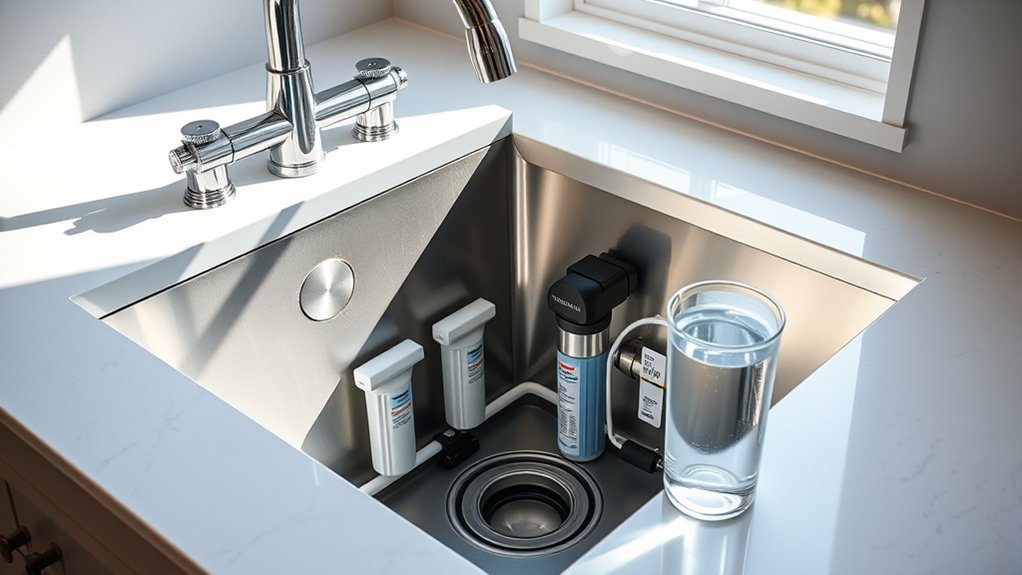
Contaminant Removal Efficiency
Start with a laboratory water test. Different contaminants require different technologies. A filter that reduces chlorine taste may not reduce nitrates, arsenic or microorganisms.
Compare the exact model’s performance data sheet with your test results. Pay attention to the specific contaminant, certified reduction claim and required operating conditions.
Filtration Technology Types
Sediment filters capture particles such as sand, rust and dirt. They can help protect downstream filters from early clogging.
Activated carbon improves taste and odor and can reduce certain chemicals, depending on the cartridge.
Ultrafiltration uses a fine membrane to capture particles and certain microorganisms. It does not significantly remove dissolved salts.
Reverse osmosis uses a much finer membrane to reduce many dissolved contaminants. Its performance depends on feed pressure, temperature and incoming water quality.
Where bacterial contamination is present, use a treatment approach designed and validated for the specific microbial risk. Do not assume that any filter alone guarantees microbiologically safe water.
Installation Complexity
Direct-connect carbon filters generally need less plumbing than reverse osmosis systems. A dedicated faucet may require a suitable existing hole or countertop drilling.
RO systems also require a drain connection. Tankless models may need electrical power. Check cabinet dimensions, feed-water pressure and the manufacturer’s installation instructions before purchasing.
Maintenance Requirements
Replace filters according to the manufacturer’s schedule. Sediment-heavy well water can shorten cartridge life, so inspect flow and water quality regularly.
Check fittings for leaks after installation and every cartridge change. If your system includes a UV stage, follow its lamp and sleeve maintenance instructions.
Flow Rate Considerations
Flow rate determines how quickly filtered water reaches your faucet. Direct-connect systems may provide faster continuous flow than some dedicated drinking-water systems.
Do not confuse gallons per day with gallons per minute. RO membrane production ratings describe output over a full day under specified conditions.
Filter Lifespan
A cartridge’s advertised capacity assumes particular test conditions. Sediment, organic matter and other well-water contaminants may shorten its useful life.
Replace filters at the recommended interval even if the water still tastes normal. Taste alone cannot confirm contaminant reduction.
Certification Standards
NSF/ANSI 42 covers aesthetic effects such as chlorine taste and odor. NSF/ANSI 53 addresses specified health-related contaminant reductions, while NSF/ANSI 58 applies to reverse osmosis systems.
NSF/ANSI 372 concerns lead content in materials. It does not establish that a filter removes lead from water.
Always check the exact model and contaminant-specific certification. A claim that individual materials meet a standard is not necessarily equivalent to certification of the entire system for contaminant reduction.
Cost and Value
Compare the total cost of ownership rather than the initial purchase alone. Include replacement cartridges, installation, pretreatment, testing, wastewater and electricity where applicable.
A longer-rated cartridge is not automatically economical if your well water causes early clogging or requires additional treatment.
Mistakes to Avoid When Buying Under Sink Water Filters
- Skipping water testing: Identify the contaminants before selecting a treatment system.
- Ignoring feed-water restrictions: Do not install a municipal-only filter directly on untreated well water.
- Confusing particle size with chemical removal: Micron ratings do not establish nitrate or arsenic reduction.
- Assuming every NSF claim is equivalent: Check the precise standard and certified contaminants.
- Ignoring pretreatment: Address excessive sediment, iron and other conditions that could damage or clog the chosen system.
Frequently Asked Questions
How Often Should I Replace Filters in Under Sink Systems?
Follow the replacement schedule for your specific model. Many cartridges require replacement every 6–12 months, while some have longer rated service lives. Well water with heavy sediment can shorten these intervals. Replace filters sooner when the manufacturer recommends doing so because of reduced flow or other operating changes.
Can These Filters Remove Bacteria From Well Water?
Some filtration technologies can reduce certain microorganisms, but not every under-sink filter is designed or certified for microbial treatment. If a laboratory detects bacterial contamination, follow your health department’s guidance. Select treatment specifically validated for that problem and verify its effectiveness with follow-up testing.
Is Installation Difficult for Under Sink Water Filters?
Installation depends on the system. Direct-connect filters may need only basic plumbing work. Reverse osmosis systems can require a dedicated faucet, storage tank, drain connection and electrical supply. Follow the manufacturer’s instructions, confirm water-pressure requirements and use a qualified installer when plumbing modifications exceed your experience.
Are Any of These Systems Suitable for High Iron Levels?
Do not assume a standard under-sink filter can handle high iron levels. Iron can clog cartridges and damage downstream equipment. Have the water tested for iron and manganese, then choose suitable pretreatment. A dedicated iron-removal system may be necessary before an under-sink drinking-water filter.
Do These Filters Affect Water Pressure or Flow Rate?
Yes. Every filter creates some resistance to water flow. The effect depends on its design, incoming pressure and cartridge condition. Sediment buildup can reduce flow further. Check the manufacturer’s rated flow and pressure range, and address upstream sediment problems before relying on a high-capacity cartridge rating.
Should I Test My Well Water Before Buying a Filter?
Yes. Test the water before choosing treatment. EPA recommends annual testing for total coliform bacteria, nitrates, total dissolved solids and pH. Your local health department can advise whether you should also test for arsenic, iron, manganese, lead or other contaminants common in your area.
Is Reverse Osmosis Better Than Carbon Filtration for Well Water?
It depends on the contaminants. Reverse osmosis reduces many dissolved substances that ordinary carbon filters do not effectively remove. Carbon is useful for certain chemicals, taste and odor. Neither technology should be chosen without considering the water test, manufacturer certifications, microbial safety and possible pretreatment requirements.
Can I Use a Municipal-Water Filter on a Private Well?
Only when the manufacturer permits it and the feed water meets its requirements. Some Waterdrop models allow appropriately prefiltered well water, while others explicitly specify municipal water. Pretreatment for sediment does not automatically solve bacterial or chemical contamination. Check the exact model’s instructions before installing it.
Final Verdict
The right under sink water filter for well water depends on your laboratory results and the treatment already installed at your home. For broad dissolved-contaminant reduction, the iSpring RCC7AK-BN provides a certified six-stage reverse osmosis approach with remineralization. It may still require upstream treatment for sediment, iron or microbial contamination.
For an existing-faucet alternative, compare the 3M Aqua-Pure 3MFF100. For tankless reverse osmosis, consider the Waterdrop T3-M.

