

Last Updated on November 4, 2026 by Mason Reed
Want to watch the stars without leaving your campsite? The best tents for stargazing have a clear overhead skylight or a mesh inner that opens up the night sky. The LifeSky inflatable tent is an appealing skylight option, the Galaxy offers roomier views for glamping, and the Clostnature two-person models suit backpacking in clear weather. Below, compare six camping tents by viewing style, size, weather protection and portability.
Disclosure: As an Amazon Associate I earn from qualifying purchases. Some links on this page are affiliate links, at no extra cost to you.
Quick Answer: Which Stargazing Tent Should You Choose?
For looking through a skylight: choose LifeSky for an opening roof, or Galaxy for multiple clear roof panels. For backpacking: choose one of the Clostnature two-person mesh-inner tents, remembering that the fly blocks most of your sky view. For a quick family setup: consider AYAMAYA. None of these tents makes cloudy skies clear, and weather protection must come before a perfect view.
Key Takeaways
- Clear roof vs. mesh: transparent roof panels let you stay more enclosed; mesh provides an open view only when the fly is off.
- For hikes: compare actual packed weights and selected tent variants before buying.
- For a group: assess floor area with sleeping pads and equipment, not just advertised capacity.
- For safety: secure your shelter and close openings when rain or wind approaches.
Our Top Tent Picks for Stargazing
| Tent | Image | Best for | Setup | Capacity | Sky view | Amazon | Details |
|---|---|---|---|---|---|---|---|
| LifeSky Inflatable Camping Tent with Panoramic Skylight | Best for Dedicated Skylight Viewing | Inflatable air frame | 4-person listing | Removable top / panoramic skylight | Check Price on Amazon | Read Our Analysis | |
| Clostnature Lightweight 2 Person Backpacking Tent | Best for Tall Backpackers | Freestanding poles | 2 people | Mesh inner with fly removed | Check Price on Amazon | Read Our Analysis | |
| Galaxy Inflatable Tent – 13-Foot Waterproof Camping | Best Spacious Stargazing Tent | Inflatable air frame | 4 people (article listing) | Nine clear skylight panels | Check Price on Amazon | Read Our Analysis | |
| Clostnature Ultralight Waterproof Backpacking Tent |  |
Best Two-Door Backpacking Alternative | Freestanding poles | 2 people | Mesh inner with fly removed | Check Price on Amazon | Read Our Analysis |
| Clostnature Lightweight Waterproof Backpacking Tent | Best for Simple Mesh-Top Camping | Freestanding poles | 2 people (linked variation) | Mesh inner with fly removed | Check Price on Amazon | Read Our Analysis | |
| AYAMAYA 4-Person Waterproof Pop Up Camping Tent |  |
Best Quick-Setup Family Pick | Automatic pop-up | 4 people | Overhead skylight | Check Price on Amazon | Read Our Analysis |
Product details are based on linked seller/manufacturer information where available. Verify the selected Amazon variation, contents and current offer before purchasing. We have not claimed hands-on testing of these tents.
More Details on Our Top Picks
-
LifeSky Inflatable Camping Tent with Panoramic Skylight
The LifeSky is a strong starting point if you want to watch the sky from a roomy tent without relying only on side windows. Its detachable roof section provides a broad overhead opening. The seller describes a 5,000 mm waterproof rating, quick inflation, mesh ventilation and storage areas for photography gear. These are manufacturer or listing claims, not independent field-test results.
Why You’ll Like It: The overhead opening helps photographers frame the sky and gives car campers more viewing flexibility than a standard closed-roof shelter.
Before You Buy: At roughly 27 lb, it is poorly suited to backpacking. The removable top must be secured before rain or strong wind, and the air frame requires inflation and care.
- Setup: Inflatable; seller claims under 10 minutes
- Capacity: 4 people, depending on sleeping layout
- Weather protection: Seller lists 5,000 mm waterproof fabric
- Viewing: Detachable panoramic skylight
- Ventilation: Mesh windows
- Weight: 26.9 lb (listing)
- Best use: Car camping and photography
- Check before purchase: Pump, packed size and top-opening details
-
Clostnature Lightweight 2 Person Backpacking Tent
If you need a carryable tent and plan to watch the stars on dry nights, this Clostnature two-person model offers mesh interior panels and two D-shaped mesh doors. Its roughly 7 ft 3 in by 4 ft 11 in floor and 3 ft 10 in peak height make it more useful for sitting up than many low-profile shelters. The maker lists a total weight of about 5.9 lb; exact weight can depend on the package or variation.
Why You’ll Like It: The near-vertical wall design gives sleepers practical headroom, while the removable rainfly makes the mesh inner useful for viewing on clear nights.
Before You Buy: With the fly fitted for rain or privacy, your view of the sky will be mostly blocked. Verify packed weight if every ounce matters.
- Setup: Freestanding pole structure
- Capacity: 2 people
- Floor: About 7 ft 3 in × 4 ft 11 in
- Peak height: About 3 ft 10 in
- Viewing: Mesh interior beneath removable fly
- Total weight: About 5.8–5.9 lb, by listing
- Doors: Two D-shaped mesh doors
- Best use: Three-season backpacking and camping
-
Galaxy Inflatable Tent – 13-Foot Waterproof Camping
The Galaxy inflatable tent puts its stargazing appeal in the roof: the product listing describes nine transparent TPU skylight panels, rather than just a removable rainfly. The approximately 13-foot-diameter design gives more floor space for a relaxed glamping trip, along with large screened windows and four doors. A removable roof cover is also described for privacy and light management.
Why You’ll Like It: It is a practical choice for groups who prioritize an enclosed view of the sky, standing space and room for sleeping gear.
Before You Buy: This large inflatable shelter is intended for vehicle-based trips. Clear panels may show condensation or reflections, and the air system must be inspected before travel.
- Setup: Inflatable structure
- Size: About 13 ft / 4 m diameter
- Viewing: Nine transparent skylight panels
- Interior: About 133 sq ft, seller stated
- Doors: Four large doors
- Ventilation: Four screened windows
- Roof: Removable cover, seller described
- Best use: Glamping and group car camping
-
Clostnature Ultralight Waterproof Backpacking Tent
This Clostnature model is another conventional two-person backpacking tent with a mesh inner, two entry doors and vestibules. Its design is useful when you want to carry a complete sleeping shelter and remove the rainfly for clear-night sky viewing. The linked listing shows a two-person occupancy, not a single tent that sleeps one to six people.
Why You’ll Like It: The combination of two doors and gear vestibules makes nighttime entry and storage easier for two campers.
Before You Buy: Despite the “ultralight” product name, a listed weight around 5.3 lb is not the lightest option in the wider backpacking market. Reattach the fly if conditions change.
- Setup: Freestanding, two-pole design
- Capacity: 2 people on linked ASIN
- Weather season: Three season
- Viewing: Mesh inner; fly off for sky views
- Weight: About 5.3 lb, Amazon listing
- Entry: Two doors and vestibules
- Floor: About 86.6 × 59 in
- Best use: Three-season two-person trips
-
Clostnature Lightweight Waterproof Backpacking Tent
The linked Clostnature configuration is a two-person, three-season backpacking tent with a PU-coated rainfly and mesh interior. It offers the same basic clear-night viewing method as other mesh-inner tents: pitch the complete shelter, then take off the fly only when weather permits. The original article mixed specifications from several capacity variants; this review focuses on the two-person listing.
Why You’ll Like It: A straightforward freestanding design with sealed seams is useful for buyers who want a conventional camping tent instead of an inflatable shelter.
Before You Buy: Do not assume the four-pound figure applies to the selected two-person configuration. Size, season labels, and packaged weight vary across options.
- Setup: Freestanding pole structure
- Capacity: 2 people on linked variation
- Weather season: Three season on linked listing
- Fly coating: PU 5,000 mm, listing stated
- Viewing: Mesh interior with fly removed
- Weight: Confirm selected variation
- Doors: One or more, depending on variation
- Best use: Ordinary three-season camping
-
AYAMAYA 4-Person Waterproof Pop Up Camping Tent
The AYAMAYA pop-up tent is useful for couples or small groups who want an overhead sky window without assembling a conventional pole system. Its linked four-person listing specifies an overhead skylight, a removable rainfly and floor dimensions of roughly 9.8 by 7.2 feet. A pop-up structure makes pitching fast, although folding it back into its disc-shaped bag requires practice.
Why You’ll Like It: The skylight and fast setup suit occasional family car-camping trips, especially when getting camp ready quickly is important.
Before You Buy: The stated four-person capacity may be tight once sleeping pads and bags are added. Practice folding it at home and check how the rainfly changes the overhead view.
For more choices for camping with children, see our family tent buying guide.
- Setup: Automatic pop-up structure
- Capacity: 4 people, manufacturer stated
- Floor: About 9.8 × 7.2 ft
- Height: About 4.1 ft
- Viewing: Overhead skylight
- Rain protection: Removable fly; 3,000 mm listed coating
- Weight: About 10 lb
- Best use: Family and couple car camping
Skylight Tent vs. Mesh-Roof Tent: What Is Better?
A clear skylight tent may let you see stars through transparent roof panels while the roof remains closed. Check whether the skylight is actually overhead, and remember that condensation, dirt and nearby lights can affect visibility. A mesh-inner tent offers excellent airflow and a clearer view on calm, dry nights, but it does not provide reliable rain protection with the outer fly removed. If storms are possible, prioritize a secure, fully pitched weatherproof shelter over an uninterrupted view.
Factors to Consider When Choosing a Tent for Stargazing
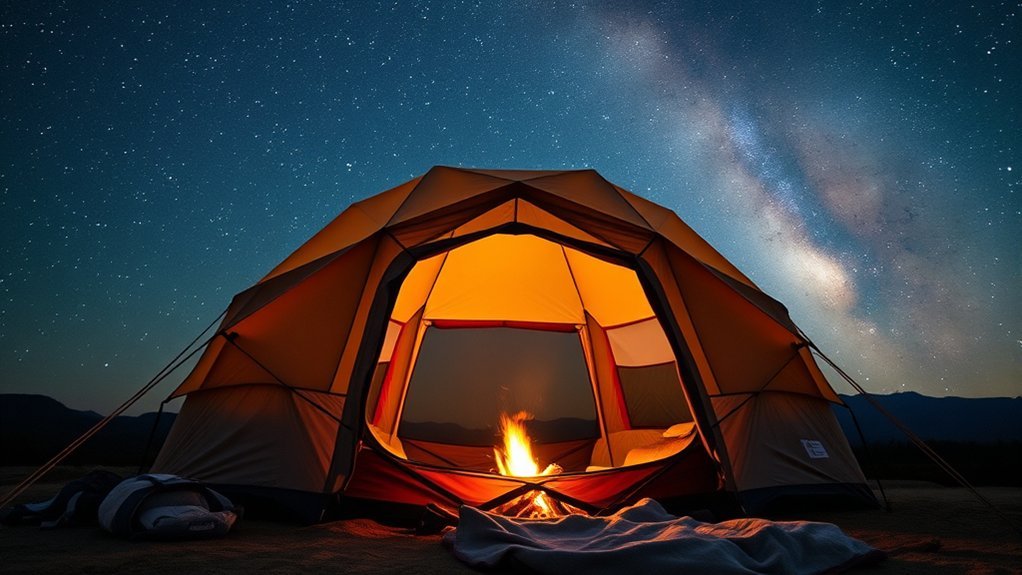
Choose the tent around how you camp first, then compare the sky-viewing feature. A backpacking tent needs manageable packed weight; a car-camping tent can trade weight for overhead windows and extra floor space.
Tent Design and Shape
For sky viewing, an overhead window or mesh roof matters more than a panoramic side window. Dome designs can be stable when pitched correctly, but wind resistance depends on poles, fabric, stakes and guy lines, not shape alone. Match the floor plan to your sleeping pads and gear.
Skylight or Window Features
Look upward from your intended sleeping position before buying. Fixed transparent panels and removable roof covers work differently. A mesh ceiling can give an unobstructed view in dry weather, but the outer rainfly usually hides the stars. Check whether the roof window is screened and whether you can close it quickly.
Weather Resistance Capabilities
Check the rainfly, seam treatment, floor construction, and anchoring points. Manufacturers may list hydrostatic-head ratings such as PU 3,000 mm or 5,000 mm; these describe material testing, not an unconditional promise of dryness in heavy wind or flooding. Always follow the shelter’s weather limits and check the forecast.
Setup Time and Ease
Pop-up tents may pitch quickly, but they can take practice to fold. Inflatable tents need a compatible pump and a check for leaks. Freestanding pole tents often allow simple repositioning, yet they must still be staked or secured. Practice at home before a night arrival.
Portability and Weight
For backpacking, compare total packed weight, packed dimensions and the exact variant. A five- to six-pound two-person tent can work for short trips but is not necessarily ultralight. For car camping, a heavier skylight or inflatable design may be worth the comfort.
Ventilation and Airflow
Your breath and damp gear can create condensation inside even a waterproof tent. Open vents when conditions allow, avoid blocking crossflow and keep the rainfly properly tensioned. Wipe clear skylight panels when needed, following the maker’s care instructions. See REI’s condensation guide.
Space and Comfort Level
Advertised sleeping capacity often assumes closely arranged pads. Check usable floor dimensions, not only a “four-person” label. Low tents are fine for lying down, while taller tents are better for sitting, dressing and sharing the space with photography equipment.
Material Durability and Quality
Inspect the listed fabric type, seam quality, zippers, clear-panel material and repair options. Look for replaceable components on inflatable shelters. A robust floor and protected stitching matter more than unverified “all-weather” marketing terms. Confirm any warranty with the manufacturer before ordering.
Before You Buy: Stargazing Camping Checklist
- Check whether the opening is overhead, not just a side window.
- Confirm the exact sleeping capacity, packed weight, floor dimensions and included rainfly or pump.
- Plan a clear night near a new moon, away from bright lights; see the National Park Service stargazing guide.
- Check wind, rain and lightning forecasts. Choose a legal campsite, avoid exposed ridges and dead branches, and stake and guy out the tent.
- Take a red-light headlamp to protect night vision; see DarkSky camping tips.
Frequently Asked Questions
What Type of Tent Is Best for Stargazing in Cold Weather?
Choose a shelter rated for the actual expected cold, wind and snow conditions, with appropriate poles, ventilation and a full rainfly. A “four-season” marketing label by itself is not enough. Plan adequate sleeping-bag and sleeping-pad insulation; a tent does not provide meaningful heating on its own.
How Do I Ensure My Tent Is Stable During Windy Nights?
Use appropriate stakes for the ground, tension every required guy line, and face the tent as the manufacturer instructs. Avoid exposed ridges and sites beneath damaged limbs. If severe weather is forecast, postpone your trip instead of relying on a clear skylight or pop-up frame.
Can I Use a Regular Tent for Stargazing?
Yes. A regular tent with a mesh ceiling can be good for observing the stars when you remove the rainfly in dry, calm conditions. A solid roof blocks overhead views, so you may prefer to sit outside and return to the tent to sleep.
What Accessories Enhance Stargazing While Camping?
Bring a red-light headlamp, warm layers, a comfortable sleeping pad or chair, a star chart app, and binoculars if you have them. Keep white lights and screens dim so your eyes adjust to the dark.
How Do I Clean and Maintain a Stargazing Tent?
Brush off dry dirt, spot-clean fabric following the manufacturer’s directions, and dry every panel fully before storage. Keep clear roof windows free from abrasive grit, inspect seams and zippers, and check inflatable components for damage if applicable.
Conclusion
The right stargazing tent depends on whether you want an enclosed overhead window or a simple mesh-roof view in good weather. LifeSky and Galaxy focus on dedicated skylights, while the Clostnature models are more useful for campers who also need a traditional packable sleeping shelter. AYAMAYA is worth comparing if fast family setup matters most. Check the exact variation and the forecast, then choose a safe campsite with dark, open skies.
