
Last Updated on July 24, 2026 by Daniel Globe
Florence rewards photographers at almost every turn, but the strongest images come from knowing where to stand and when to arrive. The city’s best photo spots range from the marble façade of the Duomo and reflections around Ponte Vecchio to hilltop panoramas, Renaissance gardens, busy food markets, and museum interiors. A little planning also helps you avoid the heaviest crowds and stay within current photography rules.
Quick Answer
The best photo spots in Florence include Piazza del Duomo for architecture, Ponte Santa Trinita for views of Ponte Vecchio, Piazzale Michelangelo and San Miniato al Monte for the skyline, Boboli and Bardini gardens for landscaped foregrounds, and Piazza della Signoria for sculpture and street scenes. Early morning and golden hour usually produce the most flattering light.
Key Takeaways
- Photograph the Duomo early for cleaner architectural compositions and softer light.
- Use Ponte Santa Trinita for the classic full view of Ponte Vecchio across the Arno.
- Piazzale Michelangelo is the classic skyline viewpoint, while San Miniato al Monte and Bardini Garden offer strong alternatives.
- Museum photography rules matter: flash and support equipment are restricted at major Florence museums.
- Spring adds roses, wisteria, and other seasonal foregrounds to several garden locations.
Disclosure: As an Amazon Associate I earn from qualifying purchases. Some links on this page are affiliate links, at no extra cost to you.
Best Florence Photo Spots at a Glance
| Location | Best Light | Best For | Planning Note |
|---|---|---|---|
| Piazza del Duomo | Early morning | Cathedral details and architecture | Dome climb requires a timed ticket and 463 steps |
| Ponte Vecchio | Golden hour and dusk | River reflections and bridge views | Photograph the bridge from Ponte Santa Trinita |
| Piazzale Michelangelo | Sunrise, sunset, blue hour | Classic Florence skyline | Sunset is beautiful but commonly busy |
| Boboli Gardens | Morning or late afternoon | Gardens, sculpture and skyline | Expect slopes, steps and uneven ground |
| Piazza della Signoria | Early morning or evening | Street scenes, statues and Palazzo Vecchio | Work with both wide architectural shots and sculpture details |
| San Miniato al Monte | Late afternoon and sunset | Elevated skyline | Continue uphill from Piazzale Michelangelo |
| Bardini Garden | Late afternoon | Garden-framed skyline | Spring wisteria adds a seasonal foreground |
Photography Rules Before You Go
Florence’s outdoor squares and viewpoints are straightforward for casual travel photography, but museums have specific rules. Check the venue before arriving with a tripod, selfie stick, lighting equipment, or professional camera setup.
Warning: The Uffizi Galleries allow personal or study photography but prohibit flash, stands and tripods. The Galleria dell’Accademia prohibits flash photography, selfie sticks, tripods and bulky support equipment. Boboli Gardens also prohibit drones and similar devices. Professional or publication photography can require separate authorization.
Inside churches and religious spaces, keep equipment unobtrusive, respect services and restricted areas, and follow staff instructions. When photographing vendors or individuals at close range, asking first is both courteous and more likely to produce a relaxed portrait.
Piazza Del Duomo
When you step into Piazza del Duomo, Florence’s most recognizable architectural ensemble surrounds you. The Cathedral of Santa Maria del Fiore, Brunelleschi’s Dome, Giotto’s Bell Tower, and the Baptistery provide enough details and perspectives for an entire photography session.
Early morning is particularly useful because softer light helps reveal the white, green, and pink marble patterns before the square reaches its busiest part of the day. Instead of photographing only the full cathedral façade, look for repeating arches, door details, marble geometry, and the contrast between the dome and the surrounding streets.
Giotto’s Bell Tower gives you another strong architectural subject, while narrow streets around the square can be used to frame the dome between buildings.
The official Brunelleschi’s Dome route involves 463 steps and has no elevator, so treat the climb as part of the photography plan rather than a quick viewpoint stop.
The Opera di Santa Maria del Fiore confirms that the stairway between the dome’s two shells leads to the lantern. A timed reservation is required for the dome climb, and visitors should review the current access rules before arriving.
Pro Tip: If your main goal is to photograph Brunelleschi’s Dome rather than photograph from it, Giotto’s Bell Tower can put the dome itself into your skyline composition.
Ponte Vecchio
After photographing the Duomo district, walk toward Ponte Vecchio, one of Florence’s defining river landmarks. The bridge seen today largely dates from 1345, while goldsmiths replaced earlier food-related trades on the bridge in 1593, according to the city’s official tourism guide.
The bridge itself is lively and visually dense, with jewelry shops, pedestrians, openings toward the river, and the Vasari Corridor running above part of the structure. Early morning works well for details and street scenes before pedestrian traffic builds.
For the classic photograph of the whole bridge, however, step away from Ponte Vecchio. Ponte Santa Trinita, the next bridge downstream, gives you a much cleaner view of the shop-lined structure and the Arno.
Golden hour and dusk are especially effective from this angle. Warm light can pick up the façades along the river, while calm water can add reflections. Stay for blue hour and you can photograph the transition from sunset color to the illuminated riverside.
Pro Tip: Do not spend your entire sunset standing on Ponte Vecchio itself. For the recognizable bridge photograph, position yourself on Ponte Santa Trinita and use the river as part of the composition.
Piazzale Michelangelo
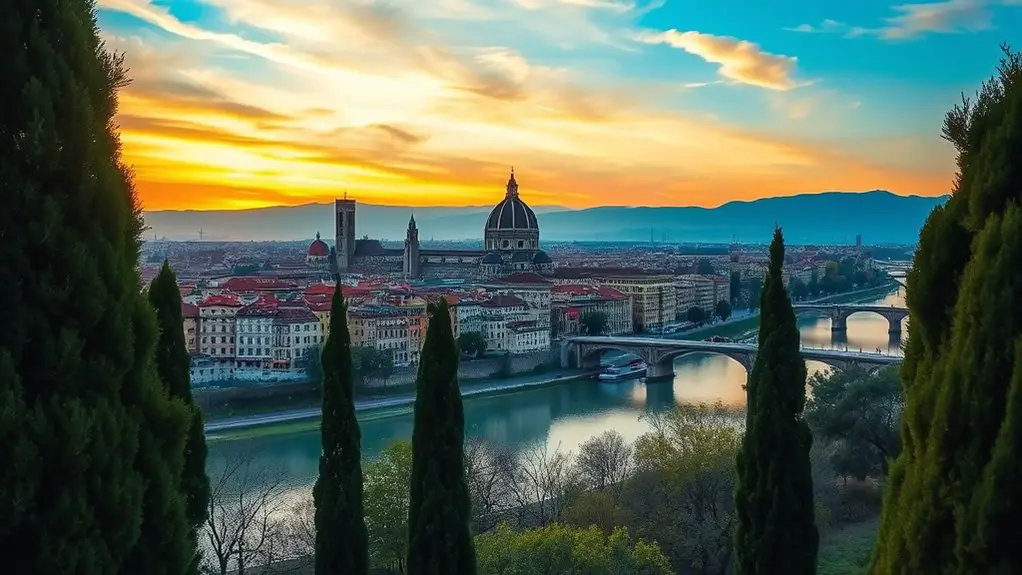
For the classic panoramic view of Florence, Piazzale Michelangelo remains one of the most useful locations in the city. The City of Florence tourism office highlights views toward the Duomo, Palazzo Vecchio, Santa Croce, the Arno, Ponte Vecchio, and the hills beyond the city.
Sunrise gives photographers the best chance of a calmer terrace and gentle light. Sunset produces richer atmosphere but also attracts far more people, so arrive before the light peaks rather than walking up at the exact moment the sun begins to drop.
A wide lens can capture the complete skyline, but a moderate telephoto lens is equally useful here. Zooming in lets you isolate Brunelleschi’s Dome, compress layers of terracotta rooftops, or place Palazzo Vecchio’s tower against the surrounding city.
Stay a little after sunset for blue-hour photographs. As street and building lights appear, the balance between the illuminated city and the remaining color in the sky can be more interesting than the sunset itself.
Boboli Gardens
Nestled behind Pitti Palace, Boboli Gardens combine landscaped paths, sculpture, fountains, architecture, and elevated views. The Uffizi Galleries, which manage the gardens, describe Boboli as part of the historic Pitti Palace complex and an important example of court garden design.
For photography, Boboli works best when you use the landscaping as more than a backdrop. Paths, hedges, statues, stairways, and cypress lines can create strong leading lines, while openings in the vegetation provide glimpses of Florence beyond the garden.
Seasonal greenery and flowers add color, particularly during spring and early summer. The Amphitheatre, Kaffeehaus area, fountains, and Buontalenti Grotto provide very different subjects within the same visit.
The elevated areas in Boboli Gardens offer a different perspective on Florence, allowing you to combine formal garden elements with parts of the city skyline.
Plan for walking. Boboli includes slopes, steps, worn surfaces, and uneven terrain. The official rules also prohibit drones and warn visitors to take extra care on damp or slippery surfaces.
Basilica Di Santa Croce
The Basilica di Santa Croce combines a striking marble façade with one of Florence’s most important collections of religious art and historical memorials. Its monumental tombs and memorials commemorate figures including Michelangelo, Galileo, Machiavelli, Rossini, and others.
The Opera di Santa Croce also highlights major works connected with Giotto, Brunelleschi, and Donatello, making the complex much richer photographically than its exterior alone suggests.
Outside, step back into Piazza di Santa Croce and experiment with the relationship between the basilica and the open square. Early light can make façade details easier to capture, while the large piazza gives you room for wider architectural compositions.
Inside, concentrate on architectural lines, fresco cycles, tomb details, and the quieter cloister spaces where permitted. Because this remains a religious complex, always follow current visitor and photography instructions.
Galleria Dell’Accademia Di Firenze
The Galleria dell’Accademia di Firenze is best known for Michelangelo’s David, created between 1501 and 1504. The sculpture’s position beneath the Tribuna makes it one of Florence’s most recognizable indoor compositions.
The museum also contains paintings, sculpture, plaster models, and musical instruments, so photographers should resist treating the visit as a one-subject stop.
For David, experiment with more than a straight-on full-length frame. Hands, facial expression, marble texture, and the surrounding architecture can produce more distinctive images while respecting barriers and visitor flow.
The museum’s current rules prohibit flash, selfie sticks, tripods, and bulky support equipment. An advance reservation is strongly recommended by the museum during busy periods, but all visitors still need to follow entrance and security procedures.
Uffizi Gallery
At the Uffizi Gallery, photography can shift from cityscape work to paintings, sculpture, architectural corridors, windows, and carefully framed views toward central Florence. The collection includes major works associated with Botticelli, Leonardo da Vinci, Michelangelo, Raphael, and many other artists.
Personal and study photography is generally permitted in accordance with the Uffizi visitor rules, but flash, stands, and tripods are prohibited. Works on loan for temporary exhibitions may be subject to additional restrictions.
Masterpieces of Renaissance Art
The Uffizi’s Renaissance collection gives you opportunities to photograph both complete works and smaller details, provided the current rules allow photography in that area. Botticelli’s paintings are among the best-known attractions, but the gallery’s value for a photographer also comes from the relationship between artwork and setting.
Look beyond the individual paintings. Long corridors, decorated ceilings, doorways, sculpture, and window light can add architectural context to your visit.
When galleries are busy, avoid holding up visitor flow for a perfectly centered composition. A clean detail or an angled frame can often work better than waiting for a completely empty room.
Advance Tickets and Timed Entry
Buying an advance ticket can make a busy museum day easier to plan, but it is better described as a reservation than a guarantee that every queue disappears.
As of July 2026, the official Uffizi price list shows a regular full-price ticket at €25 when purchased on the day of entry and €29 when purchased before the visit date. The museum also lists a €16 promotional price for entry from 4 p.m. during 2026.
Prices, promotions, free-admission days, and operating procedures can change, so use the museum’s official ticket page when setting your itinerary rather than relying on an older travel article.
Unique Photography Opportunities
The Uffizi is useful for much more than reproductions of famous paintings. Give yourself time to look for:
- Close details in Renaissance paintings and sculpture.
- Ceilings and long gallery perspectives that emphasize symmetry.
- Windows that connect the museum interior with Florence outside.
- The second-floor cafeteria terrace, which the Uffizi describes as having a panoramic view.
- Changing exhibitions that may create new visual opportunities, subject to photography restrictions.
Keep your equipment compact and work within the museum’s rules. That makes it easier to respond to the architecture and artwork without disturbing other visitors.
Mercato Centrale
Mercato Centrale offers one of the strongest changes of pace in this guide. Instead of monuments and panoramic skylines, you can work with food, people, signs, iron-and-glass architecture, color, and everyday activity.
The historic San Lorenzo market building contains two distinct levels. According to Florence’s official tourism information, the ground floor contains fruit, vegetable, meat, fish, bread, and other food sellers, while the first-floor food hall has restaurants and specialty food businesses.
Note: The two levels do not necessarily keep the same hours. Current city information lists the traditional ground-floor market during daytime hours and the first-floor food hall into the evening. Check current hours before planning an early or late photography session.
Vibrant Food Photography Opportunities
The traditional stalls are the strongest area for ingredient-focused photography. Look for repeating displays of fruit and vegetables, cured meats, cheeses, bread, spices, and other Tuscan products.
Morning is a useful time to photograph the ground floor because the traditional market is operating and natural market activity provides context. Rather than trying to eliminate every shopper from the frame, use hands, exchanges between customers and vendors, and layers of produce to tell the story of the place.
- Fresh fruits and vegetables for strong blocks of color.
- Artisanal cheeses, bread, and cured meats for texture.
- Vendor-customer interactions for candid storytelling.
- The 19th-century iron-and-glass structure for wider architectural frames.
Authentic Italian Culinary Delights
Mercato Centrale is also a practical place to connect food photography with the food itself. Instead of photographing dishes only from directly overhead, look for side light, hands preparing food, counters, menus, and the environment around each plate.
Traditional Tuscan ingredients downstairs and the larger prepared-food selection upstairs give you two different visual styles within the same building.
Ask before taking close portraits of vendors or photographing behind a counter. A brief conversation often leads to a better image than quickly pointing a camera at someone who is working.
Local Market Atmosphere Experience
The strongest market photographs often combine people and place. Wide frames can show the height and structure of the building, while tighter compositions can focus on hands exchanging produce, stacks of ingredients, signs, plates, or worn working surfaces.
Be patient rather than trying to stage every frame. Markets change from minute to minute, and the best photograph may come from waiting for a natural interaction to enter an already-planned composition.
Grand Hotel Minerva
Grand Hotel Minerva combines a central Florence location with design history and a rooftop panorama. The property stands on Piazza Santa Maria Novella and has a rooftop pool and cocktail-bar area overlooking the city.
| Feature | Description | Best For |
|---|---|---|
| Rooftop Pool | Seasonal heated pool with panoramic Florence views | Skyline and sunset photography |
| Historic Setting | Hospitality on the property dates to 1848, with much older architectural roots | Historic interiors and design details |
| Carlo Scarpa Design | Major modernist renovation with Edoardo Detti in the late 1950s | Architecture and interior design photography |
| Central Location | On Piazza Santa Maria Novella | Combining rooftop views with central sightseeing |
The hotel’s official rooftop information says the heated pool operates seasonally and is reserved for hotel guests during swimming hours, while non-hotel guests can access the rooftop cocktail-bar offering during its public evening hours.
This means it should be treated as a hospitality venue rather than a free public viewpoint. Check current access conditions before building it into a sunset shoot.
Giardino Delle Rose
Giardino delle Rose sits below Piazzale Michelangelo and combines plants, sculpture, open lawn, and elevated views toward Florence. It is particularly useful when you want a skyline image with a softer natural foreground.
The city’s official Rose Garden listing describes the garden as a terrace overlooking the historic center and also highlights works by Belgian artist Jean-Michel Folon and a Japanese garden donated by Florence’s sister city Kyoto.
Stunning Floral Displays
The garden contains more than 350 types of roses, with spring providing the strongest opportunity to combine blooms and the Florence skyline in a single frame.
- Use flowers close to the lens as foreground elements rather than photographing only individual blooms.
- Follow curved paths to create depth through the garden.
- Include Folon’s sculptures for a contrast between art and vegetation.
- Use longer focal lengths to bring the city closer behind the roses.
Seasonal opening hours vary, so check the current municipal listing rather than assuming the garden stays open until the same time throughout the year.
Breathtaking City Views
The elevated position gives you clear views toward landmarks including Santa Maria del Fiore and Palazzo Vecchio. Compared with the broad paved terrace at Piazzale Michelangelo, Giardino delle Rose gives you more choices for foreground interest.
Late-day light can work well when the garden is open late enough, but do not assume sunset will always fall within opening hours. In seasons with earlier closing times, plan for afternoon light instead.
Peaceful Nature Escape
The garden also gives photographers a welcome visual break from Florence’s dense stone streets. Grass, foliage, roses, sculpture, and hillside paths allow quieter compositions while keeping the city nearby.
It pairs naturally with Piazzale Michelangelo and San Miniato al Monte, making the hillside one of the easiest parts of Florence in which to photograph several different scenes without crossing the city repeatedly.
Piazza della Signoria
Piazza della Signoria deserves a place on any Florence photography route because it combines monumental architecture, sculpture, street life, and access to the Uffizi area in one compact space.
The official city guide describes the square as Florence’s historic political center. Palazzo Vecchio dominates one side, while the Loggia dei Lanzi functions almost like an open-air sculpture gallery.
Early morning helps isolate the architecture. Later in the day, embrace movement instead: street performers, tour groups, café activity, and pedestrians can give the square a sense of scale and energy.
Photograph the Fountain of Neptune, Palazzo Vecchio’s tower, the sculptures beneath the Loggia dei Lanzi, and the replica of Michelangelo’s David as separate details before stepping back for wider compositions.
San Miniato al Monte
A short distance uphill from Piazzale Michelangelo, San Miniato al Monte offers another elevated Florence panorama with a very different atmosphere. The City of Florence tourism guide describes the basilica as occupying one of the city’s highest and most scenic positions.
The churchyard gives you a broad view over Florence while the basilica’s white-and-green marble façade adds another major architectural subject behind you.
This is a useful choice when you have already photographed the standard Piazzale Michelangelo composition and want a higher viewpoint. A medium telephoto lens works especially well for isolating the Duomo and layers of rooftops.
Remember that San Miniato is an active religious site. Photograph quietly around services and follow posted restrictions inside the basilica.
Bardini Garden
Bardini Garden is one of the most useful additions for photographers who want both a garden and a panoramic Florence view. Its central Baroque staircase leads toward the Belvedere, where the skyline opens beyond the hillside.
The official Florence listing highlights the Belvedere panorama as well as the garden’s mixture of formal, woodland, and agricultural sections.
Spring is particularly attractive because Bardini’s famous wisteria pergola can create a vivid foreground. Flowering dates vary with the season, however, so do not plan a trip around a precise bloom date without checking current conditions.
The garden also has uneven earth and gravel surfaces with significant changes in level. Allow enough time to move between viewpoints rather than treating it as a quick rooftop-style stop.
Pro Tip: If the paved terrace at Piazzale Michelangelo feels too visually open, use Bardini’s plants, walls, stairways, and trees as foreground layers around the same recognizable Florence skyline.
How to Photograph Florence With Fewer Crowds
You will rarely have central Florence completely to yourself, but you can make crowd levels much easier to manage.
- Start with outdoor landmarks early. Piazza del Duomo, Ponte Vecchio, and Piazza della Signoria are easier to compose before the main daytime flow builds.
- Reserve major museums in advance. A timed reservation gives your day more structure even though security procedures still apply.
- Use alternative viewpoints. Combine Piazzale Michelangelo with San Miniato al Monte, Giardino delle Rose, or Bardini Garden rather than relying on one terrace.
- Stay through blue hour. Some sunset crowds begin leaving as soon as the sun disappears, just as city lights start becoming photographically useful.
- Use people deliberately. A pedestrian or cyclist can provide scale and movement. A photograph does not need to be empty to feel carefully composed.
Frequently Asked Questions
Where Can I Get the Best Views in Florence?
Piazzale Michelangelo gives you the classic Florence panorama with the Duomo, Palazzo Vecchio, the Arno, and Ponte Vecchio. For alternative elevated views, continue uphill to San Miniato al Monte or visit Boboli and Bardini gardens. The Brunelleschi Dome climb also provides a high central viewpoint, although it requires 463 stairs.
What Is the Most Scenic Place in Florence?
For a first visit, Piazzale Michelangelo is the strongest all-around choice because it puts much of Florence’s historic skyline into one view. San Miniato al Monte is a worthwhile alternative if you want a higher perspective, while Bardini Garden is particularly attractive when you want plants or flowers in the foreground.
What Is the Most Instagrammable Place in Italy?
There is no objective single most Instagrammable place in Italy. The Amalfi Coast is famous for colorful coastal scenery, while Florence offers Renaissance architecture, rooftops, river reflections, sculpture, and historic streets. In Florence itself, Ponte Vecchio, the Duomo, Piazzale Michelangelo, and Bardini Garden are among the most recognizable photo locations.
Where to Take Pictures in Florence?
Start with Piazza del Duomo, photograph Ponte Vecchio from Ponte Santa Trinita, visit Piazza della Signoria for sculpture and architecture, then climb toward Piazzale Michelangelo and San Miniato al Monte for panoramic views. Boboli, Bardini, and Giardino delle Rose add gardens and seasonal color.
Can You Take Photos Inside the Uffizi and Accademia?
Personal photography is generally possible, but equipment restrictions apply. The Uffizi prohibits flash, stands, and tripods, while the Accademia’s current rules prohibit flash, selfie sticks, tripods, and bulky support equipment. Temporary exhibitions or professional uses can have additional restrictions, so always follow current museum notices.
What Is the Best Time of Day for Florence Photography?
Early morning is usually best for quieter streets and architectural photography. Golden hour works well for the Arno and elevated viewpoints, while blue hour is excellent for illuminated skylines and bridges. Museum photography depends more on your reserved admission time and indoor crowd levels than on outdoor light.
Conclusion
Florence gives you far more than one postcard composition. The Duomo rewards early architectural work, Ponte Vecchio comes alive from across the Arno, and Piazzale Michelangelo provides the classic skyline. Gardens such as Boboli, Bardini, and Giardino delle Rose add natural foregrounds, while Piazza della Signoria, Santa Croce, the Uffizi, the Accademia, and Mercato Centrale bring art, street life, and detail into the mix.
The best approach is to match each location to the right light instead of racing through a checklist. Start early for central streets, use golden hour for river and hilltop views, stay through blue hour when possible, and check museum or garden rules before carrying specialized equipment. That preparation will give you a more varied and memorable collection of Florence photographs.
Sources
- Opera di Santa Maria del Fiore — Brunelleschi’s Dome — dome history, stair count, and access information.
- FeelFlorence — Panoramic Views of Florence — official City of Florence information on major viewpoints.
- Uffizi Galleries — Rules and Regulations — photography and visitor restrictions.
- Galleria dell’Accademia di Firenze — Visit — current visitor, reservation, and museum information.
- Opera di Santa Croce — Discover Santa Croce — artworks, monuments, tombs, and complex history.
- FeelFlorence — San Lorenzo Market / Mercato Centrale — official market layout and operating information.
