

Last Updated on September 10, 2026 by Daniel Globe
Choosing between a hard-shell suitcase and a soft duffel bag comes down to what you pack, how you move between places, and whether the bag will be carried on or checked. A rigid case gives structure and impact protection, while a duffel offers flexible packing, quick access, and easier storage between trips.
Quick Answer
Choose a hard-shell suitcase when impact protection, easy cleaning, and wheeled airport travel matter most. Choose a soft duffel when low weight, flexible packing, exterior access, and compact storage matter more. Neither style is automatically best: the right choice depends on airline limits, how you travel, and what you pack.
Key Takeaways
- Hard-shell suitcases are usually better for crush-sensitive contents, checked baggage, and smooth wheeled movement through airports.
- Soft duffels are usually better for clothing, irregular gear, short trips, road travel, and storage in small spaces.
- Weight, water resistance, durability, and carry-on eligibility depend on the exact model—not only the bag category.
- Measure the full outside dimensions, including handles, pockets, and wheels, and confirm the operating airline’s current rules before flying.
Affiliate disclosure: This article contains Amazon affiliate links. We may earn a commission from qualifying purchases at no extra cost to you.
Hard Shell vs Soft Duffel: What Is the Difference?
A hard-shell bag is normally a structured suitcase made from polycarbonate, polypropylene, ABS plastic, aluminum, or a proprietary composite. A soft duffel is a flexible fabric bag, usually made from polyester or nylon, with carry handles and often a shoulder strap. Some duffels also add wheels and a telescoping handle, creating a useful middle ground.
Samsonite’s luggage guide treats hardside luggage, softside luggage, and wheeled duffels as separate categories. That distinction matters because this is not only a shell-material comparison; it is also a comparison between a structured suitcase and a flexible carrying style.
Hard Shell vs Soft Duffel: Quick Comparison
| Factor | Hard-Shell Suitcase | Soft Duffel Bag |
|---|---|---|
| Best for | Checked flights, fragile items, airport rolling | Weekend trips, clothing, gear, road and train travel |
| Impact protection | Better resistance to crushing and pressure | Flexible shell absorbs some bumps but can be compressed |
| Packing flexibility | Fixed shape and organized split-case packing | Adapts to bulky or irregular items |
| Mobility | Usually easier on smooth floors because of spinner wheels | Easy to lift and fit into cars, but tiring when heavily loaded |
| Quick access | Often limited exterior storage | Often includes exterior pockets and a wide opening |
| Home storage | Keeps its full shape | May fold or compress when empty |
| Main trade-off | Rigid, less adaptable, and prone to visible scuffs | Less crush protection and more exposure to stains or punctures |
Our Top Soft Duffel Bag Picks
These four picks are all soft duffels, so use them to compare duffel features rather than as a hard-shell-versus-soft-shell test. Product names, availability, and specifications can change. Match the model number and dimensions on the live listing before buying.
| Samsonite Ascella 3.0 Duffel Bag | Best Organized Option | Weight: Retailer listings vary | Color: Black | Material: Polyester | VIEW LATEST PRICE | Read Our Analysis | |
| Samsonite Pro Softside Duffel Bag Black One Size | Best for Tech Organization | Weight: 2.69 lbs | Color: Black | Material: Ballistic nylon | VIEW LATEST PRICE | Read Our Analysis | |
| Samsonite UpLIFT 23" Lightweight Foldable Duffle Bag | Best Packable Option | Weight: 1.2 lbs | Color: Black | Material: Recycled polyester fabric | VIEW LATEST PRICE | Read Our Analysis | |
| Samsonite Ascentra Softside Luggage Duffel Bag Slate | Best for Toiletry Separation | Weight: About 2.69 lbs | Color: Slate | Material: Recyclex recycled PET fabric | VIEW LATEST PRICE | Read Our Analysis |
More Details on Our Top Picks
-
Samsonite Ascella 3.0 Duffel Bag
The Ascella 3.0 duffel is a non-rigid travel bag built around organization and easy stacking. The selected duffel listing describes two lined exterior pockets, a side pocket, interior organization, a StackIt Strap, a USB pass-through pocket, and an easy-wipe PU-coated bottom. The external battery is not included. The parent Amazon title mentions spinner luggage, but the duffel-specific details do not establish that this selected bag has wheels or expansion, so it should be treated as a standard carry duffel.
- Weight:Retailer listings vary for model 145065-1041
- Color:Black
- Material:Polyester
- Expandability:Not listed for the duffel variant
- Carrying Options:Carry handles and StackIt Strap
- Storage Pockets:Two lined exterior pockets, side pocket, and interior organization
- Additional Feature:USB pass-through pocket; battery not included
- Additional Feature:PU-coated easy-wipe bottom
- Additional Feature:Approximate dimensions of 19.5 x 12 x 9 inches
-
Samsonite Pro Softside Duffel Bag Black One Size
The Samsonite Pro Softside Duffel Bag is designed as a roomy shoulder duffel with business-travel organization. It weighs about 2.69 pounds and measures 21 x 16.5 x 13 inches. The side pocket is designed to hold a compatible wireless battery and phone, but the power bank is sold separately. A detachable cord pouch, smart sleeve, integrated shoe pocket, and large main compartment help separate tech, footwear, and clothing. The listing identifies the material as ballistic nylon and does not rate the bag as water-resistant.
- Weight:2.69 lbs
- Color:Black
- Material:Ballistic nylon
- Expandability:Not specified
- Carrying Options:Detachable shoulder strap, carry handles, and smart sleeve
- Storage Pockets:Large main compartment, shoe pocket, and cord pouch
- Additional Feature:Wireless charging pocket; power bank sold separately
- Additional Feature:21 x 16.5 x 13-inch body dimensions
- Additional Feature:Listing states it is not water-resistant
-
Samsonite UpLIFT 23" Lightweight Foldable Duffle Bag
If you need a light overflow bag, the Samsonite UpLIFT 23-inch duffel is the most packable option in this group. It weighs about 1.2 pounds, folds flat or into a small square, and uses body fabric made from 100% post-consumer recycled PET bottles. It includes co-molded zippers with lockable sliders, a front pocket, a zippered main opening, a removable shoulder strap, and a StackIt Strap. Its light structure is convenient for clothing and souvenirs but offers less crush protection than a rigid case.
- Weight:1.2 lbs
- Color:Black
- Material:Polyester body fabric made from 100% post-consumer recycled PET bottles
- Expandability:Not specified
- Carrying Options:Removable shoulder strap and StackIt Strap
- Storage Pockets:Small front pocket and main compartment
- Additional Feature:Upgraded co-molded zippers with lockable sliders
- Additional Feature:Folds flat or into a small square
- Additional Feature:Useful as a packed overflow bag
-
Samsonite Ascentra Softside Luggage Duffel Bag Slate
The Samsonite Ascentra duffel combines a flexible main compartment with a removable WetPak for travel-size toiletries or damp items. Its exterior and interior lining use fabric made from 100% post-consumer recycled PET bottles through Samsonite’s Recyclex Material Technology. Bail handles, a detachable shoulder strap, and a StackIt Strap provide several carrying options. Retailer listings commonly place the bag near 20 x 12 x 10.5 inches and about 2.69 pounds, but verify the live listing before relying on those measurements for a flight.
- Weight:About 2.69 lbs
- Color:Slate
- Material:Recyclex fabric made from 100% post-consumer recycled PET bottles
- Expandability:Not specified
- Carrying Options:Bail handles, detachable shoulder strap, and StackIt Strap
- Storage Pockets:Main compartment and removable WetPak
- Additional Feature:Separate storage for travel-size toiletries
- Additional Feature:Approximate dimensions of 20 x 12 x 10.5 inches
- Additional Feature:Flexible softside construction
Warning: A charging pocket does not make a power bank safe for checked baggage. Spare lithium batteries and power banks must stay in the aircraft cabin. If a carry-on is gate-checked, remove the power bank and keep it with you.
Factors to Consider When Choosing Hard Shell Vs Soft Duffel Bag
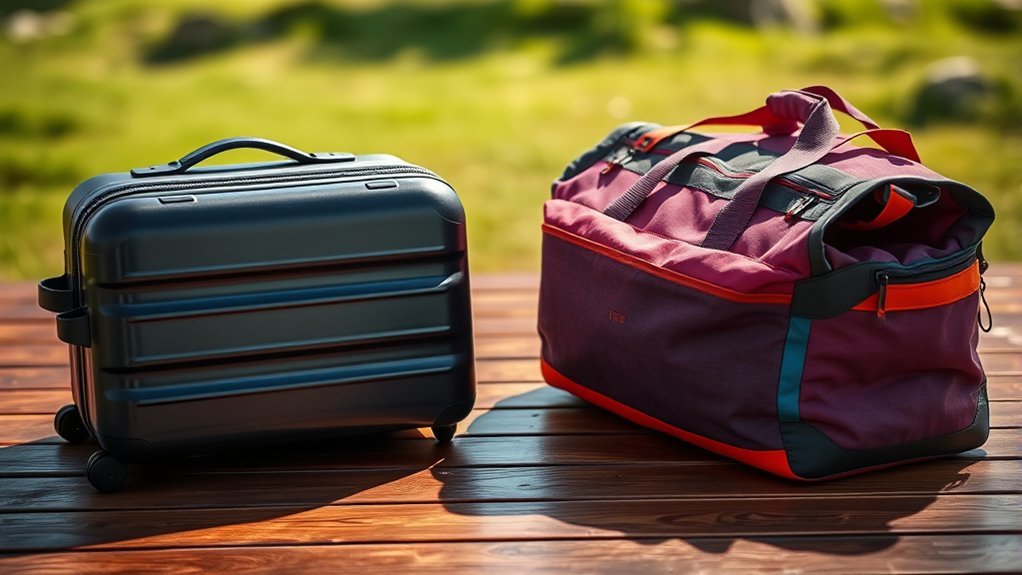
When choosing between a hard-shell suitcase and a soft duffel, compare the exact bags rather than relying on broad labels. Empty weight, dimensions, materials, zipper quality, handles, straps, wheels, and warranty coverage can matter more than the shell category alone.
Weight and Portability
Soft duffels are often light because they do not need a rigid frame, wheel housings, or a telescoping handle. The UpLIFT model above weighs only 1.2 pounds. However, a soft bag is not automatically lighter than every hard-shell suitcase. Lightweight polycarbonate or polypropylene cases can compete with heavier nylon duffels.
Also consider how the weight feels in motion. A 20-pound wheeled suitcase may be easier to move through an airport than a 15-pound shoulder duffel. If you expect long terminal walks, choose wheels or a reliable luggage sleeve. If you expect stairs, trains, car trunks, or frequent lifting, a duffel’s handles may be more practical.
Durability and Protection
A hard shell offers better resistance to crushing, which makes it a strong choice for fragile souvenirs, structured shoes, cameras packed in protective cases, or other items that should not be squeezed. Polycarbonate can flex under impact, polypropylene is known for low weight, and ABS is often budget-friendly. Aluminum is rigid and durable but usually heavier and more expensive.
A soft duffel handles a different kind of abuse. Fabric can flex when tossed or wedged into a vehicle, and it will not dent like a rigid shell. However, it can be cut, punctured, stained, or compressed by other bags. Reinforced seams, strong webbing, a durable bottom panel, and quality zippers are more useful indicators than a vague claim that one entire category is “more durable.”
Pro Tip: For fragile contents, use a rigid case plus internal padding. A hard shell reduces crushing, but it does not stop items from moving and striking one another inside the case.
Packing Capacity and Shape
Soft duffels are flexible, so they can accept boots, sports equipment, odd-shaped gifts, and extra layers more easily. Their large openings also make them simple to load. The downside is that flexible bags are easy to overfill, which can create an uncomfortable load or push the bag beyond an airline’s size or weight limit.
Hard-shell suitcases keep a predictable shape and often open into two packing halves. That layout is useful for separating outfits, shoes, and accessories. Expansion zippers can add room, but an expanded carry-on may no longer meet the airline’s permitted dimensions. Compare listed capacity in liters when available, then check the full external measurements.
Mobility and Convenience
Most hard-shell suitcases use two or four wheels. Four-wheel spinners move easily through smooth terminals and narrow aisles, while two-wheel designs can feel more stable on uneven ground. A standard soft duffel is easier to lift into a car, locker, or luggage rack but becomes tiring when carried far.
Look for padded handles, a shoulder strap that will not slip, reinforced attachment points, and a luggage sleeve or StackIt-style strap. Travelers who want duffel-style packing without carrying the full load should consider a wheeled duffel as a third option.
Water Resistance and Cleaning
Hard shells usually shed light rain and wipe clean more easily than fabric. That does not make them waterproof. Moisture can still enter around zippers, seams, locks, and openings. Soft bags vary widely: untreated fabric can absorb water, while coated polyester, treated nylon, sealed zippers, and waterproof duffels offer more protection.
Check the manufacturer’s wording. “Water-resistant” means the bag can resist some moisture under stated conditions; it does not promise submersion protection. For wet climates, use internal dry bags or waterproof packing pouches for electronics, documents, and clothing.
Security and Quick Access
Hard-shell cases often have integrated combination locks and few exterior pockets. That creates a clean exterior, but you may need to open the full case to reach a charger or document. Soft duffels often provide faster exterior access, although exposed pockets and fabric panels can be easier to cut or unzip.
A lock mainly deters casual opening; it cannot make either bag theft-proof. Keep passports, money, medication, electronics, spare batteries, and irreplaceable valuables in the cabin and under your control.
Carry-On Fit and Airline Rules
A bag marketed as a “carry-on” is not guaranteed to fit every airline or aircraft. The Transportation Security Administration directs travelers to their airlines because cabin-bag dimensions vary. The Federal Aviation Administration notes that 45 linear inches is a common maximum for many airlines, but smaller aircraft may have limited overhead space.
The bag’s label does not decide whether it is a carry-on; the full outside dimensions and the operating airline’s current rule do.
Measure the packed bag at its widest points, including wheels, handles, and bulging pockets. A soft duffel may compress into a sizer, but airline staff can still reject an overfilled bag. Check both dimensions and weight, especially for international flights.
Design and Aesthetics
Hard-shell luggage has a structured, polished look and comes in many colors and finishes. It is easy to identify on a baggage carousel, although glossy surfaces can show scratches. Soft duffels range from casual gym-bag designs to refined ballistic-nylon business bags. They often include more exterior pockets and can look less bulky when lightly packed.
Choose appearance after checking function. Dark fabrics can hide dirt, bright shells are easier to spot, and textured finishes can conceal scuffs better than smooth glossy surfaces.
Storage at Home
A hard-shell suitcase keeps its full shape in a closet. Some models can nest inside larger cases, but they still require dedicated storage. A soft duffel may flatten, fold, or fit inside another suitcase when empty. That makes duffels useful for small apartments, dorm rooms, cruises, and trips where you want to pack an extra bag for the return journey.
Price and Value
Soft duffels are available at many price levels, and simple non-wheeled designs can cost less because they use fewer mechanical parts. Premium nylon, waterproof materials, reinforced construction, and brand warranties can raise the price. Hard-shell luggage also ranges from basic ABS cases to expensive polycarbonate, composite, or aluminum models.
Judge value by cost per trip, not the lowest purchase price. Check the warranty, replacement-wheel availability, zipper quality, handle attachment, stitching, corner reinforcement, and whether the manufacturer offers repair support. A well-built bag that fits your travel pattern is a better value than a cheaper bag with features you do not use.
Which Bag Is Better for Your Trip?
- Checked air travel: Choose a hard-shell suitcase when crush protection and wheeled mobility are priorities. Use internal padding for anything fragile.
- Carry-on air travel: Either style works if the packed dimensions comply. A spinner is easier for long terminal walks; a compact duffel is easier to lift and may fit under a seat when sized as a personal item.
- Weekend or road trip: A soft duffel is usually easier to load into a trunk, carry into lodging, and store when empty.
- Train or bus travel: A duffel handles stairs and luggage racks well, while a two-wheel or four-wheel suitcase reduces carrying on long platforms.
- Sports or outdoor gear: Choose a reinforced duffel with a durable base, washable lining, and separate wet or shoe storage. For heavy loads, consider backpack straps or wheels.
- Business travel: Choose based on organization. A hard-shell carry-on protects structured clothing and gear; a refined soft duffel offers faster access to tech, shoes, and documents.
- Wet conditions: Do not rely on shell type alone. Look for a stated water-resistance level, coated fabric, protected zippers, and internal waterproof pouches.
How to Choose Between a Hard Shell and Soft Duffel
- Decide how the bag will travel. A checked bag needs different protection than a personal item carried into the cabin.
- List what you normally pack. Fragile or crush-sensitive items favor a rigid shell; clothing and irregular gear favor a flexible duffel.
- Map the journey. Long airport walks favor wheels. Stairs, car trunks, lockers, and tight luggage racks may favor a duffel.
- Measure before buying. Compare full external dimensions and empty weight with the airlines you use most. Samsonite also maintains an airline carry-on guide, but the airline’s own page should be your final check.
- Inspect the construction. Check zippers, seams, wheel housings, handles, strap anchors, lining, locks, bottom protection, warranty terms, and repair options.
Note: A hybrid or wheeled duffel may be the best answer when you want flexible packing plus rolling mobility. Do not force the decision into only two categories if your route includes both airports and rough ground.
Frequently Asked Questions
Are hard-shell bags more durable than soft duffel bags?
Hard-shell bags generally provide better crush and impact protection, but “more durable” is too broad. A hard case can scuff, dent, or crack, while a quality duffel can flex through rough handling but may puncture, stain, or fray. Material quality and construction matter more than the category alone.
Can hard-shell bags fit into overhead compartments easily?
They can fit when their full external dimensions meet the operating airline’s limit and space remains available. A rigid case cannot compress if it is slightly oversized, and smaller aircraft may have limited bins. Check the airline’s current dimensions and include wheels and handles in your measurement.
Do soft duffel bags provide better packing flexibility?
Usually, yes. Their flexible walls accept bulky and irregular items and may compress into tight spaces. The trade-off is less structure, less crush protection, and a greater chance of overpacking beyond a carry-on limit.
Which type has better water resistance?
A hard shell usually sheds light rain better than untreated fabric, but zippers and seams can still leak. A coated or waterproof duffel may outperform a basic hard case. Check the exact product’s water-resistance rating and protect sensitive items inside sealed pouches.
Are soft duffel bags always lighter than hard-shell suitcases?
No. Many simple duffels are lighter because they lack wheels and a rigid frame, but premium fabric, heavy padding, and hardware add weight. Some modern polycarbonate or polypropylene cases are lighter than large or heavily reinforced duffels. Compare the listed empty weights.
Is a hard-shell suitcase better for checked baggage?
It is often better for items that should not be crushed and for travelers who prefer wheels. A strong softside suitcase or reinforced wheeled duffel can also work well for clothing and durable gear. Whichever you choose, secure loose straps and avoid checking valuables or spare lithium batteries.
Can a duffel bag be used as a carry-on?
Yes, when the packed bag meets the airline’s size and weight rules. Measure bulging pockets and do not assume the bag can be squeezed into compliance. A smaller duffel may qualify as a personal item, but personal-item limits also vary by airline.
Which bag lasts longer?
There is no universal winner. A durable hard shell may protect contents for years but could fail at a wheel, handle, zipper, or cracked corner. A high-quality duffel may last just as long if its seams, webbing, zippers, and base are reinforced. Warranty and repair support are useful tie-breakers.
Conclusion
Choose a hard-shell suitcase when you want structure, impact protection, easy cleaning, and smooth rolling through airports. Choose a soft duffel bag when you value low weight, flexible packing, quick access, and compact storage. For many travelers, the best answer is not the toughest-looking bag but the one that fits the airline, the route, and the contents without forcing awkward carrying or overpacking.
Sources
- Samsonite Ultimate Luggage Guide — hardside, softside, material, packing, wheel, and durability trade-offs.
- Federal Aviation Administration: Carry-On Baggage Tips — common carry-on measurements and overhead-space guidance.
- Transportation Security Administration: Carry-On Size Restrictions — confirmation that airline cabin-bag dimensions vary.
- Federal Aviation Administration: Airline Passengers and Batteries — rules for power banks and spare lithium batteries.
- Samsonite Carry-On Guide — examples of differing airline size limits.
