
Last Updated on September 10, 2026 by Daniel Globe
Disclosure: As an Amazon Associate, we earn from qualifying purchases. If you click a link on this page and make a purchase, we may receive a small commission at no extra cost to you.
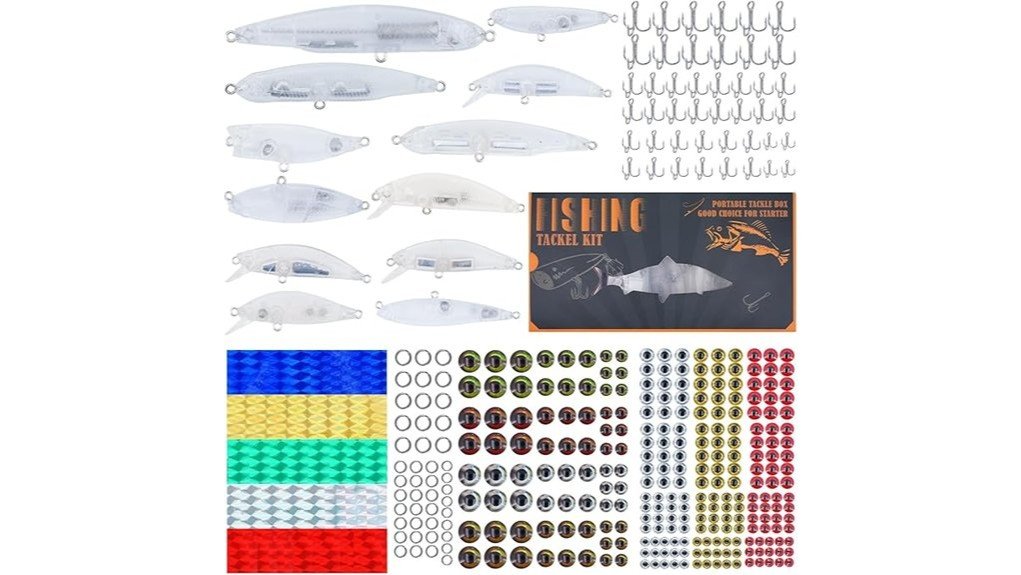
Making your own fishing lures gives you more control over color, component arrangement, and the look of each bait, but buying the right kit matters if you do not want to collect every small part separately. The 357pcs DIY Fishing Lure Making Kit combines unpainted lure blanks, treble hooks, eyes, stickers, split rings, beads, and other small components in one craft-focused set. It is best suited to anglers who enjoy experimenting and families looking for a supervised fishing-related project. The main limitation is that several important details, including the exact lure-blank material and hook corrosion resistance, are not clearly established, so you should not buy it based on those assumptions.
Quick Verdict
Rating: 7.5/10, Recommended with caveats
Best For: Anglers who want a multi-piece hard-bait crafting kit for experimenting with custom lure designs.
Bottom Line: The large assortment gives you plenty of pieces for creative lure projects without sourcing every component individually. The tradeoff is that some material and component specifications are unclear, and successful lure performance still requires testing and adjustment.
Key Specifications
| Specification | Detail |
|---|---|
| Product type | DIY fishing lure making kit |
| Package quantity | 357 pieces, according to the reviewed article |
| Lure style | Hard-bait crafting and customization |
| Included components described | Unpainted lure blanks, treble hooks, eyes, stickers, crankbait blanks, split rings, beads, and related small parts |
| Customization | Color, decorative details, and component arrangements can be varied |
| Storage | Storage bag described in the original product information |
| Best use | Building and experimenting with personalized fishing lures |
| Safety note | Contains sharp hooks and small components, so children need close adult supervision |
What Is the DIY Fishing Lure Making Kit?
The 357pcs DIY Fishing Lure Making Kit is a collection of lure-building parts intended to help you assemble and personalize hard fishing lures. Instead of starting with individual purchases of blanks, hooks, eyes, rings, beads, and decorative components, you receive a larger assortment intended for multiple projects.
The main appeal is experimentation. You can change visual details and component combinations, then test the finished lure to see how it behaves in the water. This makes the kit more useful as a creative tackle-building set than as a guaranteed shortcut to catching more fish.
Before You Buy: Do not assume the lure blanks are made from a particular material or that the included hooks are fully rust-resistant. Those details are not clearly established in the available product information. You may also need paint, finishing supplies, and basic hand tools depending on the design you want to make.
Who Should Buy It?
Best For
- Anglers who enjoy building and testing personalized hard lures.
- Beginners who prefer buying a large assortment of basic components in one kit.
- Families looking for a fishing-themed craft activity that adults can closely supervise.
Skip If
- You want finished lures that can go straight from the package to your tackle box.
- You need confirmed specifications for every blank, hook, or component before buying.
- You do not want to spend time assembling, testing, and adjusting your own designs.
Components and Build Options
The kit’s biggest practical advantage is the number and variety of components described in the package. The assortment includes unpainted lure blanks, treble hooks, eyes, stickers, split rings, beads, and crankbait-style blanks. Having these pieces together makes it easier to try several designs without buying every small item separately.
The unpainted blanks also give you room to create different visual patterns. You can use color and decorative details to make your lures easier to distinguish or to experiment with presentations for different fishing conditions. However, the kit itself does not prove that one color or pattern will catch more fish, so testing remains an important part of the process.
Customization and Ease of Use
Lure making involves more than attaching a hook to a blank. You need to think about how the hardware is arranged, whether connections are secure, and how the finished lure moves once it enters the water. The collection of rings, hooks, beads, eyes, and decorative pieces gives you several variables to work with.
This makes the kit accessible for beginners but still dependent on patience. Your first design may not track or move exactly as expected. Treat early projects as prototypes, check each connection carefully, and make small adjustments rather than assuming every assembly will perform the same way.
Pro Tip: Build one lure at a time and write down the component arrangement, color pattern, and any changes you make after water testing. Keeping simple notes makes it much easier to reproduce a design that works well.
Benefits of Crafting Your Own Fishing Lures
The strongest reason to make your own lures is control. You can change the appearance and component arrangement instead of relying only on factory-finished designs. That freedom can be useful when you want to experiment with different presentations or simply enjoy making your own tackle.
A large DIY kit may also reduce the need to purchase each small component separately. Actual savings depend on how many pieces you use, what additional paint or tools you need, and how many finished lures you successfully build. It is better to view cost savings as a possibility rather than a guarantee.
There is also a recreational benefit. Creating a lure and then fishing with it adds another hands-on part to the hobby. For families, it can become a shared project, but the sharp treble hooks and small components mean adults should handle or directly supervise the riskier assembly steps.
How It Performs in Real Use
For Your First DIY Lure Project
The broad component assortment gives you enough options to start with a simple design and learn how the pieces fit together. Beginners should resist using too many decorative or hardware components at once. A simpler first build is easier to inspect, test, and troubleshoot.
For Experimenting With Colors and Patterns
The unpainted blanks make visual customization one of the kit’s most useful features. You can try contrasting colors, eyes, and stickers instead of being limited to a factory pattern. Because paint and finishing specifications are not clearly established, choose any additional coating carefully and allow it to cure fully before fishing.
For Family Craft Sessions
The kit can provide a hands-on activity for adults and children working together. An adult should control treble hooks, cutting tools, pliers, adhesives, paints, and other potentially hazardous materials. Small parts should also be kept away from younger children who may put objects in their mouths.
For Preparing Lures Before a Fishing Trip
DIY lures are best assembled and tested before you depend on them during a trip. A quick water test lets you check whether hardware stays secure and whether the lure behaves reasonably in the water. If something looks loose or unstable, correct it before adding the lure to your active tackle.
How to Use the Kit Effectively
You will get more value from the kit when you approach lure making as a test-and-adjust process rather than expecting every first attempt to be ready for fishing.
- Start with a simple layout: Use fewer components on your first project so you can understand how each part affects the finished lure.
- Inspect connection points: Check split rings, hooks, and other hardware before use so loose parts do not separate while casting or retrieving.
- Experiment deliberately: Change one or two details at a time, such as color or component arrangement, rather than changing everything at once.
- Test before fishing: Watch how the completed lure moves in controlled water before relying on it during a fishing trip.
- Dry components after use: Moisture can shorten the useful life of metal tackle components, especially when their exact corrosion resistance is unknown.
- Stay organized: Return unused eyes, rings, beads, hooks, and other small pieces to the storage bag or a divided tackle organizer.
Safety and Material Considerations
The article identifies several parts in the kit but does not establish the exact material used for every lure blank or hook. For that reason, you should avoid assuming that the hooks are corrosion-proof or that every blank is made from plastic, wood, or another particular material.
The more immediate safety concern is the presence of treble hooks and small components. Work on a clear surface, keep hooks covered or separated until needed, and store the kit where young children cannot reach it. If children participate, an adult should supervise the entire activity and perform any step involving sharp tools or exposed hooks.
If you add paint, adhesive, clear coat, or another finishing product, follow that product manufacturer’s ventilation, handling, drying, and disposal instructions.
Pros and Cons
Pros
- 357-piece assortment provides many components for repeated DIY projects.
- Unpainted blanks support your own color and decorative designs.
- Includes small tackle parts such as hooks, eyes, stickers, rings, and beads.
- Storage bag helps keep a large collection of small pieces together.
- Works as both a fishing-related craft project and a way to experiment with custom tackle.
Cons
- Exact material details for the lure blanks and hooks are not clearly established.
- You may need separate paint, finishing supplies, pliers, or other tools for some projects.
- Sharp treble hooks and small parts make close adult supervision necessary for children.
Is It Worth the Price?
The value of this kit depends more on how much you enjoy DIY lure building than on the number printed on the package. With 357 pieces described, it can make sense if you plan to complete several projects and want a collection of blanks and small components available in one place.
You will get less value if your goal is simply to start fishing as quickly as possible. Finished commercial lures require less preparation, while this kit asks you to spend time assembling, decorating, checking, and testing your creations. It is worth considering when the creative process is part of what you want from the purchase.
How It Compares to Alternatives
A dedicated spinner-making kit may suit you better if you specifically want to build inline spinners, while a soft-plastic molding kit is the more appropriate choice if you want to pour or mold flexible baits. Ready-made hard lures are simpler if you prefer to skip assembly entirely.
The 357pcs DIY Fishing Lure Making Kit makes the most sense when you want a broad assortment for hard-bait customization and prefer experimenting with multiple components instead of focusing on one specialized lure-making method.
Frequently Asked Questions
What comes in the 357pcs DIY Fishing Lure Making Kit?
The reviewed article describes a 357-piece assortment containing unpainted lure blanks, crankbait-style blanks, treble hooks, eyes, stickers, split rings, beads, and related lure-making components. The article does not provide a verified quantity for every individual component.
What material are the lure blanks made from?
The available article identifies them as unpainted lure blanks but does not reliably establish the exact material. You should check the current Amazon product details if blank material is important to your painting or finishing method.
Are the included hooks rust-resistant?
Rust resistance is not clearly verified for the included hooks. Dry your finished lures and hardware after use, and take additional care after fishing in saltwater or other corrosive environments.
Do I need to buy paint separately?
The kit is described as containing unpainted blanks, while paint is not clearly identified among the included items. If you want fully painted designs, plan on checking the package contents and obtaining suitable paint or finishing supplies if needed.
Can children use this lure-making kit?
Children can participate only with close adult supervision. Treble hooks are sharp, the kit contains small parts, and additional tools or finishing products may introduce other hazards that an adult should manage.
How long does it take to make one lure?
There is no fixed build time. A simple assembly can take less effort than a lure that requires detailed painting, drying, finishing, hardware changes, and repeated water testing.
Will homemade lures catch more fish than store-bought lures?
There is no guarantee that a homemade lure will outperform a commercial lure. DIY construction gives you more freedom to experiment with appearance and setup, but results still depend on lure action, fishing conditions, technique, target species, and many other factors.
Who should skip this kit?
Skip it if you want finished lures with no assembly or if you need detailed, verified specifications for every component before purchase. It is better suited to buyers who enjoy experimenting, crafting, and testing their own tackle.
The Bottom Line
The 357pcs DIY Fishing Lure Making Kit is worth considering if you enjoy hands-on tackle projects and want a large assortment of blanks, hooks, eyes, rings, beads, and decorative components in one set. Its main strength is customization, while its main limitation is the lack of clearly verified material specifications for some components, so buyers seeking exact technical details should check the current listing before ordering.
If you prefer ready-to-fish lures with no assembly, this is probably not the most practical choice. For anglers who enjoy experimenting and are willing to test their finished designs, it earns a 7.5/10, Recommended with caveats.
Ready to Buy?
Check the latest product details and package contents before you decide.
