
Last Updated on July 31, 2026 by Logan Reeves
Disclosure: As an Amazon Associate, we earn from qualifying purchases. If you click a link on this page and make a purchase, we may receive a small commission at no extra cost to you.
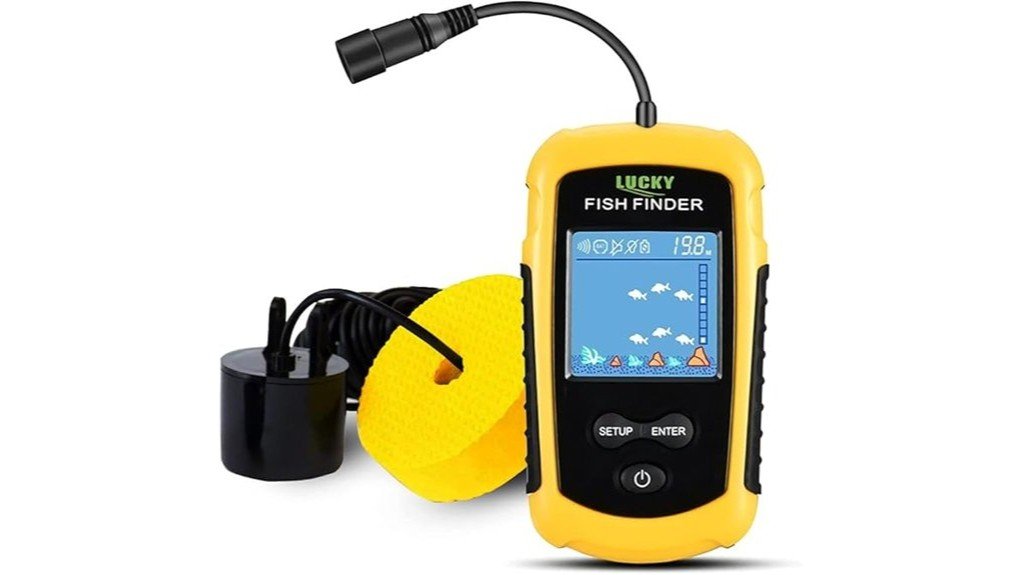
Finding depth and likely fish locations from a kayak, dock, or ice hole can be difficult when you do not have a mounted sonar system. The LUCKY Kayak Portable Fish Depth Finder FFC1108-1 gives you a simple handheld screen and a wired sonar sensor without requiring a permanent installation. It is best suited to anglers who want basic depth, fish, and bottom-condition information in a compact package. Its main strengths are portability and straightforward controls, but its small display and basic fish icons cannot match the detail of a color sonar unit with GPS.
Quick Verdict
Rating: 7.8/10, recommended with caveats
Best For: Kayak, canoe, shore, dock, and ice anglers who need a basic portable depth finder
Bottom Line: The LUCKY FFC1108-1 provides useful depth readings, approximate fish locations, bottom icons, and a fish alarm from a compact handheld unit. Choose it for simple, low-cost sonar, but skip it if you need GPS mapping, detailed color imaging, or a fully wireless setup.
| Specification | Detail |
|---|---|
| Brand | LUCKY |
| Model | FFC1108-1 |
| Product type | Portable wired fish finder and depth finder |
| Display | 2-inch TN anti-UV LCD with backlight |
| Depth range | Approximately 3 to 328 feet (1 to 100 meters) with the sensor fully submerged |
| Sonar | 200 kHz frequency with a 45-degree beam angle |
| Transducer cable | 25 feet (7.62 meters) |
| Power | 4 AAA batteries, not included |
| Advertised runtime | At least 4 to 5 hours with fresh batteries, longer with battery-save mode |
| Adjustments | Five sensitivity levels, feet or meters, backlight, fish alarm, and battery-save mode |
| Displayed information | Water depth, approximate fish depth and location, fish alarm, weeds, sand, and rocks |
| Included accessories | Wired sonar sensor, neck strap, and mounting hardware |
| Best use | Kayak, canoe, boat, shore, dock, and ice fishing in fresh or salt water |
What Is the LUCKY FFC1108-1?
The LUCKY FFC1108-1 is a handheld sonar device made for anglers who want basic underwater information without installing a large display, transducer mount, or boat power system. A 25-foot cable connects the handheld screen to a round sonar sensor that you lower, cast, or position beside a small craft.
The unit reports water depth and approximate fish depth while using simple icons for fish, weeds, sand, and rocks. It also includes a fish alarm and five sensitivity settings. These features make it approachable for beginners, but the display is a simplified interpretation of sonar returns rather than a detailed picture of every object below you.
Who Should Buy It?
Best For
- Kayak and canoe anglers who do not want a permanent electronics installation
- Shore, dock, and ice anglers who need quick depth checks and approximate fish locations
- Beginners who prefer a small standalone screen instead of a phone app
Skip If
- You need GPS, contour mapping, waypoints, or detailed color sonar
- You want a wireless castable sensor with no cable to manage
- You need species identification or precise target separation
Before You Buy: This is a basic wired sonar tool, not a chartplotter or underwater camera. Fish icons show approximate targets within the sonar cone, so you still need to judge structure, bait activity, and local conditions before choosing where to fish.
Products Worth Considering
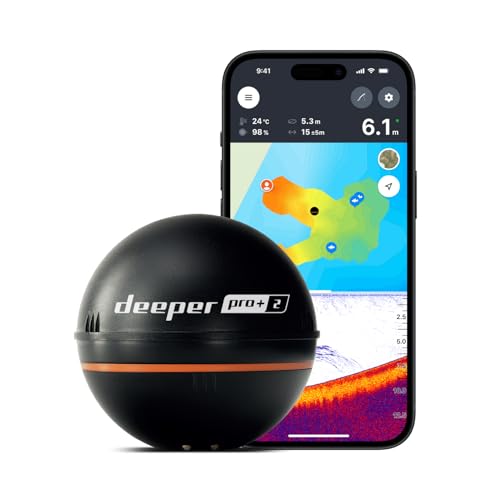
READY TO PERFORM: Wide beam, mid, and narrow beams make covering large expanses or drilling down on specific spots available at your disposal; Ideal for elite anglers who want to take their matchplay to the next level

✦ Fish Finder and Depth Finder : It is a portable fish finder that could display approximate fish location and water depth. The sonar transducer can be attached to the hull of kayak or boat in order to understand the changing of water depth when you are moving by. The water depth detection range is between 3ft(1m) and 328ft (100m) when the transducer is completely immersed in the water.

It is a portable and castable fish finder that comes with a wireless sonar probe/sensor. The maximum distance between the sensor and the handheld unit is 262FT/80M. No need to drill hole in your boat hull to install the sensor any more. Two small holes on the sensor allow you to tether it with your fishing line and cast it onto water as far as you want.
Key Features of the LUCKY Kayak Portable Fish Depth Finder
Portable Handheld Design
The compact display is designed for one-handed operation, and the included neck strap keeps it accessible while you handle a paddle, rod, or ice-fishing gear. Because the unit runs on four AAA batteries, you do not need to connect it to a 12-volt boat battery.
Portability is also the reason to consider this model over a permanently mounted fish finder. You can move it between a kayak, canoe, dock, and ice shelter. The tradeoff is cable management, since the sensor remains physically connected to the display.
Backlit 2-Inch LCD
The 2-inch TN anti-UV LCD shows depth numbers, fish icons, bottom-condition symbols, sensitivity, battery status, and other settings. The backlight helps in darkness, while the anti-UV display design supports daytime viewing.
The screen is clear enough for basic information, but it is small. You will not see the wide color palette, fish arches, split-screen zoom, or detailed contour history available on larger sonar units.
200 kHz Sonar and 45-Degree Beam
The wired transducer uses a 200 kHz signal with a 45-degree beam. This beam scans a cone-shaped area below the sensor and reports targets that return an echo. The display then converts those returns into simple fish and bottom icons.
The advertised depth range is about 3 to 328 feet when the sensor is fully immersed and positioned correctly. Actual results can change with turbulence, heavy vegetation, soft bottoms, air bubbles, extreme depth, and poor sensor orientation.
Five Sensitivity Levels and Fish Alarm
Five sensitivity levels let you reduce clutter in turbid or weedy water or increase sensitivity when returns are weak. Higher sensitivity can show more small targets, but it may also create extra icons and noise. Lower sensitivity can make the screen easier to read, though small fish may be missed.
The fish alarm gives an audible alert when the unit interprets a return as a fish or school. It is useful when you cannot watch the screen constantly, but it should be treated as a search aid rather than proof that a catchable fish is directly beneath you.
Performance and Usability
Depth Reading and Bottom Information
Depth is the most useful function on this model. It can help you find drop-offs, avoid unexpectedly shallow areas, compare holes while ice fishing, and check water under a dock or bank. The bottom icons also give you a basic idea of weeds, sand, and rock, which may help you decide where to place a lure.
Do not expect survey-grade measurements. A small portable sonar depends heavily on the sensor being level, fully submerged, and away from bubbles or strong turbulence. Readings may lag or fluctuate while the kayak is moving quickly.
Battery Life and Controls
The manufacturer advertises at least 4 to 5 hours of continuous operation with fresh AAA batteries. Battery-save mode can extend use, but actual runtime depends on battery quality, backlight use, temperature, and alarm settings.
The controls are simple enough for occasional use. You can change units between feet and meters, adjust sensitivity, activate the backlight, enable the fish alarm, and use battery-save mode. Carrying a spare set of AAA batteries is sensible for a full-day trip.
Build and Water Exposure
The sensor is made to work in water, but you should still protect the handheld display and battery compartment. Keep the battery door fully closed, avoid submerging the display, and dry the cable and sensor after use. After saltwater fishing, rinse the sensor and cable with fresh water and let them dry before storage.
Pro Tip: Start at a middle sensitivity setting, then lower it if the screen fills with false targets or raise it if you see depth but few returns. Make one change at a time so you can tell which setting improves the display.
How to Set It Up and Use It Correctly
- Install fresh batteries: Insert four AAA batteries with the correct polarity and close the battery door securely.
- Connect and secure the sensor: Check the cable and attachment point before lowering or casting the transducer. Never rely on a loose knot or damaged cable.
- Keep the sensor fully submerged: The sonar face should point downward and remain below the surface. Air bubbles and a tilted sensor can cause unstable readings.
- Turn on the display and choose units: Select feet or meters, then set the backlight and alarm for the conditions.
- Adjust sensitivity: Begin near the middle setting and fine-tune it after you see how much clutter appears.
- Compare readings over an area: Use several passes or positions instead of making a decision from one fish icon.
For shore use, cast or lower the sensor gently rather than throwing it hard. From a kayak or canoe, place it where the hull, paddle strokes, and wake create the least turbulence. For ice fishing, clear loose ice and slush so the sensor can make stable contact with the water.
Ideal Use Cases and Gifting Options
Kayak and Canoe Fishing
The FFC1108-1 makes sense on small craft with limited deck space. You can wear the display on its neck strap and lower the transducer beside the boat. It is useful for checking channels, ledges, and shallow hazards, but the cable must be kept away from paddles, hooks, and moving parts.
Shore and Dock Fishing
From a dock, pier, or bank, the wired sensor can help you compare depth and bottom conditions close to your position. The 25-foot cable limits how far you can survey, so it is less flexible than a wireless castable sonar for long-distance shore scanning.
Ice Fishing
For ice fishing, the unit can help you compare hole depth and look for approximate fish activity before you settle into one spot. Cold weather can shorten alkaline battery life, so keep spare batteries warm and protect the display from snow and slush.
Freshwater and Saltwater Trips
The listing supports use in both freshwater and saltwater. Saltwater does not change the basic controls, but care matters more. Rinse the sensor, cable, and mounting hardware with fresh water after the trip to reduce salt buildup and corrosion.
As a gift, this product fits a beginner or casual angler who values portability and simple controls. It is a less suitable gift for someone who already uses GPS mapping, CHIRP sonar, or a permanently installed marine electronics system.
Pros and Cons
Pros
- Portable handheld design requires no permanent installation
- Advertised depth range reaches about 328 feet
- Five sensitivity levels help manage different water conditions
- Fish alarm, depth units, backlight, and battery-save mode are easy to adjust
- Works for kayak, canoe, shore, dock, ice, freshwater, and saltwater use
Cons
- The 2-inch display provides basic icons rather than detailed color sonar
- The 25-foot cable can tangle and limits shore-casting distance
- Four AAA batteries are required and are not included
Is It Worth the Price?
The LUCKY FFC1108-1 sits in the budget end of portable sonar. Its value comes from combining a standalone display, wired sensor, depth readings, fish alerts, and several adjustments without requiring a phone, app, or permanent boat installation.
It offers strong value for the price when your priority is quick depth checks and basic target information. It is not the best fit if you expect detailed fish arches, GPS waypoints, contour maps, water-temperature graphs, or a wireless casting range. In those cases, paying more for a color GPS fish finder or app-based castable sonar is likely to make more sense.
Products Worth Considering
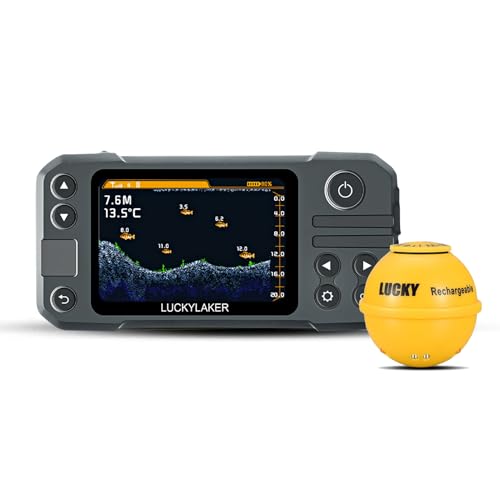
Wireless Control & Operation : Experience the ultimate freedom with the LUCKY portable fish finder, featuring a MASSIVE 853FT OPERATION DISTANCE—one of the longest ranges on the fishing market! No wires. No limits. Just cast your sonar sensor and unlock the secrets below from your boat, kayak, or shore.

Dual Beam Sonar: Choose from a narrow and a wide beam for great detail or a generous coverage area, helping you identify fish, structure and contours.

Shows you what is in the water: water depth, approximate fish location (suits for all sorts of fish), fish size(small/medium/big), short & tall weeds, sand & rocks on bottom. Suitable for fishing from a kayak, off the dock, and ice fishing. You can use the fish finder on moving kayak with slowly speed below 5mph (make sure the bottom of the transducer is horizontal).
How It Compares to Alternatives
A Deeper START is better suited to shore anglers who want a wireless castable sensor and a phone-based color display. It also removes the 25-foot cable limit, but it requires a compatible phone and app. The LUCKY model is simpler for buyers who prefer a dedicated screen and replaceable batteries.
A Garmin STRIKER 4 provides a larger color screen, CHIRP sonar, GPS, and waypoint functions, making it a stronger choice for a boat or kayak with room for a more complete setup. The FFC1108-1 makes more sense when portability, basic operation, and minimal installation matter more than mapping and sonar detail.
Products Worth Considering
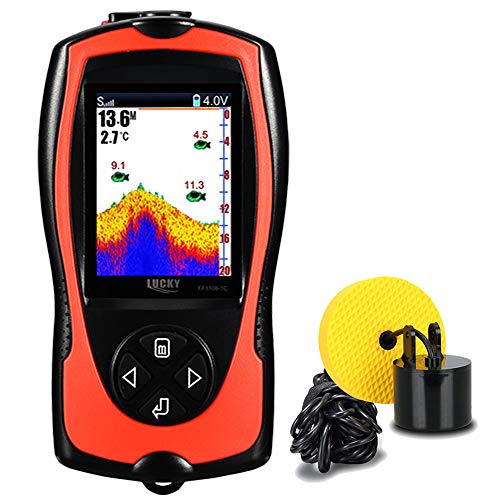
☀ The portable fish finder, with updated 2.4inch TFT color LCD screen(more clear to display), can detect and display underwater contour, water depth, water temperature and fish size(big/middle/small) and fish depth. It has two user modes: TRANSDUCER/SIMULATION. Try all functions in simulation mode and go fishing in transducer mode.

READY TO GO - Easily find where your next catch is hiding with the Deeper START Fish Finder! The lightweight and sleek design makes for a seamless reel without any messy wires or fiddly external batteries required. Ideal for shore anglers and family trips who want to get on with catching!

Pocke-Sized Sonar Fish Finder : Compact, Light, and Ready for On-the-go fishing, it is what you should put into your fishing tackle box. this portable fish finder is slim enough to slip into your fishing vest pocket. It is weighing as much as a standard smartphone, allowing you to move freely between spots without being weighed down. Perfect for kayak, bank, and ice fishing.
Frequently Asked Questions
What batteries does the LUCKY FFC1108-1 use?
It uses four AAA batteries, which are not included. The advertised continuous runtime is at least 4 to 5 hours with fresh batteries, and battery-save mode may extend that time.
Can you use this fish finder in saltwater?
Yes, the product is listed for freshwater and saltwater fishing. Rinse the sensor, cable, and hardware with fresh water after saltwater use, then dry everything before storage.
Is the handheld display waterproof?
You should protect the handheld unit from submersion and keep the battery door closed. The sonar sensor is designed to work underwater, but the display should be treated as an electronic device that needs protection from heavy water exposure.
Does it show the exact species of fish?
No. It displays approximate fish targets and depths based on sonar returns, but it cannot identify species. Vegetation, debris, bubbles, and other objects can also affect what appears on the screen.
Can it be used while a kayak is moving?
Yes, the transducer can be positioned beside or attached to a small craft, but readings are usually steadier at slow speeds. Keep the sensor below the surface and away from paddle turbulence, wake, and air bubbles.
How accurate is the 328-foot depth claim?
The listing states a maximum depth of about 328 feet under suitable conditions with the sensor fully submerged. Maximum-range performance can vary with bottom type, water conditions, sensor angle, and interference, so it should not be treated as a guaranteed reading in every location.
Is it suitable for ice fishing?
Yes. You can lower the sensor into an ice hole to compare depth and look for approximate fish activity. Clear slush around the sensor and remember that cold temperatures can reduce battery performance.
Who should choose a more advanced fish finder?
Choose a more advanced unit if you need GPS, saved waypoints, contour maps, CHIRP imaging, a larger color display, or detailed target separation. The LUCKY FFC1108-1 is intended for basic portable depth and fish-location information.
The Bottom Line
The LUCKY FFC1108-1 is a practical choice for kayak, canoe, shore, dock, and ice anglers who want basic sonar without a permanent setup. Its 328-foot advertised range, simple controls, fish alarm, and portable display are useful strengths, while the small screen, wired sensor, and lack of GPS limit it for advanced use. Skip it if detailed color sonar or mapping is essential, but consider it when portability and straightforward depth checking are your priorities.
