

Last Updated on July 27, 2026 by Daniel Globe
Wild turkeys (Meleagris gallopavo) spend much of the day on foot, moving between roosting cover, feeding areas, water, nesting or brood habitat, and safe resting sites. A useful general estimate is that a wild turkey may cover about 1 to 2 miles during an ordinary day, but there is no single fixed distance that applies to every bird, season, or landscape.
Quick Answer
Wild turkeys commonly move about 1 to 2 miles in a day, although their actual travel can be shorter or longer. Food, cover, weather, terrain, breeding activity, nesting, brood rearing, and habitat layout all affect movement. Daily mileage should not be confused with a turkey’s much larger home range.
Key Takeaways
- About 1 to 2 miles per day is a useful general estimate for wild-turkey movement, not a hard maximum.
- Daily movement changes with food, water, protective cover, weather, terrain, disturbance, and reproductive activity.
- A turkey’s home range can cover hundreds or thousands of acres, so home-range size is not the same thing as distance walked in one day.
- Wild turkeys are generally non-migratory, although they can make seasonal shifts and dispersal movements.
- GPS and radio-tracking research shows that sex, age, nesting status, and brood rearing can produce large differences among individual birds.
Disclosure: As an Amazon Associate I earn from qualifying purchases. Some links on this page are affiliate links, at no extra cost to you.
Factors Affecting Turkey Travel Distance
Food availability is one of the clearest reasons a wild turkey may change its daily movement. When acorns, seeds, fruits, insects, grasses, or agricultural foods are easy to find near secure cover, birds can meet their needs within a relatively compact area. When resources are scattered, they may have to cover more ground.
Habitat arrangement matters just as much as the amount of food. Wild turkeys do well in landscapes containing a mixture of woodland, openings, edge habitat, and suitable ground cover. The University of Missouri Extension describes forests, woodlands, openings, croplands, and early-successional vegetation as providing different resources throughout the turkey’s annual cycle.
Other factors that can change daily movement include:
- Breeding activity: Spring courtship and mate searching can change where males and females spend their time.
- Nesting: A hen preparing to nest may use space differently from a non-nesting bird.
- Brood rearing: After hatching, hens must move with poults through areas that provide insects, usable ground cover, and protection from predators.
- Weather: Snow, heavy rain, heat, drought, and wind can affect access to food and usable cover.
- Terrain: Steep slopes, rivers, dense vegetation, roads, and large open areas can redirect movement.
- Human disturbance: Development, frequent disturbance, and changes in land use can alter the routes birds use to reach feeding and roosting habitat.
Note: A number such as “1 to 2 miles per day” is best treated as a general field estimate. Individual GPS-tracked turkeys can behave very differently depending on their sex, reproductive status, habitat, and location.
Typical Daily Range of Turkey Travel
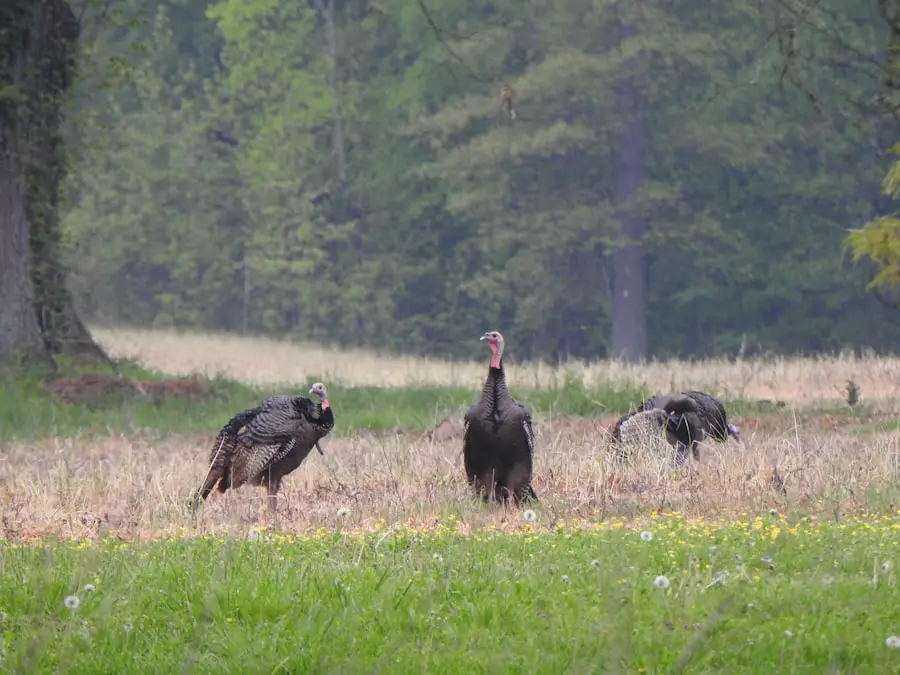
The National Wild Turkey Federation describes wild turkeys as commonly traveling roughly 1 to 2 miles while moving through their home range in search of food, water, breeding opportunities, and secure habitat. That estimate is much more useful than presenting a single large number as the distance every turkey can or will travel.
A turkey may stay relatively close to one productive feeding and roosting area on one day, then make a much broader movement on another. For that reason, there is no scientifically useful universal “maximum daily distance” for the species.
About 1 to 2 miles is a practical estimate for ordinary daily movement, but the important point is variability: wild turkeys adjust their movements to resources, reproduction, habitat, and conditions on the ground.
Daily Distance Is Not the Same as Home Range
A home range is the larger area an animal uses over a period of weeks, months, or a year. Daily distance is the length of movement made within that landscape during a particular day. A turkey can therefore have a home range covering hundreds or thousands of acres without walking across the entire area every day.
Home-range estimates also vary substantially among studies. Research published by the U.S. Geological Survey found large differences in annual and pre-nesting ranges among GPS-tracked female turkeys in Arkansas. Age and other behavioral factors helped explain some of that variation.
Sex, Age, and Reproductive Status Matter
Male and female turkeys do not necessarily use a landscape the same way. Spring courtship can change male movements, while hens may alter their space use as they search for nest sites, incubate eggs, or rear poults.
Brood movement can be especially dynamic. A large southeastern study published in the Journal of Wildlife Management found that brood-rearing females moved progressively farther from nest sites after hatch and averaged more than 1,000 meters of daily movement after the first few days. That does not create a universal rule for every brood, but it shows why age and reproductive stage matter when discussing turkey travel.
Seasonal Variations in Turkey Travel
| Season | Typical Movement Pattern | Main Drivers |
|---|---|---|
| Spring | Movement can become more variable as breeding and nesting begin. | Courtship, mate searching, nest-site selection, new plant growth, and insects. |
| Summer | Hens with poults concentrate on areas where young birds can feed and move through cover. | Insect-rich brood habitat, shade, water availability, and protective cover. |
| Fall | Flocks often reorganize and move among productive feeding areas. | Acorns, other mast, seeds, agricultural foods, and changing social groups. |
| Winter | Movement depends heavily on local food, snow, weather, and usable roosting cover. | Food accessibility, energy conservation, snow depth, shelter, and roost sites. |
Spring does not simply mean that every gobbler suddenly travels a fixed number of extra miles. Movement depends on the location of other birds, suitable display areas, roosts, feeding sites, and local habitat structure.
Hens undergo an equally important seasonal change. Pre-nesting movements can cover substantial areas, but movement often changes again once a hen begins incubating. After eggs hatch, the hen must lead poults through habitat where they can find insects while remaining protected by vegetation.
During fall and winter, food can become a major driver. Acorns and other mast may concentrate flocks in productive hardwood areas during one year, while crop fields or other foods become more important elsewhere. In northern regions, snow can reduce access to food and increase the importance of forested roosting and shelter habitat.
Impact of Habitat on Turkey Travel
Wild turkey movement makes the most sense when the landscape is viewed as a collection of different resources rather than one uniform habitat. Turkeys need places to feed, trees suitable for nighttime roosting, nesting cover, brood-rearing areas, and routes that allow them to move among those locations.
The Cornell Lab of Ornithology notes that wild turkeys forage mostly on the ground, use foods ranging from acorns and seeds to insects, and fly into trees to roost around sundown. That daily change from ground activity to elevated roosting alone requires birds to move between habitat features.
Open fields and woodland edges may offer abundant feeding opportunities, while mature trees supply roost sites. Nesting and brood-rearing birds need still other forms of vegetation. A landscape containing these resources close together may allow birds to meet their needs with relatively compact movements. When resources are farther apart, daily routes can expand.
Dense vegetation is not automatically better habitat. Young poults, for example, benefit from vegetation that supplies insects and overhead concealment while still leaving enough open ground for them to move efficiently. Good habitat therefore depends on structure and arrangement, not simply the amount of plant cover.
Importance of Turkey Travel for Conservation
Studying movement helps wildlife biologists understand whether a landscape provides the resources turkeys need throughout the year. A location that works well as winter feeding habitat may not supply good nesting cover, while an excellent brood area may lack suitable nighttime roost trees.
Movement research can therefore reveal which habitat combinations birds actually use and how far they must travel between them. Large or changing home ranges can also alert researchers to differences in food availability, vegetation, reproductive status, population density, or other local conditions.
This information is useful when wildlife managers evaluate habitat restoration, prescribed fire, forest management, agricultural practices, or development. The goal is not simply to create more acres of one habitat type. It is to maintain a functional mixture of feeding, nesting, brood-rearing, escape, and roosting habitat at a scale turkeys can use.
Tracking Turkey Travel Patterns
Modern turkey research increasingly relies on GPS, satellite, and radio telemetry. Instead of relying only on occasional sightings, researchers can record repeated locations from the same individual and reconstruct how that bird uses its environment over days or seasons.
Wild turkeys are commonly fitted with backpack-style transmitters rather than neck collars. GPS technology has allowed researchers to collect many locations from individual birds and examine movement at much finer scales than older observation-only methods.
Those data still require careful interpretation. The straight-line distance between a morning and evening location is not the same as the total path a turkey walked during the day. Likewise, the distance between two roosts does not capture every feeding loop or detour made between them.
Pro Tip: When comparing turkey-movement studies, check what the researchers actually measured. “Home range,” “distance from the nest,” “distance between roosts,” and “total daily path length” are different measurements and should not be treated as interchangeable.
Management Strategies for Supporting Turkey Travel
Effective turkey habitat management focuses on supplying several seasonal needs within a connected landscape. Depending on the region, that can include mature woodland for roosting, mast-producing trees, open or lightly wooded feeding areas, early-successional vegetation, and insect-rich brood habitat.
Landowners and wildlife managers may use timber stand improvement, carefully planned prescribed fire, mowing or disking, native-grass management, or agricultural practices to create a more useful habitat mosaic. The correct treatment depends on the existing plant community, local wildlife goals, season, and applicable fire or land-management regulations.
Connectivity also matters. Maintaining wooded strips, field edges, riparian cover, and other usable habitat between important resources can make it easier for wildlife to move through altered landscapes. However, turkey management should be based on local habitat limitations rather than applying one universal recipe.
Overall, the most accurate answer to “How far do turkeys travel in a day?” is not a rigid maximum. About 1 to 2 miles is a useful general estimate for ordinary wild-turkey movement, while GPS research makes clear that individual birds can use space very differently. Food, habitat, weather, season, sex, age, nesting, and brood rearing all help determine what a particular turkey does on a particular day.
Frequently Asked Questions
How far do turkeys travel in one day?
About 1 to 2 miles is a useful general estimate for wild turkeys during an ordinary day. It is not a hard maximum. Individual movement can be shorter or longer depending on habitat, food, weather, breeding activity, nesting status, and other conditions.
What factors affect how far turkeys travel?
Food availability, protective cover, terrain, weather, water, breeding activity, nesting, brood rearing, and the spacing of roosting and feeding areas can all influence daily movement.
Do wild turkeys migrate long distances?
Wild turkeys are generally considered non-migratory resident birds. They can still make seasonal shifts, dispersal movements, and substantial movements within or beyond a familiar home range when resources or reproductive needs change.
How do wild turkeys navigate during daily travel?
Turkeys repeatedly use familiar landscape features, feeding areas, cover, travel routes, and roosting locations. Their eyesight and hearing help them respond to their surroundings, but there is not good evidence for presenting a specific sun-based navigation system as the standard explanation for their daily movements.
Do turkeys travel in groups or alone?
Wild turkeys frequently travel in flocks, particularly outside the breeding season. Family groups of hens and young may join other family groups, while males can form separate flocks. Birds may also move alone at certain stages of the breeding and nesting cycle.
Is a turkey’s home range the same as its daily travel distance?
No. Daily travel describes movement during one day. A home range is the much larger area a turkey uses over a longer period. A bird may use hundreds or thousands of acres over time without crossing its entire home range every day.
Do turkeys return to the same roost every night?
They may repeatedly use favored roosting areas, but they do not necessarily occupy the exact same tree every night. Roost selection can change with weather, disturbance, flock behavior, and the location of feeding or breeding activity.
Sources
- National Wild Turkey Federation — Read a Turkey’s Mind Throughout the Day — supports the general 1-to-2-mile daily movement estimate and daily activity within a home range.
- Cornell Lab of Ornithology — Wild Turkey Life History — supports feeding, flocking, roosting, diet, and general behavior.
- University of Missouri Extension — Wild Turkey Biology and Habitat Management — supports seasonal habitat requirements and habitat-management information.
- U.S. Geological Survey — Effects of Prescribed Fire on Prenesting Movements of Wild Turkeys — supports variation in female home ranges and modern movement tracking.
- Journal of Wildlife Management — Behavior and Movement of Wild Turkey Broods — supports brood-rearing movement findings.
- Peer-reviewed wild turkey behavior research — supports classification of the wild turkey as a non-migratory North American game bird.

