
Last Updated on July 30, 2026 by Caleb Warren
The best climbing backpack is the one built for your actual day: a low-profile route pack for multi-pitch climbing, a rope bag with a tarp for sport cragging, a larger alpine pack for long approaches, or a divided commuter pack for gym-to-office use. This guide compares ten linked options by capacity, carry comfort, durability, organization, and packability so you can choose with fewer trade-offs.
Affiliate disclosure: This roundup contains Amazon affiliate links. If you buy through one of these links, we may earn a commission at no extra cost to you. Product prices, ratings, review counts, and availability can change.
Quick Answer
Choose the Petzl KLIFF for straightforward cragging and rope transport, the Osprey Mutant 22 for technical alpine day use, the Mutant 38 for bigger loads, and the Osprey Zealot 30 for commuting plus gym sessions. Budget rope bags work best when verified seller specs match your rope length and approach.
Key Takeaways
- A rope bag protects and organizes rope at the crag; a climbing backpack carries a broader load and usually fits better on longer approaches.
- Small 18–22 L packs suit on-route essentials, while roughly 30–40 L packs give more room for a rope, shoes, harness, layers, and food.
- Treat marketplace ratings and seller-only specifications as changeable. Confirm the current listing, model reference, dimensions, and return policy before buying.
- A pack is transport equipment, not life-support PPE. Inspect climbing ropes and hardware separately and follow each manufacturer’s care instructions.
Top Picks
|
Category |
Product |
Score |
|---|---|---|
|
💰 Best Budget |
78/100 |
|
|
🔰 Most Durable |
88/100 |
|
|
🎨 Most Visible |
76/100 |
|
|
🚀 Best Capacity |
85/100 |
|
|
🎯 Best Multi-Pitch |
86/100 |
|
|
🏆 Best Crag |
90/100 |
|
|
💼 Best Commuter |
92/100 |
|
|
⭐ Best Compact |
83/100 |
|
|
🎯 Best Alpine |
91/100 |
|
|
🚀 Best Long Days |
89/100 |
Note: The two Petzl BUG entries are separate Amazon listings for the same 18 L pack family, not two distinct pack designs. The 100-point scores are editorial comparison scores, not laboratory test results, and Amazon rating snapshots may change after publication.
How We Chose These Packs
We compared each bag across six practical factors: material and construction, usable capacity, carry comfort, organization, packability, and value. We also matched each design to a clear use case, including sport cragging, multi-pitch climbing, alpine days, arborist rope transport, commuting, and home storage.
This is a desk-researched roundup, not a claim that every pack was hands-on tested side by side. Petzl and Osprey specifications were checked against manufacturer pages or manuals. Claims for marketplace-only brands are labeled as seller-listed because independent manufacturer documentation was not available. Review summaries and sentiment charts are retained from the supplied draft and should be treated as directional rather than statistically representative.
A climbing pack should solve your main carry problem first: rope handling at the crag, freedom of movement on route, load support on the approach, or separation between climbing and everyday gear.
Climbing Backpack vs. Rope Bag
|
Pack Type |
Best For |
Main Trade-Off |
|---|---|---|
|
Folding rope bag |
Gym trips, short crag walks, clean rope flaking, compact storage |
Light suspension and limited structure for heavy loads |
|
Bucket-style arborist rope bag |
Long static lines, rigging accessories, job-site organization |
May carry like a gear bucket rather than a fitted hiking pack |
|
Crag rope backpack |
Rope, harness, shoes, and quickdraws in one simple system |
Usually fewer fit adjustments than an alpine pack |
|
Low-profile route pack |
Multi-pitch climbing, scrambling, and fast technical movement |
Small volume requires disciplined packing |
|
Alpine climbing pack |
Ice tools, crampons, rope carry, longer approaches, mixed terrain |
Technical layout may feel sparse for office or travel organization |
|
Climbing commuter pack |
Work, school, gym sessions, and short approaches |
Less specialized for steep alpine objectives |
How to Choose the Right Climbing Backpack
Match Capacity to the Day
Use 18–22 L as a practical starting range for a compact on-route pack carrying water, food, a layer, shoes, and small essentials. Packs around 30 L work well for gym-to-crag or commuter use. A 36–40 L design gives more room for a full rope system, helmet, layers, and longer-day equipment. These are starting points, not strict rules; bulky winter gear and rope diameter can change what fits.
Check Fit Before Features
A pack that rubs your neck or blocks harness access will be frustrating even if its pocket list looks perfect. Check torso fit, shoulder-strap shape, sternum-strap position, hipbelt design, and whether the pack rides high enough for your harness. Load it with your normal kit and walk for at least 10–15 minutes while testing reach and balance.
Pro Tip: Pack dense hardware close to your back, keep frequently used layers and snacks near the opening, and secure outside items so they cannot swing or snag during the approach.
Look Beyond the Denier Number
A higher denier can suggest a heavier yarn, but it does not guarantee a tougher finished bag. Weave, coating, seam quality, zipper construction, and bottom reinforcement also matter. For rough rock, tree work, and repeated trunk-to-crag use, prioritize reinforced high-wear areas and repairable hardware over a single fabric number.
Choose Access and Organization That Match Your Routine
A tarp or ground sheet helps with clean rope handling. Bucket bags make long lines easy to feed. Route packs should stay slim and keep harness gear loops clear. Commuter packs benefit from a separate shoe or chalk compartment and a protected laptop sleeve. External loops are useful, but overloaded outside gear can snag or fall.
Plan for Rain Without Assuming Waterproofing
Water-resistant fabric and a durable water-repellent finish can handle light moisture, but seams, zippers, drawcord tops, and roll closures may still admit water. Use an internal dry bag or pack liner for clothing, electronics, and other moisture-sensitive items when rain is likely.
Warning: A rope bag or backpack is for transport and storage. Do not use it as an anchor, belay component, lifting sling, or life-support system unless the manufacturer explicitly certifies that use.
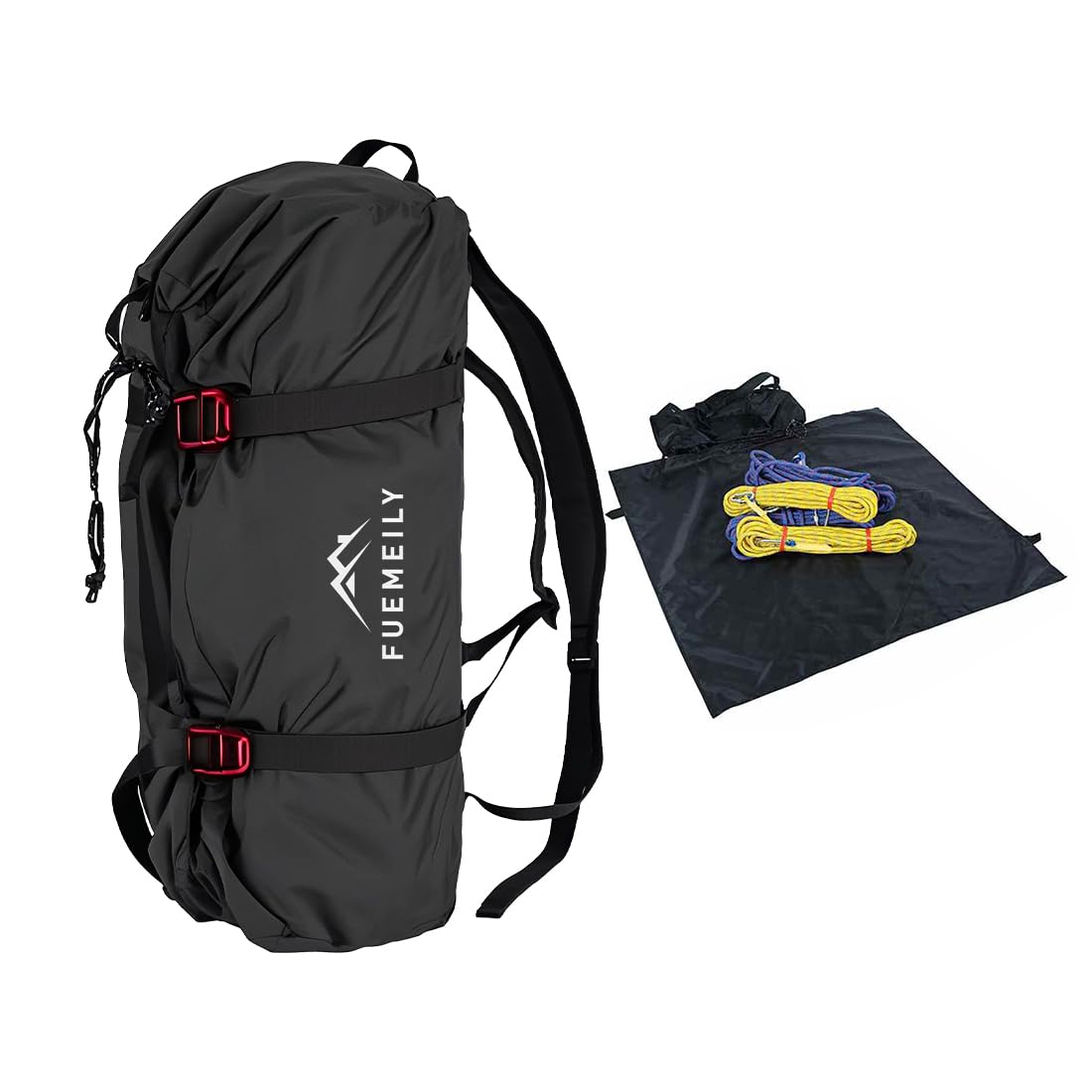
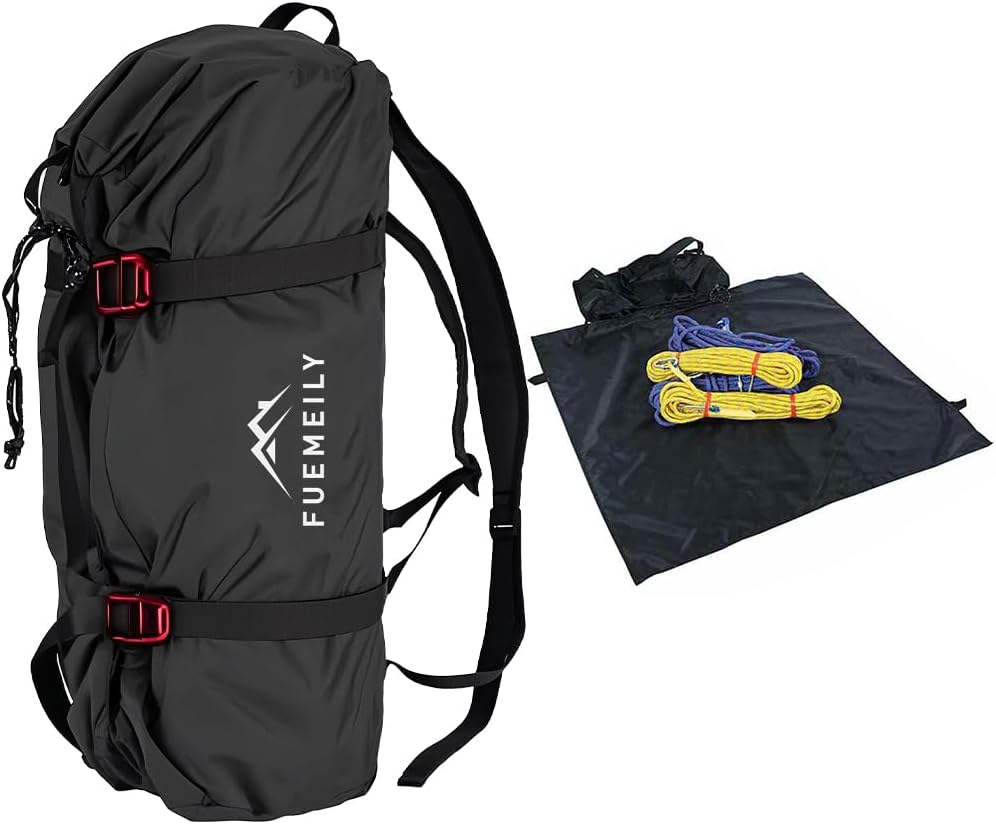
Verification note: The 500D Oxford fabric, built-in ground sheet, and capacity claims come from the linked Amazon seller listing. Confirm the current dimensions and rope-length fit before ordering.
This FUEMEILY rope bag is the kind of simple, practical piece of kit that makes moving around the crag less fiddly. You can flake your rope onto the built-in ground sheet, lay a harness on top, then fold everything into the bag and sling it on as a backpack.
It’s lightweight, water-resistant and has a mesh top pocket so you can eyeball what’s inside; the adjustable straps make it comfy for short hikes between routes. For everyday gym sessions, backyard rope storage, or casual outdoor climbs it’s a neat, packable option — if you’re a hardcore, full-time guide you might want something heavier-duty, but for most weekend missions this does the job well.
What People Say
You’ll see reviewers praising the bag’s size and foldability — people like that it holds a long rope, packs down small and keeps the rope off dirt and UV. Many call out the ground sheet and adjustable straps as handy touches.
A few note the materials feel lightweight and suggest it’s best for casual climbers or gear storage rather than heavy professional use.
Source-draft review sentiment: Positive (samples, ratings, and review counts can change)

Where It Shines
|
Situation |
How It Helps |
|---|---|
|
Crag Hops |
Flake your rope on the ground sheet, cinch it up and carry between routes without dragging gear through mud. |
|
Gym Sessions |
Keep a single rope or quick rack organized and portable — the bag packs down when not in use. |
|
Storage At Home |
Protects rope from dirt, moisture and UV when you stow it in the garage or on a shelf. |
|
Yard Work / Arborist Tasks |
Lightweight and easy to move, it’s a tidy way to keep lines and small tools together for occasional property work. |
Indoor & Outdoor Use
Works well both indoors and outdoors — great for gym-to-car transport, quick crag hikes, or storing ropes in your shed. Not overly heavy, so it’s easy to carry short distances.
Why You’ll Like It
- Built-in ground sheet for easy flaking and clean rope storage
- Lightweight, foldable design that packs into its own pouch
- Water-resistant rip-stop fabric helps keep rope dry and clean
- Adjustable shoulder straps let you carry it as a backpack
Amazon rating snapshot in the supplied July 2026 draft: 4.8 out of 5 (12+ ratings). Check the live listing for the current figure.
Verification note: The 35 L capacity, 1000-denier fabric, and reinforced-bottom claims come from the linked Amazon seller listing. No independent manufacturer specification page was available during this review.
This is the kind of no-nonsense rope bag you reach for when you want gear that just works. Made from 1000 denier fabric it feels tough without being bulky, and the 35L bucket shape swallows long ropes while keeping them accessible.
You can cinch the quickdraw top and clip tools to the daisy chains up front, stash a headlamp in the pocket, and sling it on with the adjustable backpack straps. For everyday yard and tree work it keeps lines and small tools tidy, and for a day at the crag it doubles as a durable rope carrier you won’t worry about tossing in the trunk.
If you want something rugged, simple to organize, and easy to carry, this is a solid pick.
What People Say
You’ll notice most people praise how tough and well-made the bag feels and how much rope it can hold without collapsing. Reviewers also like the backpack straps and the front loops for clipping gear, and many point out that the pockets and internal tie-offs make organizing easier. A few users mention the cinch top feels lighter duty and that there’s no rain cover, so it’s worth keeping that in mind if you expect wet conditions.
Source-draft review sentiment: Positive (samples, ratings, and review counts can change)

Where It Shines
|
Situation |
How It Helps |
|---|---|
|
Arborist Work |
Keeps ropes, lanyards and saws in one place; daisy chains and side pockets mean tools are easy to clip on and grab while you work. |
|
Transporting Long Ropes |
The 35L bucket and internal tie-off loops let you carry long lengths without tangles, so you can move ropes between sites with less fuss. |
|
Crag or Trail Hikes |
Adjustable backpack straps make it comfortable enough for short hikes between routes, and side handles give you a quick grab option. |
|
Garage Storage |
Tough fabric and reinforced bottom protect rope and gear from abrasion when you store lines and hardware at home. |
Indoor & Outdoor Use
Made for outdoor use on job sites and at the crag, but equally useful indoors for tidy storage. The fabric stands up to rough handling, though the top cinch isn’t fully waterproof so keep it covered in heavy rain.
Why You’ll Like It
- Rugged 1000 denier fabric built to withstand rough use
- Spacious 35L bucket holds long ropes and bulky gear
- Quickdraw top lets you secure and access gear fast
- Daisy chains, D-rings and pockets for neat organization
- Adjustable backpack straps plus side handles for versatile carry
- Double-reinforced bottom protects contents during transport
Amazon rating snapshot in the supplied July 2026 draft: 4.6 out of 5 (92+ ratings). Check the live listing for the current figure.
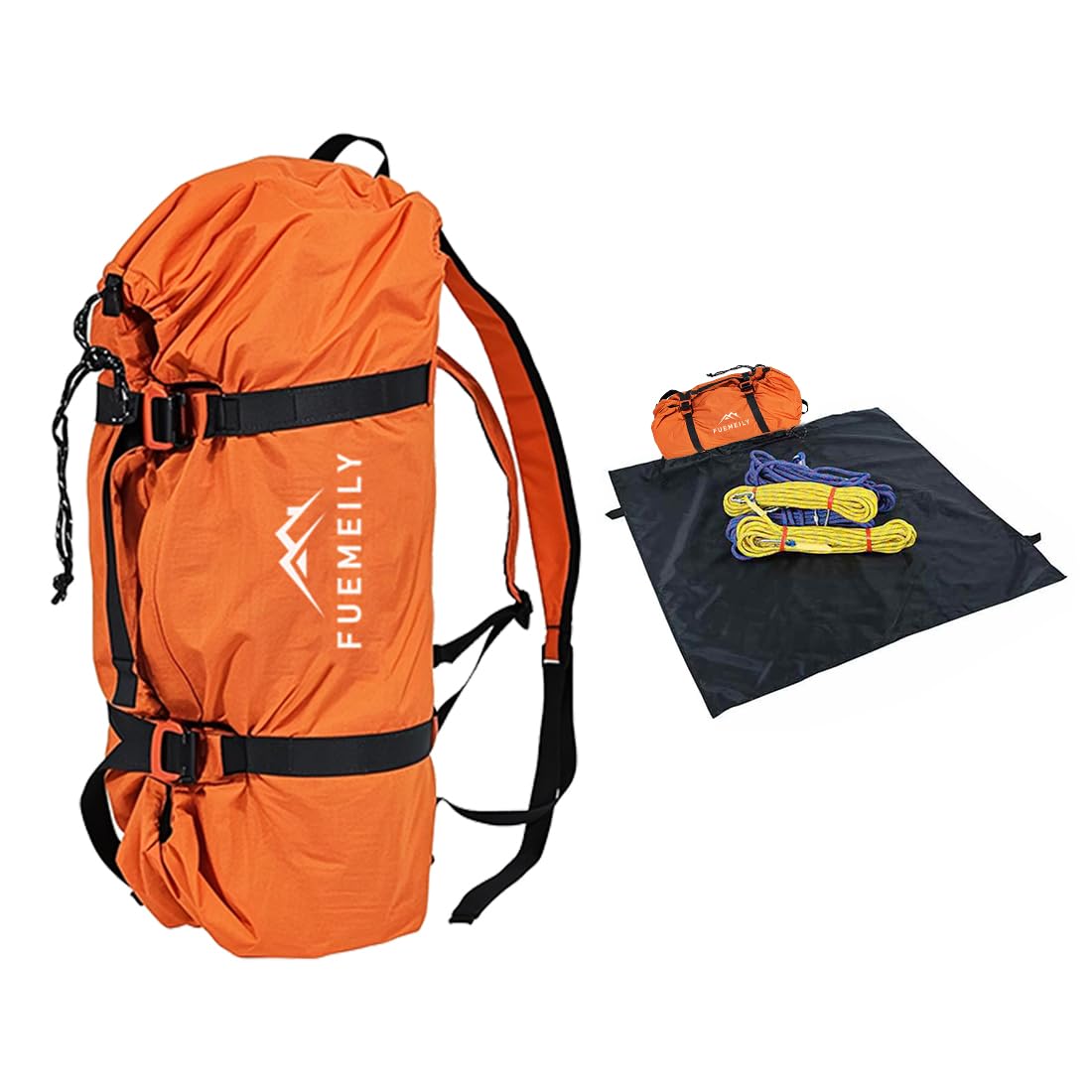
Verification note: This appears to be the orange color listing of the same FUEMEILY folding rope-bag design. Confirm color, dimensions, and included ground sheet on the current listing.
If you want something simple that keeps your rope clean and easy to move, this is a smart little option. The bag opens out into a ground sheet so you can flake your rope without getting it on dirt, then folds up into a lightweight backpack with adjustable straps when you’re ready to go.
It’s made from 500D rip-stop Oxford fabric, so it handles damp and scuffs better than a plain stuff sack, and the mesh top and zip pocket give you quick access to small bits of gear. For everyday gym sessions, short approaches at the crag, or organizing gear in the garage it makes packing and carrying less of a hassle.
If you’re after a lightweight, packable rope bag that protects your line and won’t weigh you down, this is worth considering.
What People Say
You’ll find most users appreciate how much rope this little bag holds and how handy the ground sheet is for keeping lines clean. People also like that it packs down small and that the backpack straps make moving between routes straightforward.
A few users note the materials feel lightweight—fine for casual use but not as burly as higher-end rope bags—so expectations matter.
Source-draft review sentiment: Positive (samples, ratings, and review counts can change)

Where It Shines
|
Situation |
How It Helps |
|---|---|
|
Crag Approaches |
Carry your rope comfortably between routes with the backpack straps and drop the ground sheet for a tidy flake before you climb. |
|
Gym Sessions |
Keeps a single rope or a few slings organized and off the floor, and the zip pocket holds chalk bags or tape for quick access. |
|
Arborist or Yard Work |
Lightweight storage that keeps ropes and slings clean and easy to grab when you move around the yard or job site. |
|
Travel & Storage |
Folds into a compact pack so it won’t take up space in your car or gear locker when you’re not using it. |
Indoor & Outdoor Use
Designed for outdoor use at the crag or on short hikes, but also handy indoors for tidy gear storage. The fabric is water-resistant and abrasion-resistant, however the bag isn’t fully waterproof in heavy rain, so keep that in mind for wet conditions.
Why You’ll Like It
- Integrated ground sheet for easy rope flaking and protection
- Large capacity fits long ropes while staying compact when folded
- Water-resistant 500D rip-stop fabric shields rope from damp and dirt
- Adjustable shoulder straps let you carry it as a backpack between pitches
- Top zip pocket and mesh panel for small items and quick visual checks
- Very lightweight and packable for travel or storage
Amazon rating snapshot in the supplied July 2026 draft: 4.8 out of 5 (12+ ratings). Check the live listing for the current figure.

Verification note: The 1680D nylon and 200-foot rope-capacity claims are seller-listed. Rope diameter changes how much line fits, so compare your rope dimensions with the current product measurements.
If you carry ropes often, this AOLEBA bucket-style rope bag makes life easier. You can flake a line straight into it — the bag stands up well and the top drawstring plus three built-in rope loops keep things tidy when you’re feeding or stowing rope.
It’s built from heavy 1680D nylon, has adjustable shoulder straps and a velcro handle so you can sling it over your shoulder between jobs or hikes. There are several external pockets and internal loops for small kit, and the neon colors make it easy to spot at the cliff base or on a busy job site.
If you want a roomy, rugged-feeling rope bucket that’s designed for field use, this is a solid, practical pick.
What People Say
Most users appreciate how much rope this bucket will hold and that it stands up for easy feeding and packing. People often call out the sturdy-feeling 1680D material and the useful pockets and internal loops for keeping kit organized. A few mention the base can be a bit soft and that pocket flaps sometimes struggle when fully loaded, so some add a stiffener to the bottom.
Source-draft review sentiment: Positive (samples, ratings, and review counts can change)

Where It Shines
|
Situation |
How It Helps |
|---|---|
|
Crag Approaches |
Carry the bag on your back and drop it open to flake rope neatly before the pitch, keeping your line off the dirt. |
|
Arborist Work |
Store rigging lines, gaffs and small tools in separate pockets so you can move quickly between anchors and find what you need. |
|
Rigging & Rescue |
The bucket shape and rope loops make feeding and managing long lengths of rope easier during complex rigging tasks. |
|
Gear Storage & Transport |
Use the shoulder straps or handle to move a full kit between locations, and keep small hardware in the accessory pouches for organized storage. |
Indoor & Outdoor Use
Designed for outdoor use at crags, job sites and on approaches, but equally handy in the garage for organized storage. The thick nylon is water-resistant and abrasion-tolerant, though the bag isn’t fully rigid — consider a small insert if you want a firmer base for heavy loads.
Why You’ll Like It
- Large capacity fits long ropes (listed as 200′ capacity for typical climbing lines)
- 1680D thick nylon resists abrasion and handles outdoor wear
- Top drawstring and three rope loops make feeding and securing line straightforward
- Adjustable shoulder straps and Velcro handle for easy transport
- Multiple external pockets and mesh side pouches keep small gear organized
- High-visibility color makes the bag easy to find on busy sites
Amazon rating snapshot in the supplied July 2026 draft: 4.4 out of 5 (129+ ratings). Check the live listing for the current figure.

Verified-spec note: The linked listing appears to show an earlier 18 L BUG commonly listed around 525 g. Petzl’s current BUG is still 18 L but is listed at 665 g, so check the product reference and generation before buying.
You get a stripped-down, climb-first daypack with the Petzl BUG. The linked listing appears to be an earlier 18 L version commonly listed at about 525 g (roughly 18 oz). Petzl’s current 18 L BUG is heavier at 665 g, so verify the model reference before comparing weight.
There’s a wide exterior pocket for shoes or layers, an interior sleeve for a hydration bladder (or slim laptop), and a strap on top to lash a rope. The waistbelt tucks away when you don’t need it and the adjustable sternum and compression straps keep the load stable while you’re on the move.
If you want something light that won’t interfere with your harness or feel bulky on approaches, this is an easy pick — handy for alpine days, short trad missions and everyday carry when you prefer a low profile.
What People Say
Customers frequently highlight how durable and well-built the Bug feels while still being lightweight. Many people like the compact fit that lets them carry shoes, a bladder and a few extras without getting in the way of a harness.
A few users note the volume can feel small for full day trips or heavier kits, so expectations about capacity matter.
Source-draft review sentiment: Positive (samples, ratings, and review counts can change)

Where It Shines
|
Situation |
How It Helps |
|---|---|
|
Single-Day Multi-Pitch |
Carries the essentials close to your back so the pack doesn’t snag or restrict movement while you’re clipping and stemming. |
|
Alpine Approaches |
Lightweight build and compression straps keep the load compact for long approaches where every ounce counts. |
|
Gym To Crag |
Slim profile fits under a harness or swings easily over a rope-packed harness, so you can move between training and outdoor pitches without swapping bags. |
|
Day Trips & Travel |
Enough room for shoes, layers and snacks while still packing down small in a larger duffel or checked luggage. |
Indoor & Outdoor Use
Built for outdoor climbing and approaches, but useful for everyday errands or short commutes if you like a compact pack. It handles wind and light weather in the field, though it isn’t a rigid daypack — if you need a firm base for heavy loads, add a small insert.
Why You’ll Like It
- Low-profile 18 L shape keeps the pack out of the way on climbs
- Linked older version is commonly listed around 525 g (18 oz); the current Petzl BUG is 665 g
- Stowaway waistbelt and stable sternum strap for uncluttered climbing
- Top strap for attaching a rope and side compression to secure gear
- Wide exterior pocket plus an interior sleeve for hydration or slim items
- Durable construction that stands up to regular outdoor use
Amazon rating snapshot in the supplied July 2026 draft: 4.5 out of 5 (93+ ratings). Check the live listing for the current figure.

Verified specs: Petzl lists the KLIFF at 36 L and 750 g, with a detachable 140 × 140 cm tarp and room for up to 100 m of rope.
If you spend time at the crag, this is the kind of bag you’ll reach for when you want something roomy but simple. The KLIFF packs 36 liters — enough for a long rope (or a double rope) plus shoes, harness and draws — and the removable 140 x 140 cm tarp gives you a clean surface for your rope. The rear opening keeps the part that rests against your back off the ground, the internal handles make arranging rope quick, and padded shoulder straps with a sternum strap make short approaches comfortable. It isn’t built like a full-featured trekking pack (no hip belt), but that pared-down design is exactly what makes it great for cragging, gym-to-crag days and travel when you want a durable, no-fuss rope system.
What People Say
Most folks like how much gear the KLIFF swallows without feeling bulky — reviewers often point to the tarp, roomy interior and solid construction as big wins. People also praise the easy access from the rear and the comfortable shoulder straps for short walks in. A few mention they’d prefer a hip belt or extra pockets for longer approaches, but overall customers celebrate its practicality and durability.
Source-draft review sentiment: Positive (samples, ratings, and review counts can change)

Where It Shines
|
Situation |
How It Helps |
|---|---|
|
Cragging Days |
Big internal volume and the removable tarp let you lay out and protect your rope while keeping all your gear in one place. |
|
Gym To Outdoors |
You can stash shoes, chalk and a rope and switch between training and outdoor climbs without a second bag. |
|
Short Approaches |
Padded shoulder straps and a sternum strap make the bag comfortable for short hikes to the cliff, while staying lightweight when not fully loaded. |
|
Travel & Carry |
The simple duffel-like shape and rear access mean it works as a travel carry-on or gear duffel when you need to move equipment through airports or cars. |
Indoor & Outdoor Use
Primarily designed for outdoor climbing and crag approaches, but it’s equally useful for gym sessions or short trips. It handles field conditions well and doubles as a travel or duffel bag, though it’s not intended for long alpine approaches where a hip belt would be helpful.
Why You’ll Like It
- Large 36 L capacity fits up to 100 m of rope plus shoes, harness and gear
- Detachable 140 x 140 cm tarp gives a clean area for ropes and keeps them off dirt
- Rear opening protects the back panel from contact with the ground and eases access
- Padded shoulder straps and sternum strap make short approaches comfortable
- Durable, abrasion-resistant fabric that stands up to regular outdoor use
- Internal handles and a zippered pocket help keep ropes and small items organized
Amazon rating snapshot in the supplied July 2026 draft: 4.6 out of 5 (381+ ratings). Check the live listing for the current figure.

Verified specs: The official Osprey Zealot owner’s manual lists 30 L, 0.89 kg, a 5–20 lb load range, roll-top access, a separate climbing-gear compartment, and a multifunction laptop-or-reservoir pocket. Availability may be limited because this is an older model line.
If your day flips between desk time and the climbing gym, this is the kind of pack you’ll reach for. The Zealot 30L gives you two main compartments so your stinky shoes and chalk stay away from your laptop and snacks, plus a roll-top with a vertical zip for easy access.
It is light without feeling flimsy, and the internal organization includes a multifunction pocket for either a laptop or a hydration reservoir, never both at once. The official manual lists bluesign-approved recycled fabrics, and Osprey supports repairable packs through its All Mighty Guarantee. It works well for commutes, campus days, gym sessions, and short crag approaches.
What People Say
In the very small review sample summarized in the supplied draft, buyers liked how the Zealot balances daily functionality with climbing-specific features. The separate shoe or gym compartment and practical pocket layout were the main positives, but the sample is too small to support a broad durability conclusion.
Comfort on short approaches and the practical water-bottle/front-pocket setup also come up as common positives.
Source-draft review sentiment: Positive (samples, ratings, and review counts can change)

Where It Shines
|
Situation |
How It Helps |
|---|---|
|
Daily Commute |
The clean compartment for your laptop and the roll-top access make getting in and out of the office or classroom straightforward while keeping gym gear out of the way. |
|
Gym Sessions |
You can stash shoes, chalk and a change of clothes in the separate front panel so your training gear doesn’t touch your work items. |
|
Short Crag Approaches |
Lightweight construction and padded shoulder straps make short hikes comfortable, and the simple shape keeps essentials within reach. |
|
Campus & Travel |
The organized pockets, laptop/reservoir pocket and durable fabric mean it works as a daily carry or a compact travel pack for gear-light trips. |
Indoor & Outdoor Use
Designed for hybrid use: it’s equally at home on subway rides and short outdoor approaches. The materials and layout handle gym and crag conditions well, though it isn’t intended as a substitute for a full trekking pack on long alpine routes.
Why You’ll Like It
- Dual compartments separate climbing gear and shoes from work or school items
- 30 L capacity handles a laptop, shoes, chalk and a few extras without feeling overstuffed
- Roll-top with vertical zip offers easy visibility and expandable access to the main compartment
- Dedicated internal pocket for a laptop or reservoir keeps electronics protected
- Durable bluesign-approved fabrics stand up to regular gym and outdoor use
- Front zip and open/drop-in pockets plus a key fob help keep small items organized
Amazon rating snapshot in the supplied July 2026 draft: 5.0 out of 5 (5+ ratings). Check the live listing for the current figure.
Duplicate-listing note: This is another Amazon listing for the Petzl BUG 18 L family rather than a separate pack design. Compare the current Petzl specification and choose based on confirmed generation, color, price, and seller reliability.
This is the sort of pack you’ll grab when you want something light, no-fuss and purpose-built for climbing days. The BUG’s low-profile 18 L shape sits high on your back so you can reach your harness and gear without the pack getting in the way, and the stowable waist belt keeps things tidy when you don’t need extra support.
There’s room inside for a harness, shoes, water, and small essentials, plus an exterior pocket and top rope strap. The linked older listing may be about 1.16 lb (525 g), while the current Petzl model is listed at 665 g. It is best for single-day cragging, short multi-pitch routes, and focused everyday carry rather than bulky full-day loads.
If you like gear that’s simple, durable and designed by climbers, this one’s worth considering.
What People Say
Most buyers appreciate how well thought out the BUG is for climbing: people say it’s comfortable, tough, and the slim profile makes it easy to move in tight spots. Folks commonly note the clever stowable waistbelt, external loops for shoes or helmet and the pack’s ability to carry a harness plus snacks and water.
A small number of users mention sizing surprises or minor wear issues on pockets or zips, but overall impressions skew positive.
Source-draft review sentiment: Positive (samples, ratings, and review counts can change)

Where It Shines
|
Situation |
How It Helps |
|---|---|
|
Multi-Pitch Climbing |
Its high carry position and low-profile shape keep the pack out of your way while giving you space for a harness, shoes and quick-access items. |
|
Gym Sessions |
You can stash shoes, chalk and a change of clothes inside and clip bulkier items to the outside loops so everything stays organized. |
|
Short Day Hikes |
Lightweight construction and an internal pocket for water or a lightweight jacket make it handy for quick approaches without extra weight. |
|
Everyday Carry |
If you want a compact, durable bag for daily use, its simple layout keeps essentials reachable without looking like a full hiking pack. |
Indoor & Outdoor Use
Built as a hybrid climbing/daypack: it’s equally suited to gym trips, short approaches and casual daily use. The materials and layout handle outdoor wear well, but it’s sized for day use rather than extended overnight adventures.
Why You’ll Like It
- Compact 18 L volume fits climbing essentials without getting bulky
- Sits high on the back so you can reach your harness and material loops easily
- Stowable waist belt keeps things streamlined on the climb
- Top strap and external loops let you secure a rope, helmet or shoes
- Interior pocket can hold a hydration reservoir or small electronics
- Very lightweight construction that still feels durable on frequent use
Amazon rating snapshot in the supplied July 2026 draft: 4.4 out of 5 (120+ ratings). Check the live listing for the current figure.
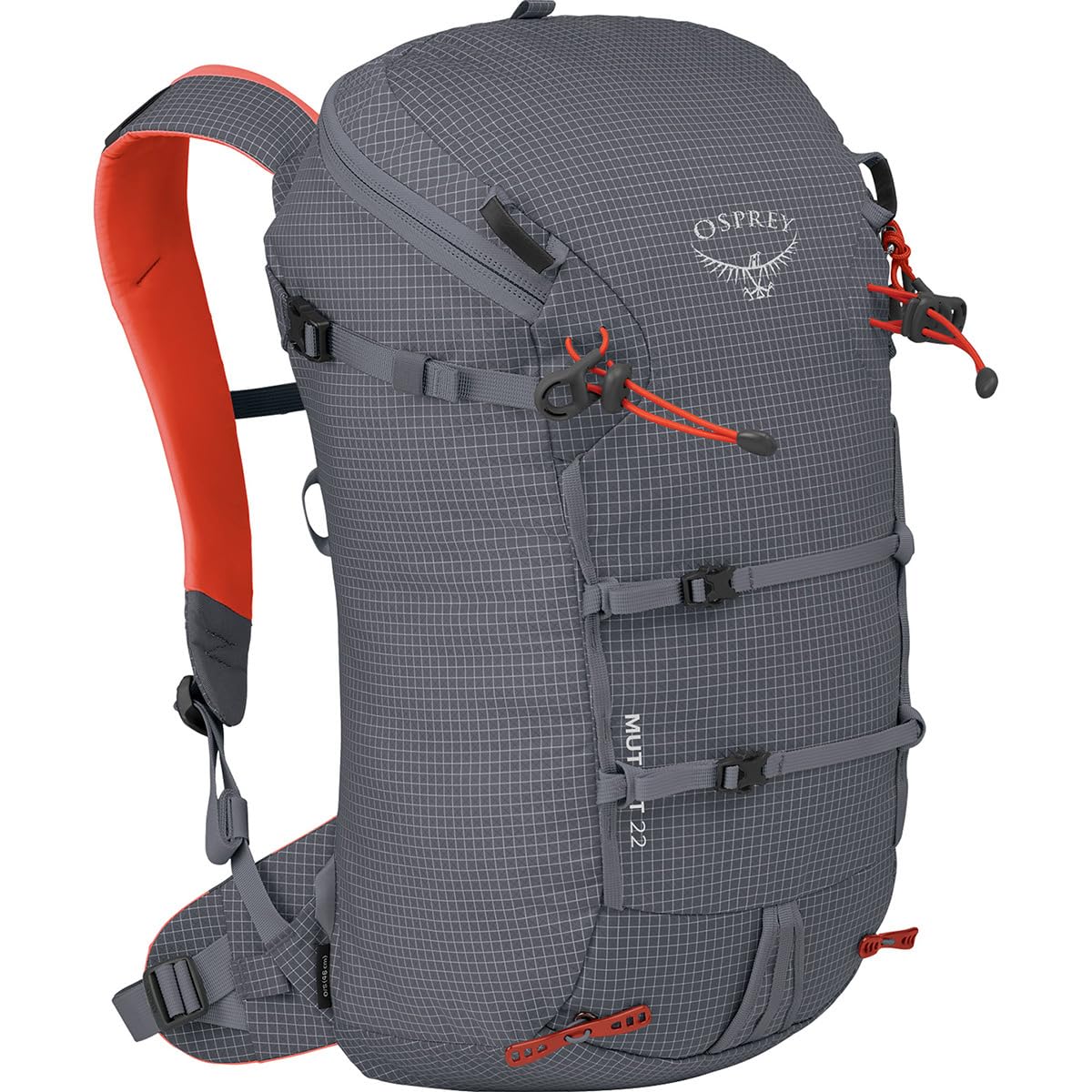
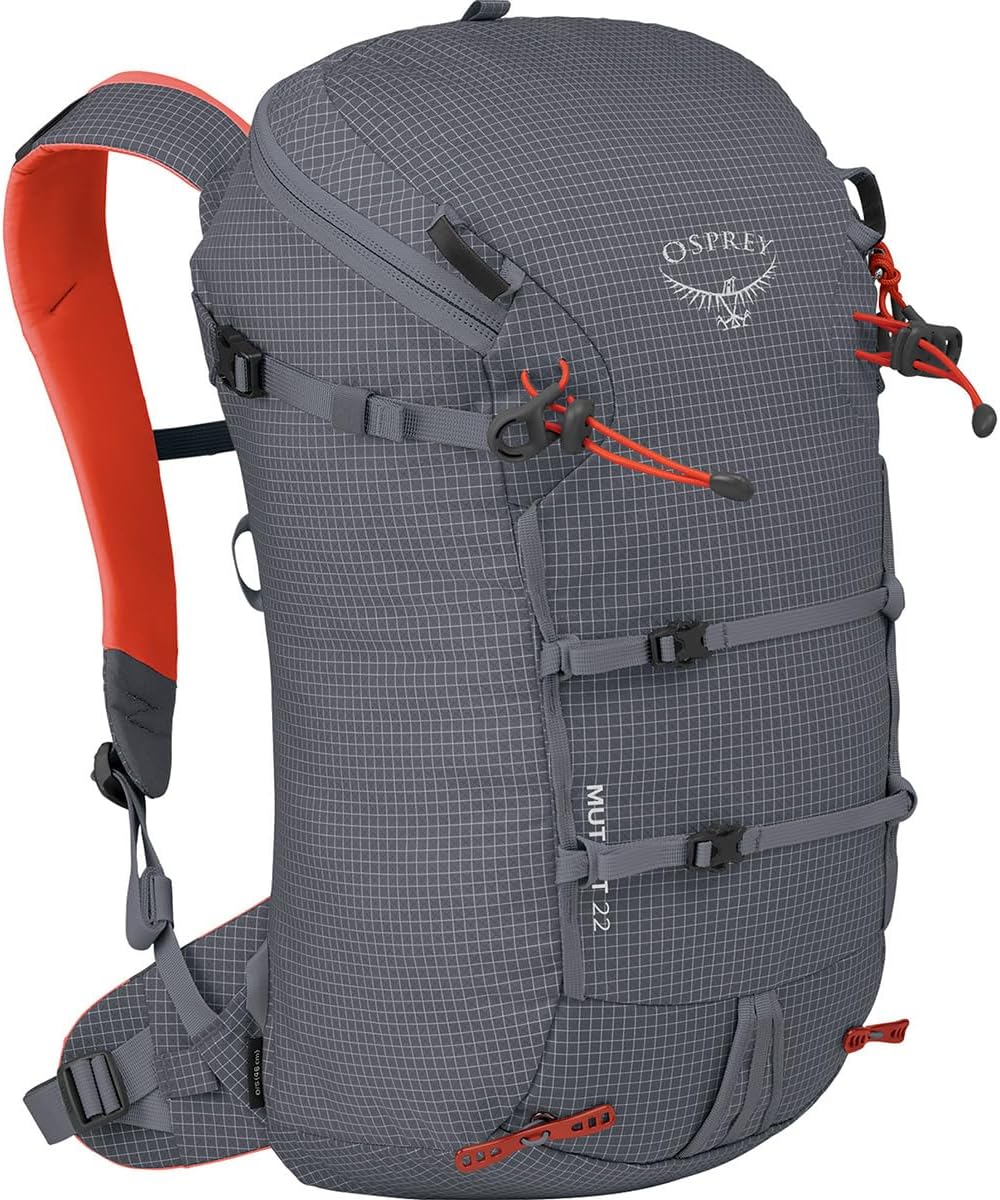
Verified specs: Osprey lists the Mutant 22 at 22 L and 0.65 kg with a recommended load range up to 11 kg.
Think of the Mutant 22 as a purpose-built daypack for steep stuff that doesn’t feel fussy when you’re not on a route. At 22 liters it’s sized to hold a harness, a pair of crampons or approach shoes, a lightweight jacket and snacks, while the rope-carry, Dual ToolLocks and exterior loops keep ice tools and a short rope neatly accessible. The updated fabrics use recycled NanoFly and robic for a lighter footprint without giving up toughness, and the suspension is tuned to sit close to your body so you feel stable on awkward terrain.
It is ideal for alpine days, ice climbs, and fast approaches. It can also work for a technical commute, but it should be treated as weather-resistant rather than waterproof. If you want a climbing-focused pack that still works off the mountain, it is a strong option.
What People Say
Buyers commonly highlight how well the Mutant handles alpine chores — people praise the durable, updated fabrics and the thoughtful tool attachment points like the Dual ToolLocks and rope-carry. Many mention the comfortable, close-fitting suspension and the handy removable hipbelt for heavier loads. A few users note the pack’s compact size can feel tight if you try to shoehorn in bulkier helmets or lots of extra gear.
Source-draft review sentiment: Positive (samples, ratings, and review counts can change)

Where It Shines
|
Situation |
How It Helps |
|---|---|
|
Alpine & Ice Climbs |
ToolLocks, rope-carry and a snowshed backpanel keep gear accessible and protected while the close-fit suspension improves balance on steep terrain. |
|
Approaches & Ski Tours |
Side loops and compatibility with Voile straps let you rig skis or long items, and the lightweight build makes longer approaches less tiring. |
|
Gym Sessions & Crag Days |
22 L is plenty for a harness, shoes and a jacket; external loops give quick spots to stash a helmet or shoes between climbs. |
|
Everyday Use |
The streamlined shape and durable materials make it a good compact option for commutes or travel when you want technical features without bulk. |
Indoor & Outdoor Use
Designed as a hybrid climbing/daypack: it performs best outdoors on alpine and ice days but translates well to gym trips or urban commutes when you want a compact, technical bag. Materials and layout stand up to outdoor wear, though the 22 L size is geared toward day use rather than overnight trips.
Why You’ll Like It
- 22 L volume sized for single-day alpine and ice missions
- Alpine-specific features: Dual ToolLocks, rope carry and snowshed backpanel
- Glove-friendly buckles and strippable features make adjustments simple when it’s cold
- Removable web belt with padded hipwings and ice gear carry loops for stability
- Internal hydration sleeve keeps you topped up without sacrificing space
- Lightweight, recycled NanoFly and robic fabrics for durability with lower impact
- Close-to-body suspension improves balance on steep approaches and exposed moves
Amazon rating snapshot in the supplied July 2026 draft: 4.8 out of 5 (10+ ratings). Check the live listing for the current figure.

Verified specs: Osprey lists size-dependent volume: 36 L and 1.14 kg for S/M, or 38 L and 1.22 kg for M/L, with a 5–13 kg load range.
If you spend time on steep routes or mixed alpine days, the Mutant 38 is built to carry a larger technical load. Capacity depends on size: Osprey lists 36 L for S/M and 38 L for M/L. That gives room for a rope, boots, helmet, harness, layers, and carefully selected overnight gear while keeping the load close to your back.
You get climbing-minded touches like Dual ToolLocks, rope-carry options, a snowshed backpanel and glove-friendly buckles, plus a removable top lid and FlapJacket for tidier access. Osprey’s recycled NanoFly and robic fabrics keep things tough without adding needless weight, and the reverse-wrap hipbelt plus internal frame help the pack feel stable when you’re hauling gear on long approaches or multi-pitch days.
It’s at home on alpine objectives, multi-pitch cragging and even as a technical daily pack when you want something streamlined and rugged. If you want a climbing-first bag that still works for travel and commuting without feeling clumsy, this is one worth considering.
What People Say
Most buyers praise the Mutant 38 for its stability and how well it carries climbing gear—people especially like the tool attachment points and the close-fitting suspension. Reviews frequently note the pack’s durable construction and lightweight feel, while a few mention the top-loading layout and limited external bottle/organization options as minor drawbacks.
Source-draft review sentiment: Positive (samples, ratings, and review counts can change)

Where It Shines
|
Situation |
How It Helps |
|---|---|
|
Alpine & Ice Climbs |
ToolLocks, rope-carry and the snowshed backpanel keep ice tools and rope tidy and protected, while the close-fit suspension helps you stay balanced on exposed pitches. |
|
Multi-Pitch & Wall Days |
The internal frame and reverse-wrap hipbelt distribute weight when you’re hauling rope and gear, and the removable lid gives quick access to belay essentials between pitches. |
|
Approaches & Fastpacking |
At 38 L you can pack a lightweight sleeping setup and a few extras; the streamlined shape and durable fabrics make longer approaches less fussy. |
|
Everyday Use & Commuting |
It doubles as a technical daypack for bike commutes or travel when you want a rugged, weather-ready bag that won’t feel oversized on city streets. |
Indoor & Outdoor Use
Designed primarily for outdoor use on alpine and climbing days, the Mutant 38 excels in harsh conditions and steep terrain but also translates well to gym trips, bike commutes or travel when you want a tough, compact pack. Its layout favors climbing gear over casual organization, so it’s best if you expect technical use more often than office-style carry.
Why You’ll Like It
- 38 L capacity fits rope, boots, harness and overnight essentials
- Alpine-specific kit: Dual ToolLocks, rope-carry and snowshed backpanel
- Close-to-body suspension and internal frame for stability on steep terrain
- Removable top lid with zip pocket, FlapJacket and stowaway pocket for organized access
- Reverse-wrap hipbelt and glove-friendly buckles for comfortable adjustments on the go
- Durable, recycled NanoFly and robic fabrics for strength with a smaller footprint
- Multiple external attachment points for crampons, ice tools and skis
Amazon rating snapshot in the supplied July 2026 draft: 4.5 out of 5 (45+ ratings). Check the live listing for the current figure.
Rope Care and Pack Safety
A rope bag helps keep dirt out of the sheath and reduces the need to coil the rope, but the bag does not replace inspection and proper storage. Petzl advises keeping ropes off the ground, drying them in a ventilated area away from UV before storage, avoiding hot car trunks, and keeping ropes away from chemicals.
Warning: Retire or quarantine a rope if you find a serious defect, chemical contamination, damage after a major load, or any condition that makes you doubt it. Follow the rope manufacturer’s inspection and retirement instructions rather than relying on the bag to protect compromised equipment.
After each trip, shake grit from the tarp and bag, let damp equipment dry fully, inspect seams and buckles, and store the rope away from sunlight, heat, sharp objects, and chemicals. See Petzl’s rope-protection guidance for more detail.
Frequently Asked Questions
How do I choose the right climbing backpack for my needs?
Start with how and where you climb. A compact 18–22 L route pack suits single-day multi-pitch use, while a 30–40 L crag or alpine pack carries more rope, layers, food, and hardware. Compare torso fit, harness clearance, suspension, closure style, tarp or rope-management features, and the durability of high-wear areas. Match capacity and construction to your normal load instead of choosing by appearance alone.
Will a lightweight rope bag keep my rope and gear safe in real conditions?
A lightweight folding bag can keep a rope off dirt, simplify transport, and reduce UV exposure during normal use. It is less suited to repeated abrasion, sharp tools, or professional job-site use than a reinforced bucket bag. It is usually water-resistant rather than waterproof, so dry wet rope before storage and use a separate waterproof liner for moisture-sensitive gear.
How should I pack and use a rope bag on the approach and at the crag?
Flake the rope onto the tarp, attach each end to a labeled tie-off if the bag provides one, and fold or roll the tarp so the rope stays contained. Keep heavy hardware close to your back, secure outside items, and avoid loose gear that can snag. After climbing, inspect the rope and bag, remove grit, dry damp equipment, and store everything away from heat, UV, and chemicals.
Is a climbing rope bag waterproof?
Most rope bags in this roundup are described as water-resistant, not waterproof. Fabric coatings may shed light moisture, but drawcord tops, zippers, seams, and open mesh panels can leak. Use an internal waterproof liner or dry bag when rain, snow, river crossings, or wet ground could soak the contents.
What size climbing backpack should I buy?
For on-route essentials, 18–22 L is a useful starting range. Around 30 L works well for gym-to-crag and commuter use. Roughly 36–40 L suits a rope, helmet, harness, layers, and longer-day gear. Your rope diameter, winter clothing, rack size, and pack torso length matter more than the number alone, so test your normal load whenever possible.
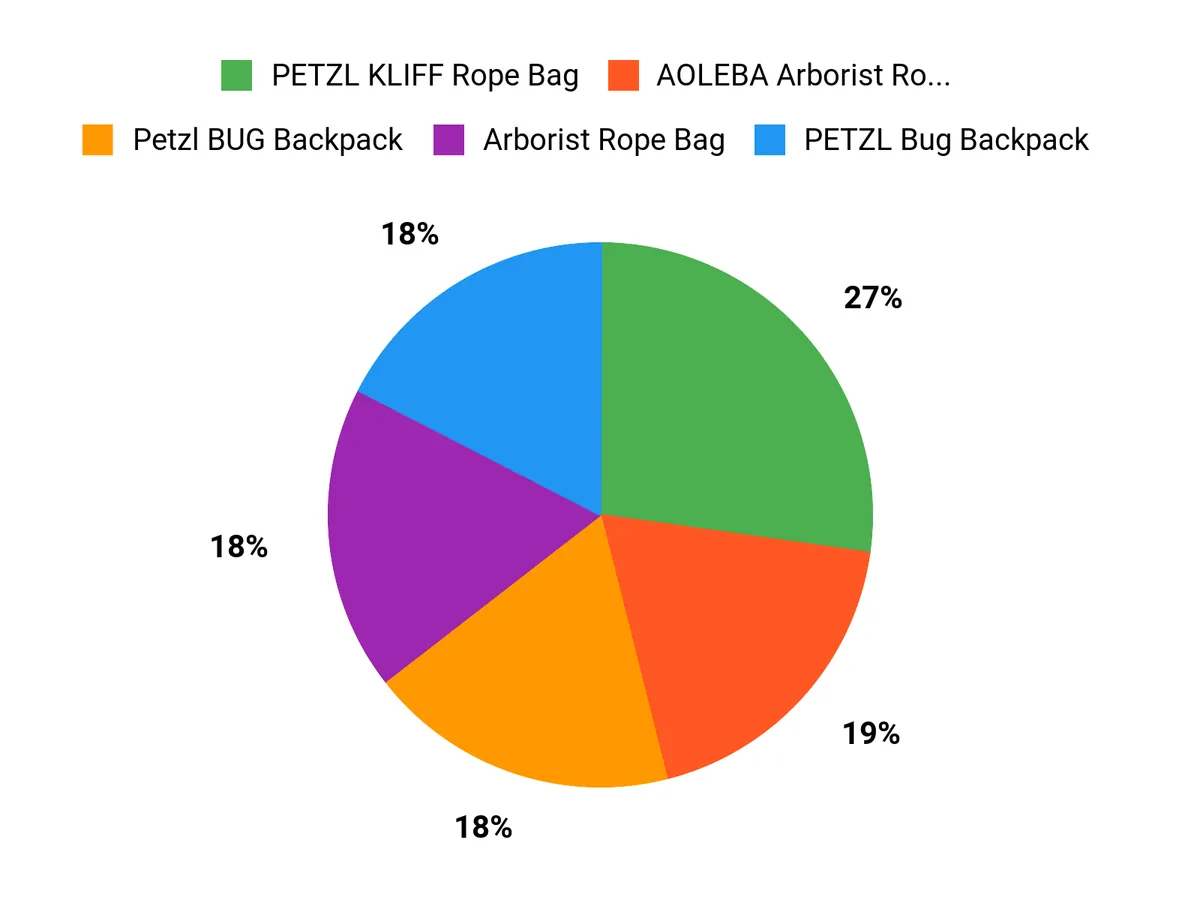
Which Pack Type Fits Your Climbing Style?
The chart below is an illustrative summary from the supplied roundup, not a representative survey of all climbers. Use it as a quick way to match priorities: a folding rope bag for compact transport, a reinforced arborist bucket for lines and tools, a crag pack for rope plus gear, a low-profile pack for climbing movement, or an alpine pack for tools and longer approaches.
Full Product Comparison
Use this table as a snapshot of the supplied July 2026 draft. Amazon ratings, review counts, availability, and seller-listed specifications can change; verified manufacturer specifications are identified where available.
| Product | Image | Rating Snapshot | Capacity | Material |
|---|---|---|---|---|
| Rock Climbing Rope Bag (Black) |
 |
4.8/5 (12-rating draft snapshot) | Seller does not state a reliable liter volume | Seller-listed 500D Oxford fabric |
| Arborist Rope Bag (Black) |
 |
4.6/5 (92-rating draft snapshot) | Seller-listed 35 L | Seller-listed 1000-denier fabric |
| Rock Climbing Rope Bag (Orange) |
 |
4.8/5 (12-rating draft snapshot) | Seller does not state a reliable liter volume | Seller-listed 500D Oxford fabric |
| AOLEBA Arborist Rope Storage Bag |
 |
4.4/5 (129-rating draft snapshot) | Seller-listed for up to 200 ft of rope | Seller-listed 1680D nylon |
| PETZL Bug Backpack (Red) |
 |
4.5/5 (draft snapshot) | 18 L | Older listing may be nylon; verify generation |
| PETZL KLIFF Rope Bag |
 |
4.6/5 (381-rating draft snapshot) | 36 L; up to 100 m of rope | Polyester fabric and straps; aluminum hook |
| Osprey Zealot 30L Climbing Backpack |
 |
5.0/5 (5-rating draft snapshot) | 30 L | 840D recycled ballistic and 630D ripstop nylon |
| Petzl BUG Backpack (Grey) |
 |
4.4/5 (120-rating draft snapshot) | 18 L | Older listing may be nylon; verify generation |
| Osprey Mutant 22L Climbing Backpack |
 |
4.8/5 (10-rating draft snapshot) | 22 L | Recycled NanoFly and robic fabrics |
| Osprey Mutant 38L Climbing Backpack |
 |
4.5/5 (45-rating draft snapshot) | 36 L (S/M) or 38 L (M/L) | Recycled NanoFly and robic fabrics |
Sources
- Petzl BUG official product page — current 18 L volume, weight, materials, colors, and product references.
- Petzl KLIFF official product page — 36 L capacity, 750 g weight, materials, and rope-bag specifications.
- Osprey Zealot owner’s manual — Zealot 30 capacity, weight, load range, materials, and compartment features.
- Osprey Mutant 22 official product page — capacity, weight, load range, and current material claims.
- Osprey Mutant 38 official product page — size-specific 36 L and 38 L specifications.
- Petzl rope-protection guidance — keeping rope off dirt and storing it dry, away from UV, heat, and chemicals.
Conclusion: Match the Pack to the Climb
For simple rope protection at a low price, the FUEMEILY bags are compact choices, but their specifications depend on the seller listing. The PAMLIAPY and AOLEBA bucket bags make more sense for lines, tools, and rougher storage needs when their current dimensions fit your equipment. For verified climbing-specific designs, the Petzl KLIFF is the strongest crag-focused pick, while the Petzl BUG is better when freedom of movement matters on a route.
The Osprey Zealot 30 is the best office-to-gym hybrid in this group. Choose the Mutant 22 for technical day objectives and the size-dependent Mutant 38 for larger alpine loads. Before buying, confirm the exact model, torso fit, live price, return policy, and whether your normal rope and gear fit without overloading the pack.
This roundup is reader-supported. Amazon affiliate links are marked as sponsored or nofollow, and we may earn a commission on qualifying purchases.
