
Last Updated on September 11, 2026 by Daniel Globe
California’s alcohol-driving laws use different blood alcohol concentration (BAC) thresholds depending on the driver. For most drivers age 21 or older, 0.08% is the per-se BAC limit, while stricter rules apply to drivers under 21, commercial drivers, passenger-for-hire drivers, and people on DUI probation. A driver can also be arrested or convicted for driving while impaired even when BAC is below a numerical limit.
Quick Answer
In California, the per-se BAC limit is generally 0.08% for ordinary adult drivers, 0.04% for commercial motor vehicle drivers and drivers carrying a passenger for hire, and 0.01% for drivers under 21 or on DUI probation. A BAC below these thresholds does not guarantee that driving is safe or lawful if alcohol has impaired your driving.
Key Takeaways
- Most drivers age 21+: California’s per-se BAC threshold is 0.08%.
- Commercial and passenger-for-hire drivers: the applicable per-se threshold can be 0.04%.
- Drivers under 21: California’s zero-tolerance rule starts at 0.01%, with an additional under-21 law at 0.05%.
- DUI probation: driving with a BAC of 0.01% or greater is prohibited under California Vehicle Code §23154.
- Below the limit is not automatically safe: California separately prohibits driving while under the influence, even without a 0.08% BAC reading.
- After an arrest: DMV administrative action and a criminal DUI case are separate processes with different consequences.
Legal information: This article provides general California driving-law information, not legal advice. DUI consequences depend on the facts, prior offenses, test results, licensing status, injuries, probation conditions, and other circumstances. For advice about a specific arrest or case, consult a qualified California attorney.
What Is California’s BAC Limit for Drivers?
California Vehicle Code §23152 makes it unlawful to drive with a BAC of 0.08% or greater. This is commonly called the per-se limit for ordinary adult drivers. The same statute separately prohibits driving while under the influence of alcohol, meaning 0.08% is not a guaranteed safe harbor.
The California Vehicle Code §23152 also sets a 0.04% threshold for a person driving a commercial motor vehicle and for a person driving when a passenger for hire is in the vehicle.
| Driver category | California BAC threshold |
| Ordinary driver age 21 or older | 0.08% or greater |
| Commercial motor vehicle driver | 0.04% or greater |
| Driver carrying a passenger for hire | 0.04% or greater |
| Driver under 21 | 0.01% or greater under zero-tolerance law; separate 0.05% provision also applies |
| Driver on qualifying DUI probation | 0.01% or greater |
Warning: A BAC below 0.08% does not mean you are automatically safe or legally protected. California separately prohibits driving while under the influence, and the California DMV warns that alcohol can impair driving below the per-se limit.
The California DMV Driver Handbook specifically warns that even one drink can affect driving ability. The safest choice is not to drive after drinking and to arrange a sober driver, rideshare, taxi, public transportation, or another safe way home.
NHTSA research found that drivers around a 0.08 breath-alcohol concentration had roughly four times the crash risk of sober drivers.
What BAC Limit Applies to Drivers Under 21?
California has a strict zero-tolerance law for drivers under 21. Under Vehicle Code §23136, it is unlawful for a person under 21 to drive with a BAC of 0.01% or greater as measured by a preliminary alcohol screening test or another chemical test.
California also has a separate under-21 provision. Vehicle Code §23140 prohibits a person under 21 from driving with a BAC of 0.05% or greater.
For DMV purposes, an under-21 driver who submits to a PAS or other chemical test showing 0.01% or more can receive a one-year suspension. Refusing or failing to complete testing required under the under-21 law can also trigger suspension or revocation consequences.
Under-21 drivers also face additional rules about carrying alcohol in a vehicle. The California DMV states that, subject to limited exceptions, an under-21 driver generally may not carry alcohol in a vehicle unless accompanied by someone age 21 or older. An opened container must be kept in the trunk or another area where passengers do not normally sit.
Because several statutes can potentially apply to the same incident, a 0.01% result should not be described as simply the equivalent of an ordinary adult DUI conviction. The exact legal and licensing consequences depend on the test result and circumstances.
What BAC Rules Apply to Commercial and Probationary Drivers?
California imposes stricter thresholds on certain drivers. Under Vehicle Code §23152, a person may not drive a commercial motor vehicle with a BAC of 0.04% or greater. The same 0.04% threshold applies when a person is driving a motor vehicle while a passenger for hire is a passenger in the vehicle.
For drivers on qualifying DUI probation, the statutory rule is different from the article’s former 0.0% description. Vehicle Code §23154 prohibits a person on probation for specified DUI offenses from operating a motor vehicle with a BAC of 0.01% or greater.
Because 0.01% is an extremely low threshold, the practical safety approach for anyone on DUI probation is to avoid drinking before driving altogether. A qualifying probationary driver who tests at 0.01% or more can face a separate DMV administrative suspension, and refusing required testing can produce even longer consequences.
How Do Breath and Blood BAC Tests Work?
California DUI investigations can involve a roadside preliminary alcohol screening test and, after a lawful DUI arrest, a separate chemical breath or blood test. These are not the same legal step.
Products Worth Considering

QUICKLY & EASILY ESTIMATE YOUR BAC - Proprietary Advanced MicroCheck Sensor technology delivers results in seconds.

ESTIMATE YOUR ALCOHOL LEVEL WITH PRO-GRADE ACCURACY - Powered by BACtrack's patented BluFire Fuel Cell Sensor, the C8 utilizes the same professional-grade technology trusted by hospitals, clinics, and even law enforcement

ESTIMATE YOUR ALCOHOL LEVEL WITH PRO-GRADE ACCURACY - Powered by BACtrack's patented BluFire Fuel Cell Sensor, the C6 utilizes the same professional-grade technology trusted by hospitals, clinics, and even law enforcement.
Breath Test Basics
A breath-testing device measures alcohol in a breath sample. California’s per-se DUI statute defines alcohol concentration using either grams of alcohol per 100 milliliters of blood or grams of alcohol per 210 liters of breath.
A roadside preliminary alcohol screening (PAS) test is primarily an investigative tool. For an ordinary adult driver who is not subject to a special under-21 or probationary testing rule, Vehicle Code §23612 says an officer using PAS must advise the person that the test is being requested to help determine whether the person is under the influence and that the person has a right to refuse the preliminary screening test.
That roadside PAS does not satisfy the separate chemical-testing requirement that applies after a lawful DUI arrest. Drivers under 21 and drivers on qualifying DUI probation have separate statutory testing requirements, so the PAS rules differ for those groups.
Blood Test Accuracy
A blood test directly analyzes alcohol in a collected blood sample rather than estimating alcohol concentration from breath. Like any forensic evidence, its reliability depends on proper collection, identification, storage, equipment, laboratory procedures, and analysis.
After a lawful arrest for an alcohol DUI, California’s implied-consent statute generally requires chemical testing and normally gives the arrested person a choice between an available blood or breath test. Special rules apply when a test is unavailable, when drug impairment is suspected, or when medical conditions affect the available test.
- A roadside PAS is primarily an investigative screening tool.
- A post-arrest chemical test is a separate legal requirement under California’s implied-consent law.
- Refusing or failing to complete a required post-arrest chemical test can cause DMV suspension or revocation consequences.
Pro Tip: If you are trying to understand a past DUI arrest, distinguish the roadside PAS result from the later evidentiary breath or blood result. The legal rules and DMV consequences are not identical.
What Alcohol Rules Apply Inside a Vehicle?
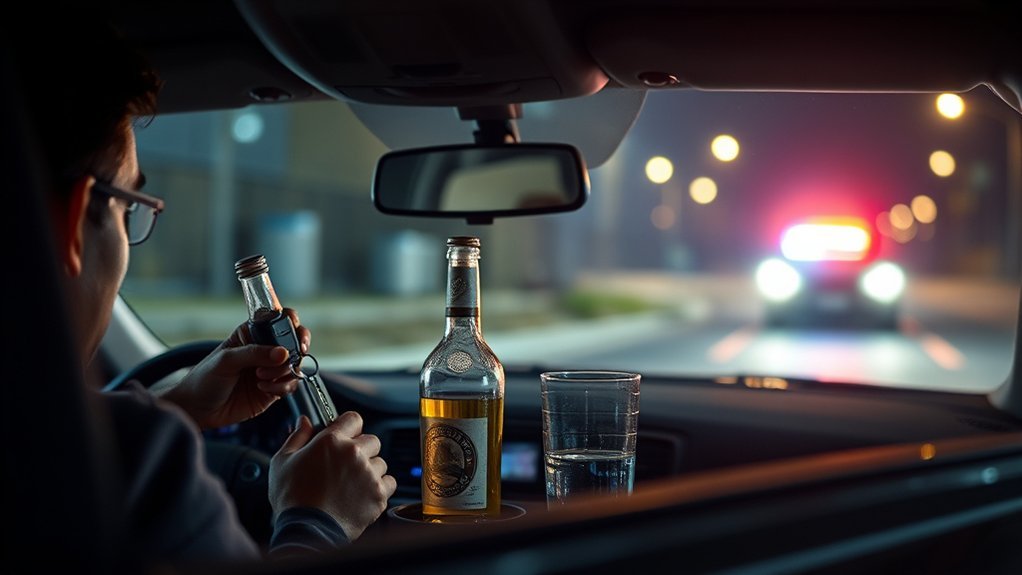
California regulates both consuming alcohol inside vehicles and possessing opened alcohol containers. Opened alcohol generally must be kept outside the normal passenger area, usually in the trunk. California also regulates opened cannabis containers and cannabis use in vehicles.
Open Container Rules
California law generally prohibits a driver from possessing an opened alcoholic-beverage container while driving on a highway. It also restricts passengers from possessing open alcohol containers in applicable vehicles.
Under Vehicle Code §23225, an opened alcohol container generally must be kept in the trunk. If the vehicle has no trunk, it must be stored in another area that is not normally occupied by the driver or passengers. A glove compartment or utility compartment is considered part of the occupied area for this rule.
- Keep unopened alcohol containers sealed during transportation.
- Put an opened alcohol container in the trunk when the statute requires it.
- If there is no trunk, use an area not normally occupied by the driver or passengers.
- Do not assume a glove box qualifies as lawful out-of-reach storage.
California also restricts drivers from possessing opened cannabis containers or loose cannabis flower while driving, subject to statutory exceptions. The trunk is specifically recognized as lawful storage for an opened cannabis receptacle under the applicable provision.
Passenger Consumption Limits
California generally prohibits drivers and passengers from drinking alcoholic beverages in a motor vehicle on a highway, subject to statutory exceptions. Similar restrictions apply to smoking or ingesting cannabis in a vehicle.
These rules are separate from DUI law. A person does not have to reach a 0.08% BAC for an open-container or in-vehicle-consumption law to matter.
Storage And Exemptions
California has limited exceptions to some passenger and open-container restrictions. Vehicle Code §23229 provides exemptions in specified circumstances involving passengers in certain licensed buses, taxicabs, and limousines for hire, as well as the living quarters of a housecar or camper and certain pedicabs.
Those are specific statutory exceptions, not a general rule allowing alcohol anywhere in a bus, taxi, camper, or motorhome. When transporting an opened container in an ordinary passenger vehicle, using the trunk is the straightforward compliance rule.
What Happens After a DUI Arrest in California?
A California DUI arrest can create two separate tracks: a DMV administrative case affecting driving privileges and a criminal case in court. A favorable result in one does not automatically resolve the other.
Under California’s Administrative Per Se (APS) process, an officer may take a California driver license, serve an order of suspension or revocation, and issue a temporary license that is generally valid for 30 days. The California DMV states that a driver generally has 10 days after receiving the suspension notice to request an administrative hearing.
The DMV hearing is an opportunity to challenge whether the administrative suspension or revocation is justified. Depending on the type of case, the issues can include the basis for the stop or arrest, the BAC result, testing, or an alleged refusal.
Warning: DMV hearing deadlines are short. Anyone dealing with an actual DUI arrest should check the notice received from the officer and obtain case-specific legal advice promptly rather than relying only on a general article.
For a driver age 21 or older who submits to chemical testing and has a BAC of 0.08% or greater, DMV currently describes a first APS offense as a four-month suspension. A second or subsequent qualifying offense within 10 years can result in a longer administrative action.
Refusing or failing to complete a required post-arrest chemical test can independently trigger suspension or revocation. Under California Vehicle Code §13353, a first qualifying refusal generally results in a one-year suspension, with longer revocations possible for repeat events.
What Are the DUI Penalties in California?
California DUI penalties depend on prior convictions, injuries, BAC, refusal, probation, and other facts. For a first violation of Vehicle Code §23152, the statutory base fine is generally $390 to $1,000. Court assessments, DUI-program charges, insurance costs, towing, license fees, ignition-interlock costs, and legal expenses can make the real financial burden much higher than the base fine.
California law also allows jail penalties. Vehicle Code §23536 specifies up to six months for a first violation, while sentencing can differ when probation is granted and according to the circumstances of the case.
For a first offender receiving probation, Vehicle Code §23538 generally requires a licensed DUI program. A first offender whose BAC was below 0.20% is generally referred to a program lasting at least three months, while a first offender at 0.20% or greater—or a person who refused chemical testing—can be referred to a program lasting at least nine months.
- Base fine: generally $390 to $1,000 for a first §23152 conviction.
- DUI program: commonly at least three months for qualifying first offenders, with longer programs in specified cases.
- Jail: possible, with the statutory maximum for a first §23152 offense reaching six months.
- DMV action: administrative and conviction-based license consequences can apply separately.
- Financial responsibility: DMV may require proof such as an SR-22/SR-1P before driving privileges are fully restored.
- Ignition interlock device: an IID may be required or may provide a restricted-driving option depending on the offense and circumstances.
California extended its statewide ignition interlock device (IID) pilot program through December 31, 2032. The current program generally requires IIDs for specified repeat and injury-involved alcohol DUI offenders, while different options can apply to qualifying first offenders.
For current licensing requirements, see the California DMV statewide IID program.
How Can You Lower BAC and Stay Safe?
You cannot quickly reverse alcohol impairment with coffee, exercise, cold showers, food, water, or fresh air. Once alcohol has entered your bloodstream, your body needs time to process it.
Food eaten before or while drinking may affect how quickly alcohol is absorbed, and water can help with hydration, but neither removes alcohol already circulating in your body. That is why a fixed “wait X hours” formula is unsafe: alcohol absorption and elimination vary among people and situations.
Counting drinks can help you understand how much alcohol you consumed, but it should not be used as permission to drive. The National Institute on Alcohol Abuse and Alcoholism defines one U.S. standard drink as about 14 grams of pure alcohol—roughly 12 ounces of 5% beer, 5 ounces of 12% wine, or 1.5 ounces of 40% distilled spirits.
NIAAA notes that a pattern reaching approximately 0.08% BAC for a typical adult often corresponds to about four drinks for a woman or five drinks for a man in about two hours. That is population-level guidance, not an individual BAC calculator. Body size, biological factors, drinking speed, alcohol strength, food, medications, and other variables can change the result.
Pro Tip: If there is any doubt about whether alcohol remains in your system or whether you are impaired, do not drive. Arrange another ride rather than trying to calculate yourself down to a legal threshold.
Frequently Asked Questions
How Many Drinks Is the 0.08 Alcohol Limit?
There is no universal drink count that guarantees a 0.08% BAC. NIAAA says a typical binge-drinking pattern reaching about 0.08% often corresponds to roughly four drinks for an adult woman or five for an adult man in about two hours, but individual BAC can differ substantially. Never use that estimate to decide that you are safe to drive.
How Many 0.5 Beers to Be Over the Limit?
There is no reliable universal number. The phrase “0.5 beer” can mean either half a beer or a beverage containing about 0.5% alcohol by volume. Those are very different amounts of alcohol. BAC depends on the total pure alcohol consumed, time, body characteristics, food, and other factors, so drink counting should not be used to decide whether to drive.
Is 40% Alcohol the Same as 80 Proof?
Yes. Under the U.S. proof system for distilled spirits, proof is twice the percentage of alcohol by volume. Therefore, 40% ABV equals 80 proof.
How Long Will 4 Beers Show up on a Breathalyzer?
There is no fixed detection time for four beers. The answer depends on the beer’s alcohol content and serving size, how quickly it was consumed, the person, and how much time has passed. Alcohol can remain measurable for hours, and a person should not rely on a fixed hourly formula to decide when driving is safe.
Can You Get a DUI in California Below 0.08% BAC?
Yes. California Vehicle Code §23152 separately prohibits driving while under the influence of alcohol. The 0.08% provision is a per-se threshold, not a rule saying every driver below 0.08% is legally safe to drive.
Is a Roadside PAS Test the Same as the Post-Arrest Chemical Test?
No. A PAS is generally a preliminary investigative breath test. For an ordinary adult driver, California law requires the officer to advise that the roadside PAS may be refused. A PAS does not satisfy the separate post-arrest chemical-testing obligation under implied consent. Different rules apply to drivers under 21 and drivers on DUI probation.
Conclusion
California’s DUI laws use several BAC thresholds rather than one universal number. For most adult drivers, 0.08% is the per-se limit; commercial motor vehicle drivers and drivers carrying passengers for hire face a 0.04% threshold; and drivers under 21 or on qualifying DUI probation face a 0.01% rule.
Those numbers should never be treated as targets. California can prosecute impaired driving below 0.08%, and alcohol can affect driving before a person feels obviously intoxicated. NHTSA research has found that drivers around 0.08 alcohol concentration have roughly four times the crash risk of sober drivers.
The safest approach is simple: if you have been drinking, do not drive. Plan a sober ride instead of trying to estimate your BAC from the number of drinks or the amount of time that has passed.
Sources
- California DMV — Alcohol and Drugs — current BAC thresholds, DUI arrest process, under-21 rules, conviction requirements and vehicle alcohol guidance.
- California Vehicle Code §23152 — DUI, 0.08% per-se limit, commercial-driver and passenger-for-hire 0.04% thresholds.
- California Vehicle Code §23136 — under-21 0.01% zero-tolerance rule.
- California Vehicle Code §23154 — 0.01% rule for drivers on qualifying DUI probation.
- California Vehicle Code §23612 — preliminary alcohol screening and post-arrest chemical-testing rules.
- National Institute on Alcohol Abuse and Alcoholism — Standard Drinks — U.S. standard-drink definitions and alcohol-content guidance.
