
Last Updated on September 10, 2026 by Daniel Globe
Good hiking boots are not simply the heaviest, tallest, or most expensive pair on the shelf. The right footwear matches your feet, the trail, the weather, the load you carry, and the way you hike. A lightweight hiking shoe can be ideal for an easy day hike, while a supportive backpacking boot makes more sense for rough terrain and heavier loads.
Quick Answer
Good hiking boots fit snugly without squeezing, leave room for your toes, grip the terrain well, and provide enough underfoot protection for your route and pack weight. Choose waterproof boots for persistently wet conditions and more breathable, non-waterproof footwear for hot or dry trails where fast drying matters more.
Hiking footwear falls into several broad groups. Lightweight hiking shoes and trail-running shoes favor flexibility, low weight, and breathability. Mid-cut day-hiking boots add more structure and protection. Backpacking boots are generally stiffer and more robust for long trips and heavier packs, while mountaineering boots are specialized footwear for snow, ice, alpine terrain, and compatible traction equipment.
There is no single type that is best for everyone. The goal is to use enough shoe or boot for the conditions without carrying unnecessary weight or sacrificing comfort.
Key Takeaways
- Match hiking footwear to terrain, trip length, pack weight, weather, and your own foot shape.
- Fit matters more than brand name. Your heel should feel secure while your toes still have room to move.
- Waterproof membranes are useful in sustained wet conditions but usually run warmer than highly ventilated non-waterproof footwear.
- Outsole rubber, lug pattern, midsole stiffness, shanks, rock plates, and toe protection can matter as much as boot height.
- A taller boot can provide more structure and protection around the ankle, but no ordinary hiking boot guarantees protection from ankle sprains.
- Break in substantial boots before a major trip and replace footwear when traction, cushioning, waterproofing, or structural integrity is badly worn.
Disclosure: As an Amazon Associate I earn from qualifying purchases. Some links on this page are affiliate links, at no extra cost to you.
Types of Hiking Boots and Hiking Shoes
The best starting point is deciding how much footwear you actually need. Current hiking-footwear guidance from REI separates lighter hiking footwear from day-hiking, backpacking, and mountaineering boots based on terrain, load, protection, and stiffness.
| Footwear Type | Best Use | Main Trade-Off |
| Trail-running shoe | Fast hiking, maintained trails, light packs | Very light and flexible, but usually less protective than a boot |
| Hiking shoe | Day hikes and light-to-moderate terrain | Good balance of protection and weight, with less ankle coverage |
| Day-hiking boot | Rockier trails, longer day hikes, moderate loads | More structure and protection with added weight and warmth |
| Backpacking boot | Multi-day travel, rough terrain, heavier packs | Stiffer and more durable, but heavier and slower to break in |
| Mountaineering boot | Snow, glaciers, technical alpine terrain | Maximum stiffness and specialized protection, but excessive for ordinary trails |
Note: Boot height alone does not determine support. Midsole stiffness, heel hold, outsole width, shanks, rock plates, overall fit, and your pack weight all influence how stable and protected the footwear feels.
Factors to Consider When Choosing Hiking Boots
Start with the trail rather than the brand. Rocky routes, muddy paths, maintained dirt trails, pavement, snow, and steep alpine terrain place different demands on footwear.
Terrain
For smooth, maintained trails, a lightweight hiking shoe may provide all the protection you need. Rougher ground with roots, loose rock, repeated descents, or off-trail travel can justify a firmer midsole, stronger toe protection, and a more substantial outsole.
Mud favors deeper, more widely spaced lugs that can shed debris. Firm trails usually need less aggressive tread. On smooth wet rock, rubber compound and the amount of sole contacting the surface can matter as much as dramatic lug depth.
Pack Weight and Trip Length
A lightweight day pack puts fewer demands on footwear than a multi-day backpack. As the load and terrain become more demanding, many hikers prefer a stiffer platform and more underfoot protection.
That does not mean every backpacker requires a heavy leather boot. Experienced hikers with light packs often use hiking shoes or trail runners. The important question is whether the footwear gives you enough comfort, protection, traction, and control for the load and terrain.
Weather and Temperature
Hot, dry conditions usually favor breathable footwear. Persistent rain, wet grass, mud, slush, or shallow stream crossings can make waterproof footwear more useful.
For snow and ice, footwear choice is only part of the system. Conditions may require insulated boots, gaiters, traction devices, or mountaineering crampons. The National Park Service notes that icy trails may require additional traction attached to hiking shoes or boots.
Warning: Ordinary hiking-boot tread is not a substitute for appropriate traction equipment on steep ice. For mountaineering or technical winter travel, make sure your boot and crampon system are designed to work together.
Finding the Right Fit for Your Feet
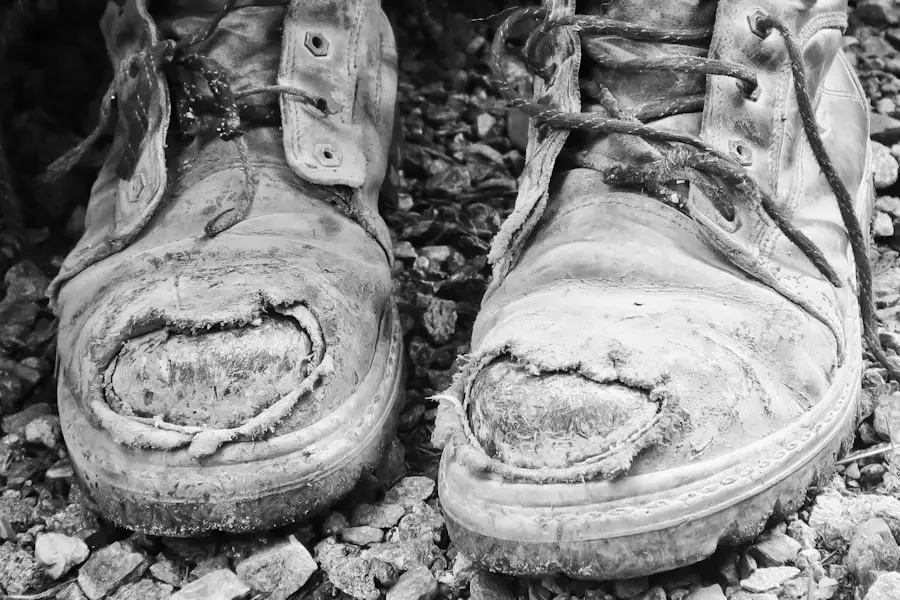
Fit is one of the most important parts of choosing hiking footwear. A technically impressive boot is still a poor choice if it pinches your forefoot, lets your heel slide, or drives your toes into the front on descents.
Try boots toward the end of the day, when your feet may be somewhat larger after normal activity. Wear the same thickness and type of socks you expect to use while hiking. The REI hiking-footwear fitting guide recommends a fit that is snug without being tight and leaves enough room to wiggle your toes.
Check Length and Toe Room
Remove the insole and stand on it. As a practical starting point, look for roughly a thumb’s width between your longest toe and the end of the insole. Your toes should not strike the front of the boot when you walk down an incline.
Check Heel Hold
Your heel should feel secure rather than lifting dramatically with every step. A little movement may occur in some footwear, but repeated rubbing is a warning sign for hot spots and blisters.
Check Width and Foot Volume
Length is only one measurement. A boot can be the correct numerical size and still be wrong because the forefoot is too narrow, the heel cup is too wide, or there is too much or too little room over the top of your foot.
Many footwear lines come in regular and wide versions. People using prescription orthotics or aftermarket insoles should bring them when trying on footwear because they can change the available volume and heel position.
Test the Boots on an Incline
Walk uphill and downhill if the store has an incline or test ramp. On the descent, your toes should not repeatedly contact the front. On the ascent, check for excessive heel lift. Also pay attention to seams, pressure points, arch discomfort, and rubbing.
Pro Tip: Do not buy painful boots expecting them to become the right size after break-in. Leather and other materials can soften and conform somewhat, but break-in cannot create adequate length or correct a fundamentally wrong foot shape.
How to Break In Hiking Boots
Flexible hiking shoes may feel comfortable almost immediately. Stiffer backpacking and mountaineering boots usually benefit from gradual break-in before a long trip.
- Wear the same socks and insoles you plan to use on the trail.
- Start with short periods around the house or neighborhood while the footwear remains returnable under the seller’s policy.
- Progress to short local walks with gentle elevation.
- Add your normal day pack and test steeper climbs and descents.
- Address rubbing, heel movement, or pressure points before committing to an all-day or multi-day hike.
Break-in should make a suitable boot more familiar and flexible. It should not be used to force an obviously poor fit.
Material and Construction of Hiking Boots
| Current Model Example | Materials | Construction / Technology |
| Salomon Quest 4 GORE-TEX | Leather/textile upper, GORE-TEX membrane, rubber outsole | 4D Advanced Chassis, All-Terrain Contagrip outsole |
| Merrell Moab 3 Mid GORE-TEX | Leather and breathable mesh upper, GORE-TEX membrane | Molded nylon shank, heel cushioning, Vibram TC5+ outsole |
| KEEN Targhee IV Waterproof | Nubuck leather upper, breathable lining, waterproof membrane | KEEN.DRY waterproofing, KEEN.FUSION construction, stability shank and KEEN.RUGGED outsole |
These are model-specific examples, not brand-wide specifications. Materials and technologies vary between footwear models and can change between generations.
Leather
Full-grain and nubuck leather are common in more substantial hiking and backpacking boots because they resist abrasion well and can provide a supportive upper. Their disadvantages include added weight, reduced ventilation compared with open mesh, and a longer break-in period in many designs.
Synthetic Materials and Mesh
Nylon, polyester, synthetic leather, and engineered mesh are commonly used to reduce weight and improve drying time. Highly ventilated synthetic footwear can be particularly comfortable in warm weather.
Durability depends on the exact material and design. It is too simplistic to assume that every leather boot lasts longer than every synthetic boot.
Construction Quality
Look at the entire boot rather than relying on a stitched-versus-glued rule. Modern hiking footwear may use cemented, molded, direct-attach, stitched, or fused construction. Check the quality of the upper-to-sole bond, stitching, protective rand, toe cap, eyelets, and flex points. Some premium boots can also be resoled, which may extend their useful life when the upper remains healthy.
Waterproofing and Breathability in Hiking Boots
Waterproof hiking boots commonly use an internal waterproof/breathable membrane. GORE-TEX footwear technology, for example, is designed to prevent liquid water from passing inward while allowing water vapor to move outward.
That does not make waterproof footwear the best choice for every hike. A waterproof membrane adds another barrier between your foot and the outside air. Compared with highly ventilated non-waterproof mesh shoes, waterproof models can feel warmer and may hold more internal moisture during hot or strenuous hikes.
Choose Waterproof Footwear When
- You regularly hike through wet grass, mud, rain, slush, or shallow water.
- Cold conditions make wet feet especially uncomfortable.
- You value keeping external water out more than maximum ventilation.
Choose Non-Waterproof Footwear When
- You mostly hike in hot or dry climates.
- You sweat heavily and prioritize ventilation.
- You expect footwear to get soaked and prefer faster drying over keeping water out.
Note: Mesh on the outside of a waterproof boot can improve flexibility and reduce weight, but the waterproof barrier comes from the membrane or waterproof bootie inside the footwear—not from the mesh itself.
Outsoles, Lugs, and Trail Traction
The outsole is your contact point with the trail, so traction should be evaluated separately from waterproofing or ankle height.
Hiking outsoles typically use rubber with raised tread blocks called lugs. Lug depth, direction, spacing, rubber compound, and the width of the outsole all affect how the footwear behaves.
- Hard-packed trails: Moderate lugs are usually sufficient.
- Mud: Deeper, widely spaced lugs help bite into soft ground and release packed debris.
- Loose or rocky terrain: Multidirectional lugs and a stable platform help during climbing, braking, and side-to-side movement.
- Smooth wet rock: Rubber compound and surface contact become especially important; aggressive tread alone does not guarantee grip.
Some boots also use a pronounced heel-brake area to improve control on descents.
Support and Stability Features in Hiking Boots
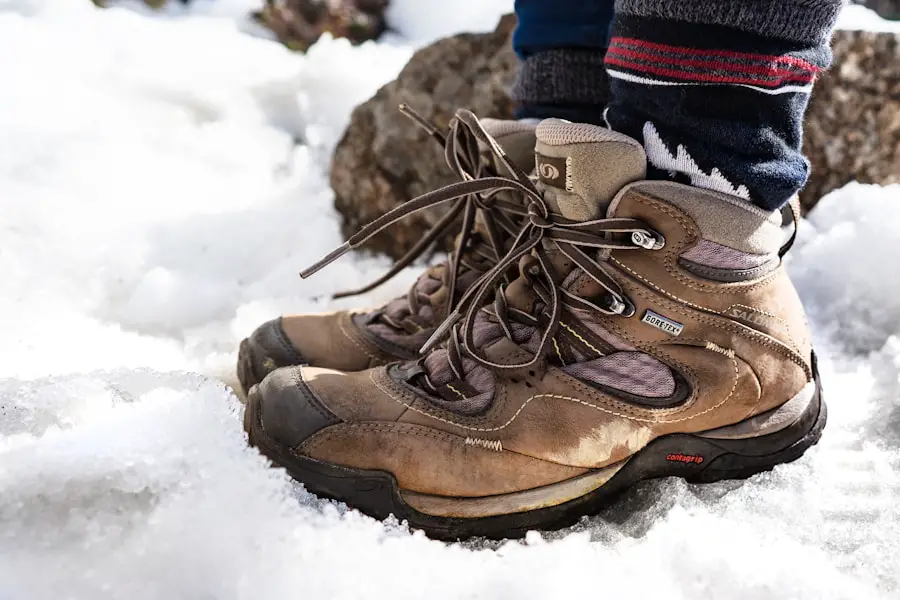
Support comes from several parts of the footwear working together. A taller collar can provide more structure around the ankle and protect it from brush, debris, and minor impacts. Stiffer midsoles can reduce excessive flex on rocky ground, while a secure heel cup can help keep the foot from sliding inside the boot.
However, it is better to think of these features as tools for structure, load handling, protection, and comfort rather than a guarantee against ankle injuries. Footwear cannot eliminate the risk created by unstable terrain, fatigue, poor footing, or previous injuries.
Midsoles
The midsole provides cushioning and controls much of the boot’s stiffness. EVA foam is common because it is relatively light and cushioned. Firmer materials such as TPU may appear in more supportive footwear where durability and stiffness are priorities.
Shanks
A shank is a structural element between layers of the sole. It adds load-bearing stiffness and helps prevent the footwear from folding too easily over uneven ground.
Rock Plates
A rock plate is a protective layer that reduces pressure from sharp rocks and can increase torsional stiffness. Rock plates are especially common in trail-running shoes and lightweight hiking footwear that need protection without the mass of a very thick sole.
Toe Caps and Rands
Rubber toe caps and protective rands shield the upper from repeated scraping and help protect your toes from bumps against rocks or roots.
The best hiking boot is the lightest and most comfortable option that still gives you enough fit, traction, protection, and structure for the trail you are actually hiking.
Hiking Socks, Insoles, and Lacing Matter Too
A good boot can perform badly with the wrong sock or poor lacing. The National Park Service hiking-safety guidance recommends wool or synthetic moisture-wicking socks for longer hikes.
Use socks similar in thickness to those worn during fitting. A much thicker sock can make a correctly sized boot too tight, while a much thinner sock can increase movement inside the footwear.
Aftermarket insoles may help adjust cushioning, arch feel, or shoe volume. Custom orthotics should be tested inside the exact boot before purchase.
Lacing can also fine-tune fit. Different patterns can reduce heel lift, relieve pressure over the top of the foot, or improve forefoot security, but lacing cannot rescue a boot that is fundamentally the wrong shape or size.
Durability and Longevity of Hiking Boots
A durable boot needs more than a tough-looking upper. Inspect the outsole, midsole, flex points, toe protection, eyelets, seams, and the bond between the upper and sole.
Leather remains a strong choice for abrasive environments, but modern synthetic boots can also be highly durable. How long either type lasts depends on mileage, terrain, moisture, storage, body weight, pack weight, construction, and maintenance.
Signs Your Hiking Boots May Need Replacement
- Lugs are worn smooth enough to noticeably reduce traction.
- The outsole is separating from the upper.
- The midsole feels permanently compressed or uneven.
- The upper has cracks, tears, or failed seams that compromise protection.
- A waterproof boot repeatedly leaks because the membrane or construction has failed.
- The heel counter no longer holds your foot securely.
- The footwear causes new pain or instability despite correct sizing and lacing.
How to Care for Hiking Boots
Regular cleaning helps protect materials and lets you spot damage before a trip. After muddy hikes, remove loose dirt with a soft brush and clean the footwear according to the manufacturer’s instructions.
For GORE-TEX footwear, GORE-TEX care instructions recommend removing laces, shaking out dirt, brushing away loose debris, washing with lukewarm water and a small amount of liquid detergent, and drying naturally at moderate temperatures.
Warning: Avoid drying hiking boots directly against a heater, stove, fire, or other intense heat source. Excessive heat can damage leather, adhesives, waterproof components, and other materials.
If the outer surface of waterproof footwear stops beading water, follow the footwear or membrane manufacturer’s directions for restoring its durable water-repellent treatment. Leather boots may require a different conditioner or treatment, so always follow the instructions for that specific product.
Budget-Friendly Options for Hiking Boots
You do not need the most expensive boot in the store for an easy local trail. Budget-friendly hiking footwear can work well when it fits correctly and provides the traction and protection your hiking actually requires.
Start by deciding which features are essential. Paying extra for a highly rigid backpacking boot makes little sense if you only take short walks on maintained trails. Likewise, buying an ultralight shoe solely because it is inexpensive may be poor value if your normal hikes involve sharp rock, mud, heavy packs, or extended wet weather.
Previous-season models can offer good value, especially when the update is mainly cosmetic. Outlet sales can also reduce the cost of established designs.
Pro Tip: Prioritize fit over a bargain. A deeply discounted boot that pinches, slips, or does not match your terrain is more expensive in practice than a comfortable pair you will actually use.
If you’re looking for the perfect gear for your outdoor adventures, you may also be interested in checking out this article on the best solar-powered camping lanterns. Just like choosing the right hiking boots, having dependable equipment that matches the conditions can make a camping trip safer and more comfortable.
Love travel? Join Our Facebook Community For More Tips.
Frequently Asked Questions
What are good hiking boots?
Good hiking boots fit your feet securely, leave adequate toe room, grip the terrain, and provide enough cushioning, stiffness, and protection for your route and pack weight. Waterproofing is useful for wet conditions but is not automatically better for hot or dry trails.
What should I look for in a good hiking boot?
Check fit first, then evaluate outsole traction, underfoot protection, midsole stiffness, heel hold, toe protection, upper durability, breathability, waterproofing, weight, and suitability for the terrain and load you expect to carry.
What are the different types of hiking boots?
Common choices include trail-running shoes, low-cut hiking shoes, mid- or high-cut day-hiking boots, backpacking boots, and mountaineering boots. As footwear becomes more specialized for heavy loads and difficult terrain, it usually becomes stiffer, heavier, and more protective.
How do I choose the right hiking boot for me?
Start with your normal terrain, trip duration, pack weight, and climate. Then try footwear that matches those conditions and choose the model that best fits your foot length, width, volume, and heel shape. Fit should take priority over brand reputation.
How should hiking boots fit?
They should feel snug but not tight. Your heel should remain secure, your toes should be able to wiggle, and your toes should not strike the front during descents. As a useful starting check, stand on the removed insole and look for roughly a thumb’s width between your longest toe and its end.
Are waterproof hiking boots better?
Not always. Waterproof boots are useful in sustained rain, wet grass, mud, slush, and cold wet conditions. Non-waterproof footwear can be more comfortable in hot, dry weather because it generally ventilates and dries faster.
Do high hiking boots prevent ankle sprains?
A higher or stiffer boot can provide additional structure, coverage, and a feeling of support, but ordinary hiking boots should not be treated as guaranteed protection against ankle sprains. Fit, fatigue, terrain, strength, previous injuries, and how you move all affect injury risk.
How do I care for my hiking boots?
Remove dirt after hikes, clean the footwear according to its manufacturer’s instructions, and let it dry at moderate temperatures away from direct heat. Apply only treatments that are suitable for the upper material and waterproof technology used in your specific boot.
Sources
- U.S. National Park Service — Hike Smart — hiking footwear, socks, equipment, and trail-safety guidance.
- REI — How to Choose Hiking Boots and Hiking Shoes — footwear types, terrain, components, fit, toe room, socks, and break-in guidance.
- GORE-TEX — Footwear Technology — waterproof and breathable membrane function.
- GORE-TEX — Footwear Care Instructions — cleaning, drying, and water-repellent treatment guidance.
- Merrell — Moab 3 Mid GORE-TEX — current example of leather/mesh construction, shank, waterproof membrane, and Vibram outsole.
- KEEN — Targhee IV Waterproof Hiking Boot — current example of waterproof membrane, fused construction, shank, and rugged outsole.

