

Last Updated on November 4, 2026 by Logan Reeves
If you are looking for the best water filters for old pipes, start by identifying what is coming from your faucet. Rust particles, sediment, iron, and dissolved lead need different filtration methods. The Frizzlife MS99 is worth considering for a filtered refrigerator or drinking-water line, while the Waterdrop Whole House Water Filter System is better suited to treating sediment, iron, and chlorine in incoming water. Reusable spin-down filters can also help catch larger particles before they reach appliances. This guide compares five practical options and explains what each filter can and cannot do.
Disclosure: As an Amazon Associate I earn from qualifying purchases. Some links on this page are affiliate links, at no extra cost to you.
Quick Answer: The best filter depends on your water test results and where contamination enters your plumbing.
For a compatible refrigerator or drinking-water line, the Frizzlife MS99 offers independently certified lead-reduction capabilities. For incoming iron, sediment, and chlorine, consider the Waterdrop Whole House Water Filter System.
If your main problem is sand or visible rust particles arriving from the water supply, a Waterdrop Spin Down Sediment Filter can work as a reusable first-stage prefilter. However, coarse sediment filters are not a substitute for certified drinking-water lead filters.
Important Safety Note: Old pipes can release lead and other metals into drinking water. A whole-house filter installed before your home’s interior plumbing cannot remove lead released by pipes farther downstream. If lead is a concern, test your water and choose a point-of-use filter with independently verified lead-reduction certification. A filter does not repair damaged or corroded plumbing.
Key Takeaways
- For lead concerns: Choose a drinking-water filter independently certified to NSF/ANSI 53 for lead reduction. NSF/ANSI 42 Class I particulate reduction is another useful verified claim.
- For rust and sediment: Whole-house sediment filters help catch particles entering the property before they reach appliances and fixtures.
- For iron and manganese: Use a system specifically designed for those contaminants, based on water testing.
- For reusable filtration: Spin-down filters can be flushed instead of requiring frequent disposable cartridge changes.
- For installation: Check the connection type, pipe diameter, flow rate, operating pressure, and available installation space.
- For long-term safety: Maintain your filters and address deteriorating plumbing rather than depending on filtration alone.
Top Water Filter Picks
Compare the five options below by their main filtration purpose, suitable installation location, and limitations.
| Product | Image | Best For | Filtration | Installation | Main Limitation | Amazon | Review |
|---|---|---|---|---|---|---|---|
| Frizzlife Inline Water Filter System for Fridge |  |
Best for Filtered Drinking Water | Type: Inline carbon-based filtration with NSF/ANSI 42 and 53 certified claims | Use: Compatible refrigerator or under-sink drinking-water line | Limitation: Filters only the connected water line | Check Price on Amazon | Read Our Analysis |
| Waterdrop Whole House Water Filter System |  |
Best Combined Whole-House Filtration | Type: Sediment, carbon, iron, and manganese treatment | Use: Incoming household water | Limitation: Not certified as a point-of-use lead filter | Check Price on Amazon | Read Our Analysis |
| Waterdrop Spin Down Sediment Filter System |  |
Best Reusable Sediment Prefilter | Type: Reusable spin-down mesh filtration | Use: Whole-house incoming water prefiltration | Limitation: Does not remove dissolved lead | Check Price on Amazon | Read Our Analysis |
| WHC40 Reusable Spin Down Sediment Water Filter | Best Adjustable Mesh Options | Type: 40, 100, and 200-micron mesh options | Use: Whole-house sediment prefiltration | Limitation: Captures particles, not dissolved contaminants | Check Price on Amazon | Read Our Analysis | |
| 50 Micron Spin Down Sediment Filter for Water | 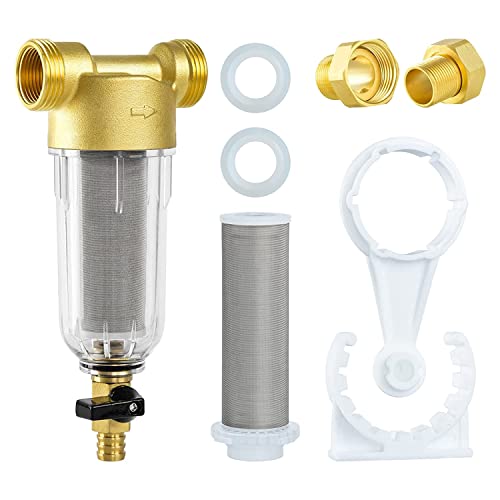 |
Best Basic 50-Micron Prefilter | Type: 50-micron reusable sediment mesh | Use: Compatible water inlet or appliance supply | Limitation: Connection size and whole-house capacity need checking | Check Price on Amazon | Read Our Analysis |
How We Selected These Water Filters
These products were compared using their intended filtration purpose, available specifications, installation requirements, maintenance needs, and relevance to common problems in older plumbing systems.
Priority was given to products that address a specific buyer need, such as certified lead reduction at a drinking-water outlet or removal of incoming rust and sediment. Products with unsuitable applications or unclear drinking-water benefits were excluded.
Selection note: These are specification-based recommendations, not claims of personal hands-on testing. Product details, replacement requirements, and certification status should be confirmed for the exact model before purchase.
More Details on Our Top Picks
-
Frizzlife Inline Water Filter System for Fridge
If your older home’s plumbing raises concerns about lead in drinking water, the Frizzlife MS99 Inline Water Filter System deserves attention for a compatible refrigerator or drinking-water line. Unlike a basic sediment screen, this model has independently certified contaminant-reduction claims under NSF/ANSI 42 and 53, including lead reduction.
The system uses a replaceable carbon-based filtration cartridge. It can help reduce specified contaminants while improving chlorine-related taste and odor. This makes it particularly useful if you regularly drink water from a refrigerator dispenser or use filtered refrigerator water for ice.
Another advantage is its inline installation design. The manufacturer describes compatibility with common 3/8-inch water connections and suitable PEX or flexible copper tubing configurations. It also features a twist-in cartridge replacement mechanism.
Why You’ll Like It: This is a more targeted choice for drinking-water lead concerns than a coarse whole-house sediment filter. Its certified reduction claims provide a clearer basis for selection.
Who Should Buy This: Homeowners who want filtered water from a compatible refrigerator, ice maker, or dedicated under-sink water line.
Who Should Avoid This: Anyone needing full-house filtration or a system that treats every drinking-water faucet without additional plumbing.
Important limitation: The MS99 filters only water passing through its connected line. It does not correct corrosion elsewhere in your plumbing. The manufacturer’s replacement guidance varies by contaminant, usage, and cartridge, so check the current certified capacity and replacement instructions rather than assuming the cartridge will provide two full years of lead reduction.
- Filtration Type: Inline carbon-based filtration
- Compatible Use: Refrigerator, ice maker, or compatible drinking-water connection
- Certification: IAPMO R&T certification against NSF/ANSI 42 and 53 for specified claims
- Contaminant Focus: Certified lead reduction, particulate reduction, and chlorine taste and odor reduction
- Connection: Designed around common 3/8-inch US water supply connections
- Maintenance: Replaceable internal cartridge
- Additional Feature: Twist-in cartridge replacement
- Additional Feature: Compatible with specified PEX and flexible copper tubing arrangements
- Main Limitation: Point-of-use filtration only
-
Waterdrop Whole House Water Filter System
The Waterdrop Whole House Water Filter System is a practical option when incoming water contains sediment, iron, manganese, or chlorine. It combines sediment filtration with carbon and iron/manganese-reduction media to address several water-quality problems.
Its two-housing, multi-stage design is useful for homeowners who want more than a basic particle screen. The filtration process targets larger particles, including rust and sand, while the carbon stage can help improve chlorine-related taste and odor.
Waterdrop advertises a flow rate of up to 15 gallons per minute for the applicable system configuration. Actual household flow depends on plumbing conditions, incoming pressure, cartridge condition, and installation.
Why You’ll Like It: One system addresses several common incoming-water problems instead of relying on a single coarse mesh filter.
Who Should Buy This: Homeowners with tested iron or manganese concerns, sediment-heavy incoming water, or a need for combined sediment and carbon filtration.
Who Should Avoid This: Anyone expecting the system alone to solve lead contamination caused by old interior pipes.
Important limitation: NSF/ANSI 372 certification concerns lead content in product materials. It is not proof that a system removes dissolved lead from your water. This filter also cannot remove contamination introduced by pipes located after the filter.
- Filtration Type: Multi-stage sediment, carbon, and iron/manganese filtration
- Compatible Use: Whole-house incoming water
- Filtration Design: Two filter housings with multiple treatment stages
- Particle Filtration: Nominal 5-micron filtration described for the system
- Flow Rate: Advertised up to 15 GPM under specified conditions
- Maintenance: Replace cartridges according to usage and manufacturer instructions
- Additional Feature: Targets incoming sediment and rust particles
- Additional Feature: Carbon filtration for chlorine-related taste and odor
- Main Limitation: Not a substitute for certified point-of-use lead reduction
-
Waterdrop Spin Down Sediment Filter System
If you frequently find sand, grit, or rust particles in incoming water, the Waterdrop Spin Down Sediment Filter System offers a reusable first-stage filtration approach.
The system uses a stainless steel mesh screen to intercept larger particles before they move through downstream plumbing and water-using appliances. The product listing describes 50-micron and 200-micron mesh options, allowing you to select the appropriate screen for your water conditions.
A major advantage is its reverse-flush cleaning mechanism. Instead of replacing a disposable sediment cartridge whenever it becomes dirty, you can flush accumulated particles through the drain arrangement according to the manufacturer’s instructions.
The applicable Waterdrop spin-down series advertises flow of up to 20 GPM. Actual flow and pressure loss vary with water conditions, mesh selection, and installation.
Why You’ll Like It: Reusable filtration and a visible filter housing make this a convenient choice when incoming sediment requires frequent attention.
Who Should Buy This: Homeowners wanting a maintainable sediment prefilter ahead of compatible household filtration equipment.
Who Should Avoid This: Anyone who needs dissolved lead, chlorine, bacteria, or other dissolved contaminants removed from drinking water.
Important limitation: This is a coarse particle filter. It is not a complete drinking-water purification system, and it will not remove rust or lead introduced by interior pipes after its installation point.
- Filtration Type: Reusable spin-down sediment filtration
- Compatible Use: Whole-house incoming-water prefiltration
- Mesh Options: 50 and 200 microns as described for the listed configuration
- Material: Stainless steel mesh with a durable housing
- Maintenance: Reverse-flush cleaning
- Flow Rate: Advertised up to 20 GPM for the applicable series
- Additional Feature: Transparent sediment collection housing
- Additional Feature: Reusable mesh design
- Main Limitation: Coarse sediment removal only
-
WHC40 Reusable Spin Down Sediment Water Filter
Best Adjustable Mesh Options
Check Price on AmazonThe WHC40 Reusable Spin Down Sediment Water Filter is another useful option when incoming water contains visible sediment, sand, or rust particles.
Its main advantage is filtration flexibility. Product listings describe interchangeable 40, 100, and 200-micron mesh elements. These options let you adapt the prefilter to different levels of incoming sediment.
The finer 40-micron screen captures smaller particles than the coarser 100 or 200-micron versions. However, finer screens can also require more frequent flushing when water contains substantial debris.
The WHC40 uses a transparent housing for inspecting collected sediment. Its reusable design lets you flush the filter periodically instead of disposing of an entire cartridge.
Why You’ll Like It: Multiple mesh choices can be helpful when you are still determining which prefiltration level works best with your incoming water.
Who Should Buy This: Homeowners with changing sediment loads or well-water supplies who want adjustable coarse filtration.
Who Should Avoid This: Anyone needing a stand-alone filter certified to remove dissolved lead or other health-related contaminants.
Important limitation: The mesh options capture particles, not dissolved metals. Confirm the package contents, fittings, pressure rating, and replacement screen availability for the exact listing before purchase.
- Filtration Type: Reusable spin-down sediment filtration
- Compatible Use: Whole-house incoming-water prefiltration
- Mesh Options: 40, 100, and 200 microns
- Material: Brass valve head and stainless steel mesh
- Connections: Listed with 1-inch MNPT and 3/4-inch threaded connection options
- Maintenance: Periodic flushing and mesh inspection
- Additional Feature: Transparent housing
- Additional Feature: Changeable coarse-filtration screens
- Main Limitation: Does not remove dissolved lead
-
50 Micron Spin Down Sediment Filter for Water
The 50 Micron Spin Down Sediment Filter is worth considering when your main goal is to intercept larger sediment particles without adding a complex multi-stage treatment system.
The identified product listing describes a reusable stainless steel mesh prefilter for compatible whole-house, well-water, and appliance applications. Its 50-micron screen is intended to trap particles such as sand, dirt, and visible rust flakes.
This type of prefilter can help reduce the particle load reaching finer downstream cartridges. It can also be useful when sediment contributes to clogging in water-using equipment.
Why You’ll Like It: A simple reusable mesh provides an easy-to-understand solution for coarse sediment problems.
Who Should Buy This: Homeowners who need basic incoming-water particle filtration and have confirmed that the device fits their plumbing and required flow.
Who Should Avoid This: Anyone looking for certified lead removal, chemical filtration, or guaranteed full-house flow without checking the specifications.
Important limitation: A 50-micron screen cannot capture all fine particles and does not remove dissolved contaminants. Confirm the actual inlet and outlet connection sizes, pressure ratings, installation requirements, and potable-water suitability before using it in household plumbing.
- Filtration Type: 50-micron sediment mesh
- Compatible Use: Compatible whole-house inlet or appliance prefiltration
- Material: Brass and stainless steel components described in product listings
- Installation: Connection specifications must be verified
- Maintenance: Flushable and reusable design
- Primary Benefit: Captures larger sand, dirt, and rust particles
- Additional Feature: Suitable as a first-stage sediment filter where specifications match
- Additional Feature: Reusable mesh construction
- Main Limitation: Does not provide dissolved-contaminant treatment
Factors to Consider When Choosing Water Filters for Old Pipes
The right filter depends on your plumbing material, incoming water quality, and the contaminants you need to reduce. Before choosing a system, use the following factors to narrow your options.
1. Identify Your Water Contamination Problem
Start with a water test instead of relying only on color, taste, or odor. Older plumbing can cause several different problems.
- Rust and sediment: May appear as orange, brown, or gritty particles. Sediment filtration can help remove particles passing through the filter.
- Dissolved lead: Can enter water from older service lines, solder, or plumbing components. It cannot be reliably detected by taste, smell, or appearance.
- Iron and manganese: May cause staining, discoloration, and unpleasant taste. Treatment depends on the form and concentration of these metals.
- Chlorine taste and odor: Carbon filtration can improve taste when the system has suitable verified reduction claims.
- Hardness and scale: Usually require water-softening or other specifically designed treatment rather than a basic sediment screen.
If you use municipal water, review your utility’s water quality report and ask about service-line materials. For private well water, arrange appropriate laboratory testing.
When lead is suspected, request a test designed to evaluate lead at the tap. This helps you identify whether your plumbing is contributing contamination.
2. Look for Verified Lead-Reduction Certification
If lead is your main concern, do not assume that any water filter will remove it.
Look for a system independently certified for lead reduction under NSF/ANSI 53. EPA also recommends checking for NSF/ANSI 42 Class I particulate reduction when selecting filters for lead-related concerns.
These standards address different aspects of filtration:
- NSF/ANSI 42: Covers specified aesthetic claims such as chlorine taste and odor, and can include particulate reduction.
- NSF/ANSI 53: Covers specified contaminants associated with health effects, including lead when that claim is part of the certification.
- NSF/ANSI 372: Addresses lead content in product materials. It does not establish that a filter removes lead from water.
Certification to a standard does not mean every contaminant covered by that standard is removed. Always verify the exact model, contaminant claim, rated capacity, and replacement cartridge.
For additional guidance, see the EPA guide to identifying lead-reduction filters and NSF’s explanation of water treatment standards.
3. Choose the Right Filtration Location
Where you install a filter matters just as much as the filtration method.
Point-of-entry filters treat water as it enters the property. They can reduce incoming sediment and other specified contaminants before the water travels through household plumbing.
Point-of-use filters treat water close to where it is consumed, such as at a kitchen faucet or refrigerator drinking-water line.
If lead enters the water through interior pipes, a suitable point-of-use filter located after those pipes is generally more directly relevant to reducing lead exposure at that outlet.
Pro Tip: A whole-house sediment filter and a certified drinking-water filter can serve different purposes. You may need both when incoming water contains sediment and older indoor plumbing also raises lead concerns.
4. Compare Micron Ratings
A micron rating tells you the approximate particle size a filter is designed to capture. Lower numbers generally indicate finer particle filtration, but actual performance also depends on whether the rating is nominal or absolute.
| Micron Rating | Typical Purpose | Important Limitation |
|---|---|---|
| 200 microns | Larger debris and coarse incoming sediment | Allows smaller particles through |
| 40–100 microns | Sand, grit, and larger visible rust particles | Not a dissolved-metal filter |
| 5 microns | Finer sediment and small suspended particles | Does not automatically remove dissolved lead |
| 0.5 micron | Fine particle filtration in suitable cartridge systems | Contaminant claims still require specific certification |
A finer mesh is not always the best first stage. Heavy sediment can quickly clog a small-pore cartridge, causing pressure loss and more frequent replacement.
5. Check Compatibility With Pipe Sizes
Older homes can have different plumbing materials and connection types. Check the filter’s inlet and outlet specifications before ordering.
Common threaded plumbing sizes include 1/2-inch, 3/4-inch, and 1-inch connections. However, matching the number alone is insufficient.
Verify whether the connections use NPT plumbing threads, garden-hose threads, compression fittings, or another connection type. These are not automatically interchangeable.
Also inspect the condition of nearby pipes and valves. Old galvanized or corroded connections can be difficult to loosen without causing damage.
Compatibility Note: If your home has aging or fragile plumbing, consult a licensed plumber before modifying the water line.
6. Consider Flow Rate and Water Pressure
Whole-house filters must supply enough water for the fixtures and appliances you use at the same time.
Check the manufacturer’s flow rating, the pressure available at your property, and any pressure loss caused by the selected cartridge or mesh.
A filter advertised at 15 or 20 gallons per minute may not achieve that rate in your home. Actual performance changes with water pressure, pipe diameter, sediment accumulation, and installation conditions.
If your existing pipes already restrict water pressure, adding an undersized or clogged filter can make the problem worse.
7. Evaluate Maintenance and Durability
Filter maintenance is particularly important when incoming water contains substantial sediment.
Reusable spin-down filters need periodic flushing. Fine sediment cartridges usually need replacement according to their rated capacity, service interval, or pressure-loss condition.
Carbon-based drinking-water cartridges also have contaminant-specific performance limits. Replace them before their certified capacity is exceeded.
Look for accessible replacement parts, a reliable housing design, and installation space that allows safe servicing.
Transparent prefilter housings can help you notice accumulated debris, but visual inspection alone cannot confirm that a drinking-water cartridge is still effectively reducing lead.
8. Understand the Limits of Corrosion Protection
Corrosion in aging pipes may release metal particles and dissolved contaminants into water. Sediment filters can remove some of the particles traveling through them, but they cannot reverse corrosion.
Iron-removal systems may help control iron already present in incoming water. They do not automatically prevent existing household pipes from corroding.
If testing shows lead or copper entering water because of plumbing materials, replacing problem components and correcting underlying water chemistry may be necessary.
Do not rely on filtration as a permanent substitute for repairing unsafe plumbing.
Before You Buy: Water Filter Checklist
Check these details before purchasing:
- Identify the contaminants using suitable water tests.
- Confirm whether contamination enters before or after the proposed filter location.
- Verify the exact product model and certified reduction claims.
- Match pipe size, thread type, pressure rating, and flow requirements.
- Check whether replacement cartridges or mesh screens are available.
- Confirm whether the system is intended for potable-water use.
- Allow enough space for maintenance, cartridge changes, or drain connections.
- Check whether professional installation is recommended for your plumbing.
Frequently Asked Questions
How Do I Know if My Pipes Need a Water Filter?
Brown or cloudy water, visible sediment, metallic taste, and recurring fixture clogs can indicate water-quality problems. However, some contaminants, including dissolved lead, have no noticeable taste, smell, or color. Test your water and identify the source of contamination before selecting a filter.
Can Water Filters Remove Lead From Old Pipes?
Some filters can reduce lead in drinking water, but not every filter is designed or certified to do so. Choose a point-of-use system independently certified under NSF/ANSI 53 for lead reduction, and verify the specific contaminant claim and rated capacity. A filter does not remove lead from the pipes themselves or repair the plumbing.
Can a Sediment Filter Remove Rust From Old Pipes?
A sediment filter can capture rust particles passing through its filter media, provided those particles are within its effective filtration range. It cannot remove rust attached to the inside of pipes or stop new corrosion. If rust forms after the filter, those particles may still reach your faucet.
Is a Whole-House Filter Enough for Old Plumbing?
Not always. A whole-house filter can improve incoming water quality, but it cannot remove contamination introduced after its installation point. If older interior plumbing releases lead, you may also need a certified point-of-use filter at each relevant drinking-water outlet and a plan to address the plumbing.
How Often Should I Replace My Water Filter?
Replacement depends on the filter type, water quality, daily usage, and manufacturer instructions. Some cartridges require replacement after a specified number of months or gallons, whichever limit comes first. Reusable spin-down mesh filters are typically flushed periodically. Follow the certified capacity for health-related contaminant reduction rather than relying only on the cartridge’s appearance.
Are Water Filters Compatible With All Pipe Materials?
No. Compatibility depends on the fitting, connection size, operating pressure, temperature, and pipe material. Older galvanized pipes and corroded connections may need professional attention before installation. Always confirm the manufacturer’s plumbing requirements.
Do I Need Professional Help to Install a Water Filter?
Some point-of-use filters can be installed with basic tools when their connections match your plumbing. Whole-house systems often require more work, including water-line modifications, mounting, and pressure management. Professional installation is advisable if your plumbing is aging, leaking, or difficult to access.
Can a Water Filter Improve Low Water Pressure?
A water filter generally does not increase the pressure supplied to your home. In fact, a clogged or undersized filter can reduce flow. If low pressure is caused by mineral buildup or corrosion inside old pipes, filtration alone will not correct the restriction.
Does Boiling Water Remove Lead?
No. Boiling does not remove lead from water. If lead contamination is suspected, use an appropriate certified treatment system or another verified safe drinking-water source while investigating the problem.
Should I Replace Old Pipes or Install a Water Filter?
These solutions address different problems. A suitable water filter can reduce specified contaminants, while replacing hazardous or deteriorating plumbing addresses the source. If testing identifies lead from pipes or fixtures, contact your water utility or a qualified plumbing professional about replacement options. Filtration can serve as an exposure-reduction measure, but it should not be treated as a repair.
Conclusion
The best water filter for old pipes depends on whether you are dealing with dissolved lead, incoming sediment, iron, or other water-quality problems.
For a compatible refrigerator or drinking-water line where lead reduction matters, the Frizzlife MS99 is a strong option because of its independently certified contaminant-reduction claims. For broader treatment of incoming sediment, iron, manganese, and chlorine, consider the Waterdrop Whole House Water Filter System.
If you mainly need reusable coarse sediment filtration, the Waterdrop Spin Down Sediment Filter System offers a practical backwashing design. The WHC40 provides multiple mesh options, while the 50 Micron Spin Down Sediment Filter offers a simpler particle-filtration approach where installation specifications match.
Final Recommendation
For lead concerns: Prioritize a certified point-of-use filter and verify its exact lead-reduction claims.
For incoming rust, sediment, or iron: Match your filter to water test results and the particle or contaminant type.
For aging or unsafe pipes: Address the plumbing problem itself. A filter can improve water quality within its verified capabilities, but it cannot repair deteriorating pipes.
Start with water testing, verify the filter’s specifications, and maintain the system according to the manufacturer’s instructions. This approach helps you make a more informed choice without expecting one filter to solve every problem caused by old plumbing.
