

Last Updated on November 4, 2026 by Caleb Warren
If you want the best electronic door locks for homes in 2026, start by deciding whether you need a keypad deadbolt for your front door or a keyless handle for easier room access. Our top picks include the Veise Keyless Entry Deadbolt with Lever Handles, Amazon Basics Electronic Keypad Deadbolt, Veise Keypad Door Lock with Handle, and TMEZON Smart Fingerprint Door Lock. Each offers a different balance of convenience, access control, and installation requirements.
The Veise deadbolt-and-lever set is our Best Overall choice for buyers who want a traditional deadbolt with keypad entry. The Amazon Basics model is a straightforward alternative, while the Veise keypad handle and TMEZON fingerprint lock suit buyers who prefer integrated handle-based access.
Disclosure: As an Amazon Associate I earn from qualifying purchases. Some links on this page are affiliate links, at no extra cost to you.
Quick Answer: Which Electronic Door Lock Should You Choose?
For a standard home entry door, the Veise Keyless Entry Deadbolt with Lever Handles is the most complete option in this comparison because it combines an electronic deadbolt with matching lever handles.
If you prefer fingerprint unlocking for a bedroom, home office, or suitable interior door, consider the TMEZON Smart Fingerprint Lock. Always verify door compatibility and intended installation location before ordering.
Key Takeaways
- Best Overall: Veise Keyless Entry Deadbolt with Lever Handles for keypad-controlled deadbolt access and coordinated hardware.
- Best Simple Deadbolt: Amazon Basics Electronic Keypad Deadbolt for straightforward keypad and mechanical-key operation.
- Best Keypad Handle: Veise Keypad Door Lock with Handle for convenient PIN access using an integrated handle.
- Best Fingerprint Option: TMEZON Smart Fingerprint Door Lock for biometric entry and local Bluetooth app control.
- Important: A keypad handle lock is not automatically equivalent to a separate deadbolt. Check the locking mechanism, door measurements, and outdoor suitability before buying.
Our Top Electronic Door Lock Picks
| Veise Keyless Entry Door Lock with Lever Handles |  |
Best Overall | Lock Type: Electronic keypad deadbolt with lever handles | Access: Up to 20 user codes and mechanical keys | Best For: Home entry doors with compatible deadbolt and handle preparations | Check Price on Amazon | Read Our Analysis |
| Amazon Basics Electronic Keypad Deadbolt Door Lock | Best Simple Deadbolt | Lock Type: Electronic single-cylinder deadbolt | Access: Six user codes and keyed entry | Best For: Buyers who want basic electronic deadbolt operation without app connectivity | Check Price on Amazon | Read Our Analysis | |
| Veise Keypad Door Lock with Handle and Code |  |
Best Keypad Handle | Lock Type: Electronic keypad handle lock | Access: Up to 21 user codes and backup keys | Best For: Compatible doors needing convenient keypad-operated handle access | Check Price on Amazon | Read Our Analysis |
| TMEZON Smart Fingerprint Keyless Entry Door Lock |  |
Best Fingerprint Option | Lock Type: Biometric electronic handle lock | Access: Fingerprint, PIN, IC card, Bluetooth app, and key | Best For: Bedrooms, home offices, and other suitable interior doors | Check Price on Amazon | Read Our Analysis |
Before You Choose: The first two recommendations are electronic deadbolts. The other two are electronic handle locks. For an exterior entry door, confirm that the selected product meets your security requirements, fits your door, and is approved by its manufacturer for the installation environment.
More Details on Our Top Picks
-
Veise Keyless Entry Door Lock with Lever Handles
The Veise Keyless Entry Door Lock with Lever Handles is our top choice for homeowners who want keypad convenience while retaining a familiar deadbolt locking mechanism. Unlike an electronic handle-only lock, this set includes an electronic deadbolt and matching lever handles.
You can create up to 20 user codes for household members and other authorized users. The lock also supports one-time access codes, making it useful when you need to provide temporary entry without sharing your regular PIN.
The backlit keypad helps with nighttime entry, while the adjustable auto-lock function can be set between 10 and 99 seconds. Two mechanical keys provide an alternative way to unlock the deadbolt if keypad access becomes unavailable.
The satin nickel finish offers a coordinated appearance. The included handles may also simplify your hardware selection when replacing an existing compatible deadbolt-and-handle arrangement.
Why You’ll Like It: You get keypad access, a separate deadbolt mechanism, matching handles, and mechanical-key backup in one package.
Best For: Homeowners replacing a compatible deadbolt and handle set who want straightforward keyless entry without relying on a smartphone.
Who Should Avoid It: Buyers looking specifically for fingerprint unlocking, Wi-Fi connectivity, or app-based remote access.
Before You Buy: Check your door thickness, backset, bore dimensions, and the distance between the deadbolt and handle holes. The manufacturer documentation specifies a minimum center-to-center clearance of approximately 4 inches between the deadbolt and handle preparations.
- Lock Type:Electronic keypad deadbolt with separate lever handles
- Keyless Entry:Up to 20 user codes
- Temporary Access:Supports one-time access codes
- Auto-Lock:Adjustable delay from 10 to 99 seconds
- Installation:Designed for compatible standard US door preparations
- Backlit Keypad:Yes
- Backup Entry:Two mechanical keys
- Power Source:Four AA batteries
- Additional Feature:One-touch locking
- Additional Feature:Mute mode
- Additional Feature:Vacation mode
Our Verdict: This is the most practical all-around pick in our comparison for someone who specifically wants an electronic keypad deadbolt with coordinated lever handles. Confirm mechanical fit and current warranty terms before purchase.
-
Amazon Basics Electronic Keypad Deadbolt Door Lock
Best Simple Deadbolt – Straightforward Keyless Access
Check Price on AmazonIf you prefer a simple electronic deadbolt without extra smart-home features, the Amazon Basics Electronic Keypad Deadbolt is worth considering. It combines keypad entry with a conventional mechanical key, giving you two familiar ways to access a compatible door.
The lock supports up to six customizable user codes and provides an option for temporary single-use codes. That capacity can be enough for a smaller household that does not need dozens of permanent access credentials.
You can configure the automatic locking delay between 10 and 99 seconds. A one-touch locking function also makes it easier to secure the deadbolt without entering your access code every time.
Another useful feature is its straightforward operation. You do not need to connect a phone or manage an online account to use the keypad functions. The traditional key remains available as a backup entry method.
Why You’ll Like It: It focuses on essential electronic deadbolt functions instead of adding app settings or biometric enrollment.
Best For: Households that need a limited number of PIN codes and prefer a familiar electronic deadbolt with mechanical-key backup.
Who Should Avoid It: Large households requiring many individual user codes or buyers who want fingerprint recognition and connected-home functions.
Before You Buy: This model is specified for doors approximately 1-3/8 to 1-3/4 inches thick. Check the installation manual, bore and backset measurements, and environmental-use restrictions. Do not assume it is suitable for direct rain exposure.
- Lock Type:Electronic single-cylinder keypad deadbolt
- Keyless Entry:Up to six customizable user codes
- Temporary Access:Single-use guest codes
- Auto-Lock:Adjustable delay from 10 to 99 seconds
- Installation:Designed for compatible standard door preparations
- Door Thickness:1-3/8 to 1-3/4 inches
- Backup Entry:Traditional mechanical key
- Connectivity:Standalone keypad operation without required app pairing
- Additional Feature:One-touch locking
- Additional Feature:Low-battery indication
- Additional Feature:Interior thumb-turn operation
Our Verdict: Choose this model when you want basic keypad deadbolt functionality without unnecessary connectivity features. Its main limitation is the smaller user-code capacity. Confirm that your intended installation environment meets the manufacturer’s requirements.
-
Veise Keypad Door Lock with Handle and Code
The Veise Keypad Door Lock with Handle is a convenient option if you want to replace a compatible conventional door handle with an electronic keypad-operated handle lock.
It supports up to 21 user codes, allowing you to assign separate access credentials to family members or other approved users. One-time codes also help when you need to provide temporary access.
The programmable auto-lock function reduces the need to remember manual locking after each use. You can also use one-touch locking from the exterior and operate the lock using its interior control.
The satin nickel finish gives it a clean appearance, while the backlit keypad improves visibility in low-light conditions. Physical backup keys provide another entry option if the electronic controls are unavailable.
For compatible standard US doors, installation may require only a screwdriver. However, this depends on your existing door preparation and the product’s exact dimensional requirements.
Why You’ll Like It: You can manage multiple PIN codes and temporary access without needing Bluetooth, Wi-Fi, or a smartphone app.
Best For: Bedrooms, home offices, secondary entry points, or compatible doors where convenient keypad-operated handle access is the priority.
Who Should Avoid It: Buyers who need a separate electronic deadbolt or app-controlled access.
Before You Buy: This is an integrated handle-and-latch solution, not a replacement for every deadbolt configuration. If installing it on an exterior entry door, assess whether a separate deadbolt is needed and verify the manufacturer’s suitability guidance.
- Lock Type:Electronic keypad handle lock
- Keyless Entry:Up to 21 user codes
- Temporary Access:One-time codes supported
- Auto-Lock:Programmable locking delay
- Installation:Designed for compatible standard US door preparations
- Backlit Keypad:Yes
- Backup Entry:Mechanical keys
- Power Source:Four AA batteries
- Additional Feature:One-touch exterior locking
- Additional Feature:Passage mode
- Additional Feature:Low-battery alert
Our Verdict: This Veise lock is a good fit when your priority is replacing a compatible handle with keypad access. It offers generous code capacity without app complexity, but it should not be confused with a separate deadbolt.
-
TMEZON Smart Fingerprint Keyless Entry Door Lock
The TMEZON Smart Fingerprint Keyless Entry Door Lock is a useful choice if you prefer biometric unlocking instead of entering a code every time you open a door.
This electronic handle lock supports several access methods, including fingerprints, passcodes, IC cards, physical keys, and app control. That flexibility can be convenient for a shared home office, bedroom, or another compatible indoor space.
The TMEZON T8-US is advertised as supporting more than 50 fingerprints and up to 100 IC cards. This makes it useful when several authorized people need access through different methods.
The TUYA Bluetooth app can help manage supported access functions and view available lock activity information when connected within Bluetooth range. It is important to understand that Bluetooth control does not automatically mean you can unlock the door from anywhere.
Internet-based remote operation requires a compatible Tuya gateway and supported configuration. Check gateway compatibility and whether any additional hardware is required before purchasing.
The lock also offers automatic locking and mechanical-key backup. Its integrated design is intended for compatible standard door preparations, although exact measurements should be checked before installation.
Why You’ll Like It: You can choose the entry method that suits you, from fingerprint unlocking to a PIN or backup key, without relying on one access method alone.
Best For: Bedrooms, home offices, storerooms, and other suitable interior doors where biometric access is useful.
Who Should Avoid It: Buyers looking for a conventional exterior deadbolt, confirmed direct Wi-Fi connectivity, or remote access without additional gateway hardware.
Before You Buy: Verify the supported door dimensions and installation environment. This model is primarily marketed for indoor applications, so do not assume it is weather-rated for an exposed exterior entrance.
- Lock Type:Biometric electronic handle lock
- Keyless Entry:Fingerprint, passcode, IC card, and app access
- Fingerprint Capacity:Advertised support for more than 50 fingerprints
- IC Card Capacity:Advertised support for up to 100 registered IC cards
- Connectivity:Bluetooth with TUYA app
- Remote Access:Compatible gateway required for supported internet-based operation
- Auto-Lock:Supported
- Installation:Designed for compatible standard door preparations
- Backup Entry:Mechanical keys
- Power Source:Four AAA batteries
- Additional Feature:Access-management functions through the supported app
Our Verdict: TMEZON is the most flexible electronic access option in this selection for appropriate interior doors. Choose it for fingerprint convenience and multiple unlocking methods, but verify the connectivity requirements before assuming remote-control capabilities.
Factors to Consider When Choosing Electronic Door Locks for Your Home
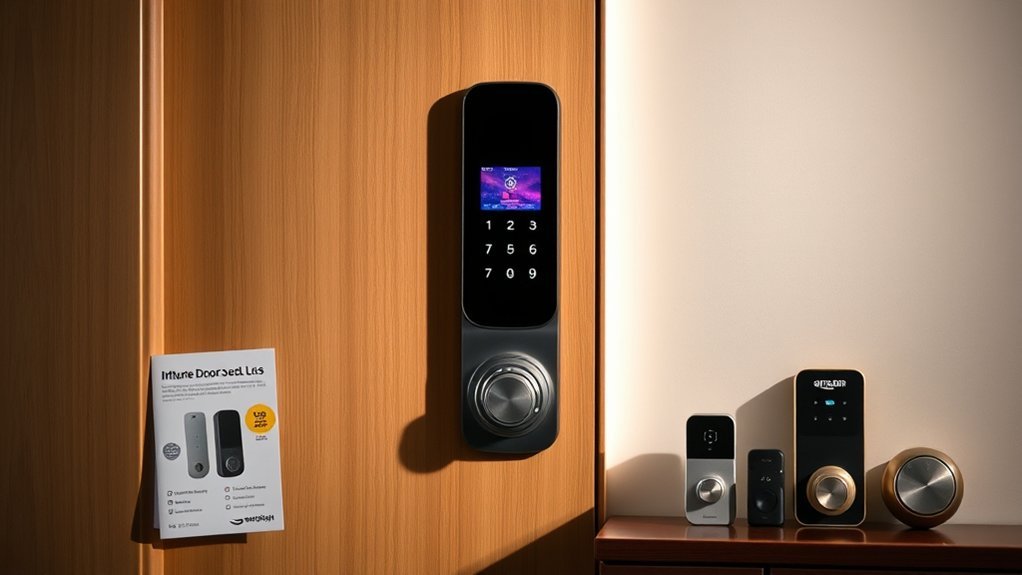
Choosing the right electronic door lock involves more than comparing the number of codes or unlocking methods. You should consider the actual locking mechanism, your door’s measurements, environmental exposure, battery requirements, and the kind of access management your household needs.
1. Locking Mechanism Options
Electronic door locks come in several designs, but not every design provides the same mechanical locking function.
- Electronic deadbolt: Uses an electronically operated deadbolt. It is a practical option when replacing a compatible traditional deadbolt.
- Electronic keypad handle: Combines access control and handle operation, usually through a latch mechanism. It may be suitable for interior doors or as part of a properly designed exterior entry arrangement.
- Fingerprint lock: Uses biometric authentication for access. The underlying locking mechanism still needs to be evaluated separately.
- Connected smart lock: May provide app control, access logs, alerts, or remote operation, depending on the supported connectivity and configuration.
If you are upgrading your primary entrance, first decide whether you want to replace the existing deadbolt or the door handle. That decision will narrow your choices quickly.
2. Installation Ease and Door Compatibility
Many electronic locks are designed for DIY installation, but no-drill installation is only possible when the existing door preparation matches the lock’s requirements.
Before buying, measure the following:
- Door thickness: Check that your door falls within the manufacturer’s supported range.
- Backset: Measure from the door edge to the center of the main lock hole. Common US residential preparations use 2-3/8-inch or 2-3/4-inch backsets.
- Bore diameter: Confirm that the existing opening matches the required lock body.
- Door handing: Check whether the lock supports left-handed, right-handed, or reversible installation.
- Hardware spacing: If the package includes a deadbolt and handle, confirm there is enough space between the existing holes.
- Door alignment: Make sure the door closes properly and the latch or deadbolt can engage without resistance.
Pro Tip: Take photos and measurements of your existing lock before ordering. Compare them with the exact installation diagram on the product listing or in the manufacturer manual.
3. Security Features
When selecting an electronic lock for your home, focus on both physical hardware security and electronic access protection.
Useful features can include:
- Mechanical construction: Choose hardware suitable for the intended door and expected use.
- Documented security grading: Look for verifiable ANSI/BHMA grading information when mechanical security performance is important.
- Individual PIN codes: Separate credentials make access easier to manage.
- Temporary access: One-time or time-limited codes can reduce the need to share permanent codes.
- Auto-lock: Can reduce the chance of leaving a lock manually disengaged.
- Low-battery warning: Helps you replace batteries before power becomes insufficient.
- Backup entry: A mechanical key or other manufacturer-supported emergency method can help if electronic access fails.
An electronic lock is only one part of door security. The door material, strike plate, frame, installation quality, and proper alignment also matter.
Safety Note: Auto-lock does not necessarily mean a lock can detect whether the door is physically closed. Some models re-engage after a timer even when the door is open. Always check that the door is shut and the latch or bolt is fully engaged.
4. User Code Capacity
The number of supported access credentials becomes important when several people regularly use the same door.
For example, the Amazon Basics model provides six customizable user codes, while the Veise keypad models in this comparison offer larger code capacities.
If you frequently need to give access to visitors, cleaners, or contractors, look for one-time or temporary codes. These are often more convenient than providing your regular household PIN.
Also consider whether you can remove individual codes without resetting every credential. This makes it easier to stop access when someone no longer needs it.
5. Smart Home Compatibility and Connectivity
Not every electronic door lock is a connected smart lock.
Standalone keypad locks generally work without an internet connection. They are useful when you want keyless entry without apps, accounts, or wireless setup.
Bluetooth locks may offer app control from nearby devices. However, Bluetooth alone does not provide internet-based access from another location.
Wi-Fi-enabled or gateway-connected locks may support additional functions such as remote locking, access notifications, and smart-home integrations.
Before choosing a connected lock, confirm the supported app, required hub or gateway, internet dependency, update support, and compatibility with your existing smart-home system.
6. Battery Life and Emergency Access
Battery life is important because most electronic door locks depend on replaceable batteries rather than household wiring.
Some manufacturers advertise operation lasting many months or approximately a year under specified conditions. Actual battery life depends on factors such as usage frequency, temperature, battery quality, motor operation, and wireless features.
When comparing models, check:
- The required battery type and quantity.
- Whether batteries are included.
- Whether the lock provides a low-battery warning.
- Whether replacement batteries are easy to access from inside.
- What emergency entry method is available if the batteries are depleted.
Pro Tip: Keep backup keys in a secure, accessible location rather than inside the locked home. Replace batteries when the low-battery warning appears instead of waiting for the lock to stop working.
7. Weather Resistance and Durability
If you plan to install an electronic lock on an exterior door, pay close attention to the manufacturer’s environmental specifications.
A weather-resistant exterior keypad does not necessarily mean every part of the lock can withstand direct rain, extreme temperatures, or continuous sun exposure.
Review the documented operating temperature, weather-resistance rating, and installation instructions. Also check whether the interior electronic assembly must remain protected from moisture.
A lock designed primarily for indoor use should not be installed on an exposed exterior door unless the manufacturer specifically approves that application.
8. Warranty and Customer Support
Warranty terms vary between electronic door lock manufacturers, models, and sellers. A longer advertised warranty does not automatically guarantee better mechanical performance or reliability.
Before purchasing, review the warranty information for the exact product variant and seller. Check whether coverage applies to electronics, mechanical components, finish defects, and normal wear.
Also consider the availability of installation instructions, replacement parts, technical support, and troubleshooting documentation.
Clear after-sales guidance is particularly valuable when programming codes, replacing batteries, or resolving a door-alignment issue.
Which Electronic Door Lock Is Best for Your Needs?
| Your Priority | Recommended Lock | Main Reason |
|---|---|---|
| Keypad entry with a separate deadbolt | Veise Deadbolt with Lever Handles | Combines keypad deadbolt access with matching handles. |
| Basic electronic deadbolt operation | Amazon Basics Keypad Deadbolt | Provides code access and traditional keyed operation without app setup. |
| Keypad-controlled door handle | Veise Keypad Handle Lock | Offers multiple PIN codes through an integrated electronic handle. |
| Fingerprint access for a suitable interior door | TMEZON Fingerprint Lock | Supports biometric access alongside other unlocking methods. |
Before You Buy: Electronic Door Lock Checklist
Check These Details Before Ordering:
- Confirm whether you need a deadbolt or an electronic handle lock.
- Measure your door thickness, backset, and existing hardware holes.
- Check whether the lock supports your door’s handing.
- Verify that the lock is suitable for an interior or exterior installation.
- Choose enough permanent and temporary user codes for your household.
- Confirm whether Bluetooth, Wi-Fi, or a separate gateway is required.
- Review battery requirements, low-battery alerts, and emergency access.
- Check the latest product specifications and warranty terms.
Frequently Asked Questions
How Long Do the Batteries Last in Electronic Door Locks?
Electronic door lock batteries commonly last several months or longer, depending on the model and operating conditions. Some manufacturers advertise approximately one year of use under specified conditions, but actual results vary. Heavy usage, cold temperatures, and wireless connectivity can increase battery consumption. Replace batteries promptly when the lock displays a low-battery warning.
Can Electronic Door Locks Be Hacked?
Connected electronic locks can have cybersecurity vulnerabilities, just like other connected devices. The risk depends on the hardware, software, wireless configuration, and security practices.
For supported smart locks, use unique account passwords, enable multifactor authentication when available, install manufacturer security updates, and avoid sharing permanent access credentials unnecessarily. Standalone keypad locks have different electronic risks because they do not depend on internet connectivity.
Do Electronic Locks Work During Power Outages?
Most standalone electronic door locks use replaceable batteries and can continue operating during a household power outage.
However, a drained battery can prevent electronic unlocking. Keep your backup entry method available and check whether your selected lock offers a mechanical key or another manufacturer-supported emergency access option.
Are Electronic Locks Compatible With Smart Home Systems?
Some electronic locks integrate with smart-home systems, but many keypad locks are completely standalone. Bluetooth-enabled locks may require a compatible gateway for internet-based operation. Check the exact model’s supported connectivity and smart-home platforms before assuming compatibility.
Are Electronic Door Locks Suitable for Front Doors?
Electronic locks can be suitable for front doors when the model is designed for that application, the mechanical locking system meets your security requirements, and the installation follows the manufacturer’s instructions.
For primary entry doors, pay particular attention to deadbolt construction, door-frame condition, weather exposure, and hardware fit. Do not assume that every electronic handle lock provides the same protection as a separate deadbolt.
Can I Install an Electronic Door Lock Myself?
Many electronic locks are designed for DIY installation using common tools, especially when replacing hardware with matching dimensions.
However, your door may require modifications if the bore, backset, thickness, or hardware spacing does not match the new lock. Consult the installation manual, and consider professional installation if you are unsure about fit, alignment, or security.
How Do Temporary Access Codes Work?
Temporary access codes allow you to provide entry without sharing your permanent household PIN. Depending on the lock, these codes may work only once or remain active for a configured period.
After the visitor no longer needs access, remove the credential or confirm that it has expired. Always check which temporary-code functions your specific model supports.
Is a Fingerprint Lock Better Than a Keypad Lock?
Neither unlocking method is automatically better for every home. Fingerprint locks provide convenient biometric access, while keypad locks allow people to unlock a door without enrolling biometric information.
If several family members use the door, consider how easily you can add or remove their credentials. Also compare the mechanical lock design, battery requirements, and backup entry methods.
What Is the Warranty on Electronic Door Locks?
Warranty coverage differs by manufacturer, product model, and seller. Some locks include limited warranties covering manufacturing defects, but the duration and exclusions are not identical across products.
Check the current warranty terms on the manufacturer’s website or the relevant Amazon product listing before purchasing. Keep your purchase documentation in case you need service or replacement support.
Conclusion: Which Electronic Door Lock Should You Buy in 2026?
The best electronic door lock for your home depends on the type of door you want to secure and how you prefer to unlock it.
For a compatible residential entry door where you want an electronic deadbolt and matching handles, the Veise Keyless Entry Deadbolt with Lever Handles is our Best Overall recommendation. It combines keypad access, multiple user codes, and a familiar deadbolt mechanism.
The Amazon Basics Electronic Keypad Deadbolt is a practical alternative if you prefer straightforward code entry without app connectivity. The Veise Keypad Door Lock with Handle offers convenient keypad-operated handle access, while the TMEZON Smart Fingerprint Lock is worth considering for biometric entry on a suitable interior door.
Before buying, confirm your door measurements, installation environment, locking mechanism, and backup access options. Choosing a lock that properly fits your door and meets your everyday access needs is more important than selecting the model with the longest feature list.
Final Recommendation
If your priority is a keypad-controlled deadbolt with matching handles, start with the Veise Keyless Entry Door Lock with Lever Handles. Review the installation dimensions before ordering and confirm that the hardware meets your intended door-security requirements.
Check Veise Price on Amazon
