


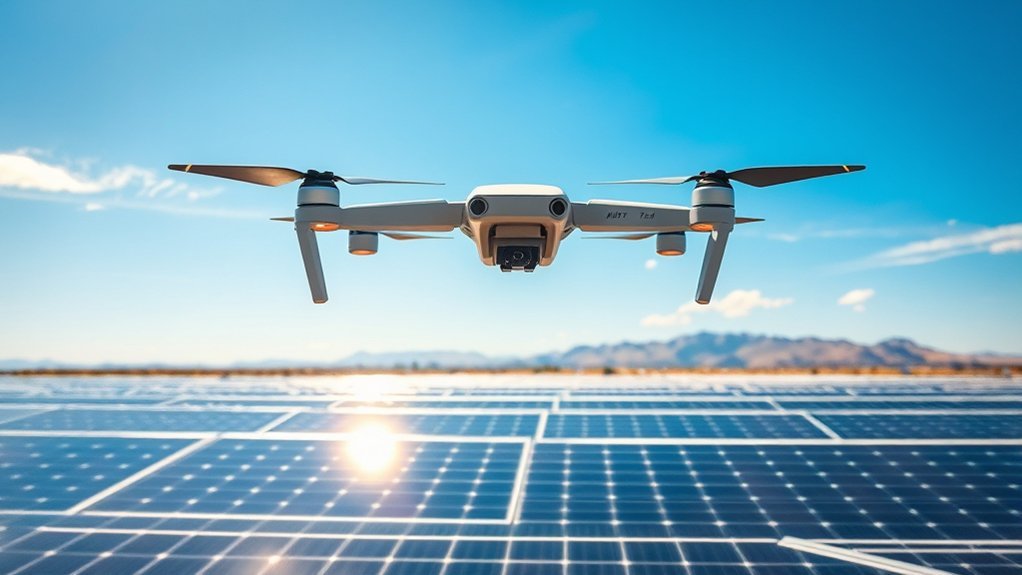
For 2026 solar panel inspections, experts recommend the Parrot Anafi Thermal Drone for its thermal imaging capabilities, and the DJI Mavic 2 Pro for high-quality imagery. The Holy Stone GPS Drone (HS175D) offers impressive flight time and photo stability, while the Potensic ATOM SE stands out for its portability and advanced features. The DEERC D65 Drone is also a great option with its intelligent flight modes. Each provides unique benefits, so exploring the details will help you choose the right one.
| Parrot Anafi Thermal Drone with 4K HDR Camera |  | Best for Thermal Inspections | Camera Quality: 4K HDR with thermal imaging | Flight Time: 26 minutes | GPS Functionality: Yes, for thermal analysis | VIEW LATEST PRICE | Read Our Analysis |
| Holy Stone GPS Drone with 4K Camera (HS175D) |  | Best Beginner-Friendly | Camera Quality: 4K Ultra Clear | Flight Time: Up to 46 minutes | GPS Functionality: Yes, GPS Auto Return | VIEW LATEST PRICE | Read Our Analysis |
| Potensic ATOM SE GPS Drone with 4K Camera |  | Longest Flight Time | Camera Quality: 4K EIS | Flight Time: 93 minutes (with 3 batteries) | GPS Functionality: Yes, precise GPS auto-return | VIEW LATEST PRICE | Read Our Analysis |
| DEERC D65 Drone with 4K UHD Camera |  | Best for Portability | Camera Quality: 4K EIS | Flight Time: Not specified (implied long-lasting) | GPS Functionality: Yes, built-in GPS for hover precision | VIEW LATEST PRICE | Read Our Analysis |
| DJI Mavic 2 Pro Drone with Hasselblad Camera |  | Professional Grade | Camera Quality: 20MP Hasselblad with HDR 4K | Flight Time: Up to 31 minutes | GPS Functionality: Yes, omnidirectional obstacle sensing | VIEW LATEST PRICE | Read Our Analysis |


More Details on Our Top Picks
Parrot Anafi Thermal Drone with 4K HDR Camera
The Parrot Anafi Thermal Drone with its 4K HDR camera is a game-changer for solar panel inspectors looking for efficiency and precision. Weighing less than a pound, this ultra-compact drone is ready for action in just three seconds. With thermal imaging capabilities that detect thermal leaks and hot spots, you can perform detailed inspections with ease. Its 21MP visible camera offers stunning visuals, while the 180° tilt and 3x zoom enhance your analysis. With a flight time of 26 minutes and a range of 2.5 miles, you’ll have the tools you need to get the job done right.
- Camera Quality:4K HDR with thermal imaging
- Flight Time:26 minutes
- GPS Functionality:Yes, for thermal analysis
- Portability:Ultra-compact and lightweight
- Intelligent Flight Modes:Yes, merging thermal and RGB views
- Wind Resistance:Up to 31 mph
- Additional Feature:Compact design, ultra-lightweight
- Additional Feature:Merging thermal views
- Additional Feature:Quick photo/video sharing
Holy Stone GPS Drone with 4K Camera (HS175D)
For those looking to elevate their solar panel inspections, the Holy Stone GPS Drone with 4K Camera (HS175D) stands out with its impressive 4K Ultra Clear Camera and wide-angle capabilities. You’ll appreciate the high-resolution images and stable videos, thanks to the 5GHz FPV transmission. With two batteries, you can enjoy up to 46 minutes of flight time, making it perfect for thorough inspections. Its GPS Auto Return feature enhances safety, ensuring it returns to you in emergencies. Plus, the foldable design and lightweight build make it easy to carry, while intelligent flight functions simplify your experience.
- Camera Quality:4K Ultra Clear
- Flight Time:Up to 46 minutes
- GPS Functionality:Yes, GPS Auto Return
- Portability:Foldable fuselage design
- Intelligent Flight Modes:Yes, automatic tracing and following
- Wind Resistance:Not specified
- Additional Feature:110° wide-angle camera
- Additional Feature:Foldable fuselage design
- Additional Feature:Includes carrying case
Potensic ATOM SE GPS Drone with 4K Camera
Weighing in at less than 249g, the Potensic ATOM SE GPS Drone with 4K Camera is an ideal choice for solar panel inspectors seeking portability and ease of use. Its fold-up design fits snugly in your jacket pocket, making it easy to transport. With a max speed of 16m/s and a flight time of 93 minutes using three batteries, you won’t miss a detail. The impressive 4K EIS camera captures stunning images and video, while features like Follow Me and Waypoint Flight enhance your inspection experience. Plus, the precise GPS auto-return guarantees safety during your flights.
- Camera Quality:4K EIS
- Flight Time:93 minutes (with 3 batteries)
- GPS Functionality:Yes, precise GPS auto-return
- Portability:Fold-up design fits in a pocket
- Intelligent Flight Modes:Yes, Follow Me and Waypoint Flight
- Wind Resistance:Level-5 wind resistance
- Additional Feature:Built-in brushless motor
- Additional Feature:ShakeVanish stabilization technology
- Additional Feature:60W fast charging hub
DEERC D65 Drone with 4K UHD Camera
With its lightweight design and advanced 4K EIS camera, the DEERC D65 Drone is perfect for solar panel inspectors who need high-quality imagery without the hassle of heavy equipment. Weighing under 249 g, its foldable arms make it incredibly portable, fitting easily into backpacks or shoulder bags. The built-in GPS enhances hover precision, while the automatic Return-to-Home function guarantees safety during flights. With intelligent flight modes like Follow Me and Waypoint Flight, you can focus on capturing those vital shots. Plus, its brushless motors and Level-4 wind resistance make it durable for various outdoor conditions.
- Camera Quality:4K EIS
- Flight Time:Not specified (implied long-lasting)
- GPS Functionality:Yes, built-in GPS for hover precision
- Portability:Foldable arm design
- Intelligent Flight Modes:Yes, Follow Me and Orbit modes
- Wind Resistance:Level-4 wind resistance
- Additional Feature:2-axis mechanical gimbal
- Additional Feature:Ideal for road trips
- Additional Feature:Rated for Level-4 wind resistance
DJI Mavic 2 Pro Drone with Hasselblad Camera
The DJI Mavic 2 Pro Drone, featuring the exceptional Hasselblad L1D-20c camera, stands out as an ideal choice for solar panel inspection professionals who demand high-quality imagery. With its 20MP 1” CMOS sensor and HDR 4K video capabilities, you’ll capture stunning visuals effortlessly. Enjoy up to 31 minutes of flight time and speeds reaching 44 mph, making inspections quicker and more efficient. The 3-axis gimbal guarantees steady shots, while intelligent features like ActiveTrack 2.0 and omnidirectional obstacle sensing enhance your operational safety. Plus, the included DJI Smart Controller provides a crystal-clear display for seamless control during your inspections.
- Camera Quality:20MP Hasselblad with HDR 4K
- Flight Time:Up to 31 minutes
- GPS Functionality:Yes, omnidirectional obstacle sensing
- Portability:Not specified (larger size)
- Intelligent Flight Modes:Yes, ActiveTrack 2.0 and Hyperlapse
- Wind Resistance:Not specified
- Additional Feature:Hasselblad L1D-20c camera
- Additional Feature:Omnidirectional obstacle sensing
- Additional Feature:ActiveTrack 2.0 tracking
Factors to Consider When Choosing Drones for Solar Panel Inspections
When you’re choosing a drone for solar panel inspections, you’ll want to contemplate several key factors. Camera quality and resolution are essential for capturing detailed images, while flight time and range can impact how efficiently you conduct your inspections. Don’t forget about thermal imaging capability, portability, and user-friendly features to guarantee you get the best results with ease.
Camera Quality And Resolution
How can you guarantee your drone captures the finest details during solar panel inspections? Start by choosing a camera with high resolution. A 4K camera is ideal for providing clear, detailed images that allow you to identify defects and thermal anomalies effectively. Additionally, opt for drones equipped with thermal imaging capabilities, as these can reveal temperature variations critical for detecting hot spots and thermal leaks. Look for cameras that offer tilt and zoom features, enabling you to focus on specific areas of interest. Finally, make certain the drone has image stabilization technology to reduce shake and distortion during flight, resulting in sharp, usable images for thorough analysis. Your choice in camera quality and resolution can make all the difference in inspection outcomes.
Flight Time And Range
Choosing the right drone for solar panel inspections hinges on two critical factors: flight time and range. You’ll want a drone with a minimum flight time of 25 minutes to cover large solar fields without constantly changing batteries. A range of up to 2.5 miles is ideal, allowing you to inspect expansive areas efficiently while maintaining a strong connection. If you opt for drones with multiple battery options, you could achieve total flight times of up to 93 minutes, enhancing operational flexibility. Also, consider wind resistance ratings; drones that can handle winds up to 31 mph will perform better in various weather conditions. Finally, verify the maximum operating altitude is at least 4,500 meters for inspecting elevated installations.
Thermal Imaging Capability
After considering flight time and range, the next key feature to look for in drones for solar panel inspections is thermal imaging capability. Drones equipped with thermal cameras can detect thermal differences, helping you identify hot spots, cold spots, and thermal leaks on solar panels. With a temperature range from -14°F to 752°F, these cameras perform well in various environmental conditions. Merging thermal and visible imaging enhances analysis, giving you clearer insights into solar panel performance and integrity. Plus, drones can cover vast areas quickly, cutting down the time and labor needed for manual inspections. Their ability to operate at high altitudes (up to 4,500m) allows for extensive evaluations beyond ground-level assessments, making them invaluable for thorough inspections.
Portability And Design
When it comes to solar panel inspections, portability and design are essential factors that can substantially impact your efficiency. Choosing a drone that weighs under 250g means you won’t need FAA registration, making transport and deployment hassle-free. Look for a foldable design that fits easily into small bags or even jacket pockets, perfect for inspectors on the go. Lightweight drones, especially those under one pound, allow for quick operations, enabling you to conduct inspections swiftly. Additionally, compact drones that set up in seconds minimize downtime, boosting your productivity. Finally, opt for models with durable designs that can withstand wind and other environmental factors, ensuring reliable performance no matter the weather conditions.
User-Friendly Features
User-friendly features can make all the difference in your solar panel inspections, enhancing both efficiency and accuracy. Look for drones with intuitive applications that let you easily switch between thermal and RGB views, helping you analyze potential issues more effectively. Drones that merge thermal and visual views provide clearer insights into thermal leaks or defective panels, making your assessments more reliable. Quick sharing capabilities for photos and videos streamline communication with stakeholders. Additionally, playback options allow you to review footage in detail, identifying areas of concern with ease. Intelligent flight modes, such as automated tracking or waypoint navigation, further simplify the inspection process, ensuring you capture every critical detail accurately. Choose wisely for the best results!
Safety And Navigation Systems
Selecting the right drone for solar panel inspections goes beyond user-friendly features; safety and navigation systems play a significant role in ensuring effective and secure operations. Look for drones equipped with GPS Auto Return features, which automatically bring the drone back when the signal drops or the battery runs low. Advanced navigation systems improve stability and minimize drift during inspections, while multiple flight modes, such as Follow Me and Waypoint Flight, enhance maneuverability for thorough coverage. Intelligent safety features like obstacle sensing technology help avoid collisions with nearby structures, ensuring a smooth inspection process. Additionally, lightweight designs under 250g often eliminate FAA registration requirements, making compliance easier and deployment quicker for your projects.
Frequently Asked Questions
What Is the Average Flight Time for These Drones?
The average flight time for these drones typically ranges from 20 to 40 minutes, depending on the model and conditions. You’ll want to take into account battery life when planning your inspections for efficiency.
Are These Drones Suitable for Beginners?
Yes, these drones are suitable for beginners. They often feature user-friendly controls and automated flight modes, making it easy for you to learn. Plus, their lightweight design helps reduce the chances of accidents during practice.
How Much Do These Drones Typically Cost?
These drones typically cost between $300 to $3,000, depending on features and capabilities. You’ll find entry-level models at lower prices, while advanced options with better cameras and software come at a premium.
Can I Use These Drones for Other Inspections?
You can definitely use these drones for other inspections! In fact, 75% of drone users report conducting multiple inspection types, from roofs to bridges, showcasing their versatility and efficiency in various industries.
What Safety Regulations Apply to Drone Usage for Inspections?
You’ve got to follow FAA regulations, ensuring your drone’s registered and you’re flying within legal limits. Additionally, consider local laws, privacy concerns, and any specific safety protocols related to the inspections you’re conducting.
Conclusion
To sum up, selecting the right drone for solar panel inspections can greatly enhance efficiency and accuracy. Did you know that drones can reduce inspection time by up to 90% compared to traditional methods? By choosing models like the Parrot Anafi or DJI Mavic 2 Pro, you’ll not only save time but also guarantee thorough inspections. So, gear up with one of these recommended drones, and watch your solar panel maintenance transform!